The eldest son of the Pujols defends his businesses and denounces the "shredder" of the National Court
Jordi Pujol Ferrusola justifies that "he was passing on privileged information" and assures that his father never spoke to him about grandfather Florenci's inheritance

-
CAT -
CAST
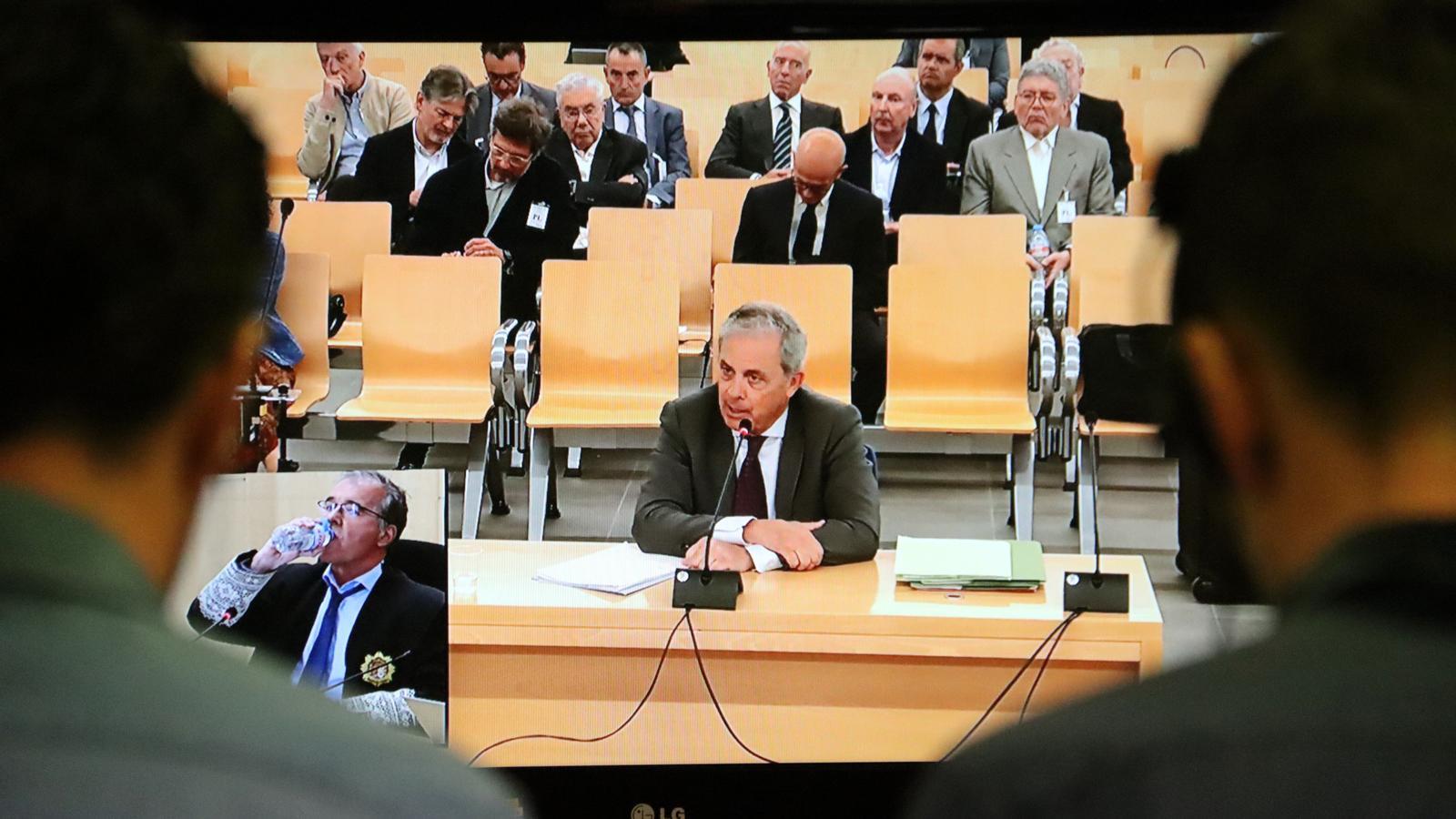
San Fernando de HenaresAfter the decision to exclude President Jordi Pujol from the case, the main event at the National High Court has been the testimony of his eldest son, for whom the Prosecutor's Office is seeking 29 years in prison for five crimes. The first session lasted almost three hours, until his lawyer asked to end it upon seeing him "manifestly tired". Prosecutor Fernando Bermejo has dedicated himself to reviewing his businesses in detail, and the firstborn has defended his work tooth and nail. "What I have done is well done" and "there is nothing to hide", he claimed at two points during the interrogation.
One of his usual jobs was "passing on privileged information" in exchange for compensation. He used his contacts and firsthand knowledge to act as an intermediary in private business dealings. For example, if someone was selling a piece of land, he would "spread the word" and find someone who wanted to buy it, and in return, he would charge a fully legal commission – he described. The conclusion, in all the operations that have been reviewed, has always been the same: "The deal was done, it was paid for, and I collect my invoice, so the transaction exists." Initially, the family's firstborn explained that he operated abroad to distance himself from the "political contamination" that his surname could cause in Catalonia, but when he saw that Spain "was doing well", in the 2000s, he also did business in Spain. Often, he worked without a contract, one of the things the Prosecutor's Office questions him about: "I am a person who trusts people a lot and I do it a lot out of trust", Jordi Pujol Ferrusola defended.
The firstborn has thus denied having done anything wrong. On the contrary, he has accused the National Court of being a "shredder" of his circle. At one point during the interrogation, while reviewing one of his businesses, the prosecutor brought up an intermediation in the sale of clinker – the main component of Portland cement – for which he pocketed 99,000 euros. Fernando Bermejo asked him what the names of the people he put in contact were, but he refused to give them: "I will not say it because every time I say someone's name, this is a shredder and everyone is destroyed. We have had fifteen years of shredder." The firstborn also assured that it was false that he made trips to Andorra with bags of banknotes. This is what his ex-lover, Vicky Álvarez, said in the complaint she filed with the UDEF in 2012.
Grandfather Florenci's inheritance
Jordi Pujol Ferrusola also referred to the inheritance from his grandfather Florenci, which, in fact, was what initially focused the prosecution's suspicions. The family's main argument is that the money in Andorra comes from his legacy and not from alleged corrupt business dealings. The eldest son said he had "vague" knowledge of this inheritance when his grandfather explained it to him in 1976 or 1977:
In September 1980, when Florenci Pujol died, his father gathered the family and showed them a letter he had written to his wife, Marta Ferrusola:
Ten years later, the eldest son received the "order" from Joaquim Pujol – his father's cousin, who had managed them until then – to take charge of the funds in Andorra. He told him in a meeting where his six brothers and his mother were present. However, the then president of the Generalitat was not there. Jordi Pujol Ferrusola has also wanted to make it clear that neither he nor any of his siblings have lived in Spain with money that came from Andorra: "We have had our independent lives. There was no dependence on the money that was in Andorra to be able to spend here," he stressed.

A permanent shadow of doubt
With a tactic similar to the "Chinese drip" (water torture), prosecutor Fernando Bermejo has persistently tried to link Jordi Pujol Ferrusola's private businesses with the Generalitat de Catalunya. Three of the companies that are central to the trial are Copisa, EMTE, and Isolux: "Did you know that they had been awarded public contracts?", he asked him. "I suppose so", he replied. But there is no award under suspicion. In fact, Isolux received "three times" more money from awards with the tripartites than with Pujol in Plaça Sant Jaume, the Generalitat represented only "5%" of EMTE's turnover, and Copisa's success rate in tenders called by the Catalan government was double with the PSC than with Convergència.
But that was not the only moment. The prosecutor asked him if his father knew Josep Cornadó, the founder of Copisa, whom he presented as "one of the important contractors in Catalonia". "My father knew not only the builders, but also the poultry seller. Knowing everyone was his strength", defended the eldest son. "Did your father introduce Mr. Carles Vilarrubí? Had he provided any service to your father?", he asked later. "Not to my father, but to the Generalitat", clarified the eldest son. And he recalled that he had met him when he was fourteen years old playing Basque pelota in Premià and that years later the businessman, who died four months ago, was commissioned to found TV3 and Catalunya Ràdio.
On two occasions during the interrogation, Jordi Pujol reproached the prosecutor for giving him "biased information" regarding a luxury development in Ronda (Málaga) and accused him of having "left out half the story" by talking about the Tivissa landfill. The prosecutor also asked him if in 2017 he paid the bail to get out of jail with money that arrived from Argentina. And he categorically denied it, recalling that his accounts were frozen – and therefore he could not use them – and that he could not pay it until it was reduced from the initial three million euros to 500,000 euros. This Tuesday, starting at 9 a.m., the questions to the eldest son of the Pujols will continue.
