The 'Catalan' president with whom the opposition would have "three beers"
Juanma Moreno Bonilla gets emotional with the film 'The 47' and has a surprising musical facet
-
CAT -
CAST
MadridJuanma Moreno recalls having been "obsessed" with being president of Andalusia since October 22, 1995. That day, at 25 years old, he was elected president of Noves Generacions del PP of Andalusia. What at that time seemed the impossible dream of a young promise of the right became a reality on January 18, 2019, when he took office and became the first head of the Andalusian executive not to be a socialist in history. He did so despite having obtained the worst results for the PP in decades —he was the second force with 26 deputies and 20.75% of the votes— thanks to a pact with Cs and Vox. Almost seven and a half years later, Moreno has managed to turn this fluke with which he ousted the PSOE into hegemonic leadership. As he himself explains in his book Manual de convivencia (Espasa, 2025), "perseverance" is one of the qualities that represent him.
Some of his party colleagues, consulted by ARA, add the adjectives "serenity," "calmness," and "generosity" to define him. In the media, he is often associated with the word "moderate." Since his arrival at the Palacio de San Telmo, Moreno has configured his political profile as an internal counterpoint to the harder faction of the PP, represented by Isabel Díaz Ayuso. In fact, his great support in his rise within the party was Mariano Rajoy and, in the primaries for the national leadership held a few months before his victory in late 2018, Moreno clearly positioned himself in favor of Soraya Sáenz de Santamaría. Moreno admits his "close relationship" and "trust" with both and, in his book, dedicates a chapter to advice given to him by the former president of the Spanish government. "Do what I do. Don't read the press," he explains that Rajoy recommended to him.
This conversation took place after Moreno decided to leave Madrid —he was a member of Congress for eleven years and Secretary of State for Social Services and Equality in Rajoy's government for three more— to return to Andalusia. In 2014, he became the autonomous presidency of the PP, and in the Andalusian elections the following year, he became the leader of the opposition against the government of the socialist Susana Díaz. It is in the face of the difficulties and criticisms he faced in this role —he recounts that a sector of the PP asked him to "give more heat"— that he turned to Rajoy, one of his political endorsers along with Javier Arenas, former leader of the Andalusian PP who never managed to govern —despite being the leading party in 2012— and a confidant of the former Spanish president. "Since that day, I have followed his advice," states Moreno, who claims to have maintained his "initial strategy" of moderation.
The "wolf in sheep's clothing"
Sources from the Andalusian PSOE who have dealt with Moreno distinguish his human side from politics. On a personal level, they describe him as "respectful", "polite", "moderate", and "good-natured". "He is someone with whom you would have three beers," they summarize. However, in politics, they label him a "wolf in sheep's clothing". "When he has to change his skin, he has no shame." These sources recall how he made a pact with Vox in 2018 and how that year the campaign began in a brothel to denounce socialist corruption. They do acknowledge, however, his ability since becoming president of the Junta de Andalusia to "construct a character that gains political centrality." "He is not interested in playing to be the right" but rather wants to embody "transversality" by downplaying party affiliations, they add. Nevertheless, Moreno is a party man.
In terms of education, he holds a degree in Protocol from the private university Camilo José Cela, but his entire professional career is linked to the PP. He joined at 19 and six years later entered the Malaga City Council as a councilor in Celia Villalobos' municipal government. In 1997, he made his first leap into national politics as the president of Nuevas Generaciones throughout Spain. He held this position until 2001. Popular Party sources who coincided with him at that time remember him as "a team man" who likes to "innovate" and "take risks," but "without ruptures." Both the PP and the PSOE agree in situating Elías Bendodo —now deputy secretary in Alberto Núñez Feijóo's leadership— and Antonio Sanz as key figures in Moreno's consolidation as a leader. The latter is his current (acting) Minister of the Presidency, Health, and Emergencies and has been in charge of managing the Adamuz crisis and the breast cancer screening program.
Son of Andalusian emigration
"Watching films like El 47 now excites me because it recreates times I lived through, but don't remember," confesses Moreno in his book about his parents' time as emigrants in Catalonia. Originally from Alhaurín el Grande (Málaga), they left seeking "a better future." Moreno was born in Barcelona, but "after a few months," the family returned to Andalusia and opened "a small shop" in their town. The Andalusian president recalls doing his homework in the "back shop" with his two sisters. He recounts with pain how his father died of an illness even before he could see him leading the Andalusian PP. He is married to a political scientist he met while a militant in the PP, with whom he has three teenage children, and whose "intelligence" he praises, which has made her "an excellent advisor."
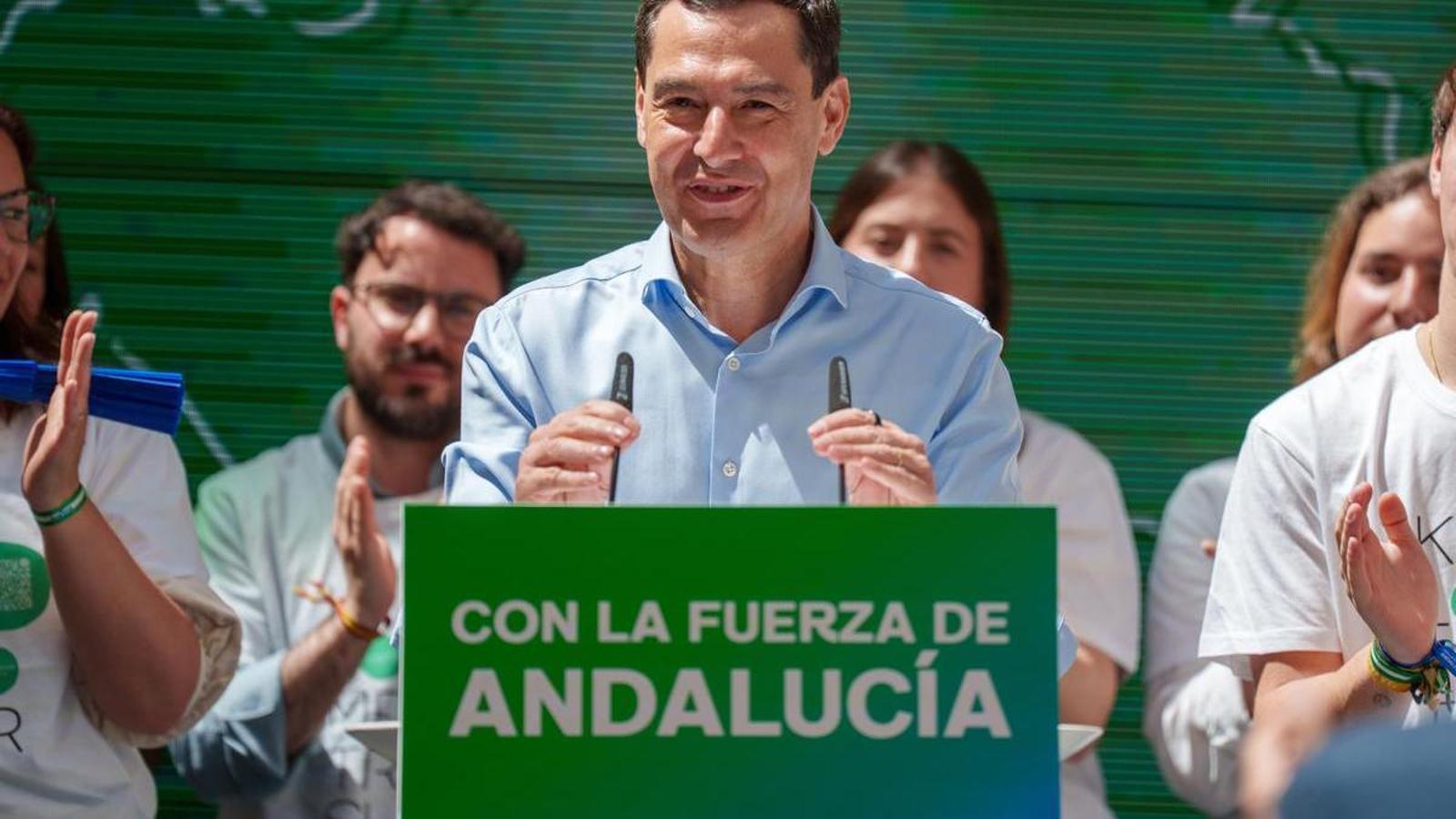
With a very curated social media profile, Moreno is seen with his family and proudly displays "Andalusian pride" with ties to the region's traditions such as Holy Week brotherhoods or bullfighting. The week before the elections, he surprised by revealing that he is the vocalist of his campaign song. As a young man, Moreno was the singer of various pop music groups. A facet he has recovered to boost his affable image.
