Bridge enrages Junts, which reaffirms itself in the break with PSOE after the ECJ
The Minister of Transport challenges Puigdemont to return despite the prison order: "I would do it"
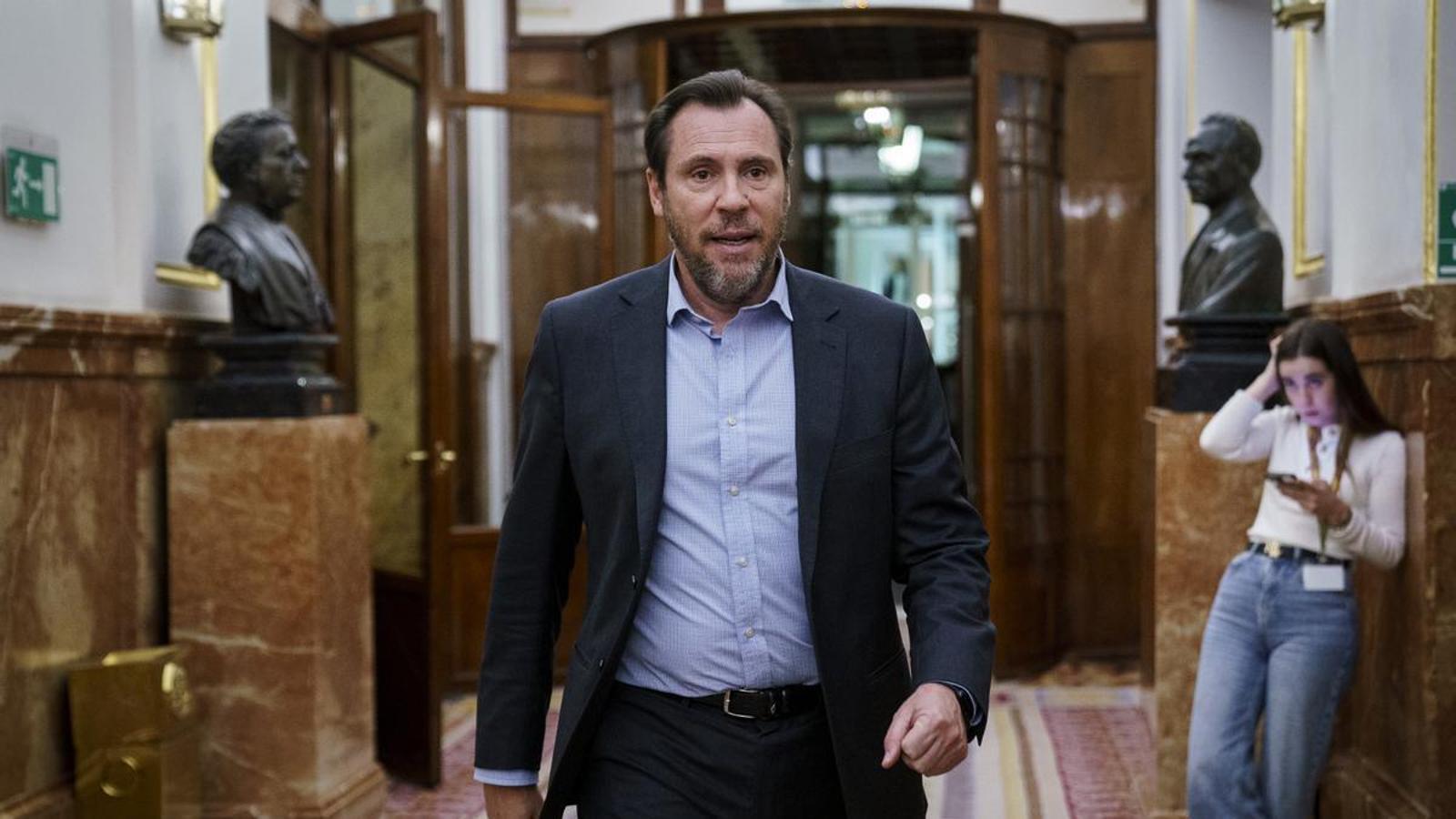
Madrid / BarcelonaThe day after the European justice's endorsement of the amnesty everyone builds their own narrative. While the independence movement celebrates the ECJ's decision, but warns that this does not end the repression, both the Catalan and Spanish governments see their "reconciliation" agenda validated and claim the end of the "political crisis" between Catalonia and the State. Moreover, the Minister of Transport, Óscar Puente, has assured that if he "were Carles Puigdemont" he would return to Spain, "without a doubt". "We must face up to it once and for all," he said in an interview with RNE, as reported by Efe. This attitude has not pleased Junts at all, as the arrest warrant remains in effect and the former president would be arrested. "What misery and frivolity," replied the party's general secretary, Jordi Turull. After this, party sources consulted by ARA reaffirm their break with the Spanish government, also after the ECJ's ruling in favor of amnesty.
Although the PSOE flirts with the idea that Europe's endorsement of the law could mean a rapprochement with the separatists, especially now that negotiations for the state budget are to begin, Carles Puigdemont's party cuts off this possibility at the root. They recall that the European court endorses the instrument (amnesty) that the independence movement has long defended to end the criminal proceedings of the Procés and emphasize that now the ball is in the State's court: specifically in the Constitutional Court, with a progressive majority, which must resolve the appeals for protection of the independence leaders, and then in the Supreme Court. They consider that Puente's message is part of a "campaign" to present Puigdemont as a "coward" and put pressure on him, even though the ball is with the Constitutional Court. "Now it's their turn," these sources emphasize, "they are nervous," they interpret about the PSOE.
At a press breakfast in Madrid, within the framework of the Nuevo Economía Forum, the leader of Esquerra, Oriol Junqueras, also warned that the ECJ ruling is a "political victory" but "incomplete": "The law is not measured only by its approval, but by its application," he said, and wondered "what happens to Spanish democracy" considering that the courts do not enforce the norm.
What is Minister Puente's argument? For the PSOE leader, even though Puigdemont would risk going to prison, it would be a move to hold the Supreme Court up to the mirror. "If I cannot move freely through a country that has decided that I am free, let's all turn red once: they say that one minute of red is better than a lifetime of yellow. I would do it," he assured, adding that in his opinion it would be "tremendously complicated to understand that Spanish justice tries to breach" the law. In fact, Puente considers that the ruling of the ECJ shows that there is a part of the judiciary in Spain that does not respect the legitimacy of the legislative power, that questions its capacity to decide and that believes it is above it.

Be that as it may, both the Catalan and Spanish governments urged Spanish courts this Friday to apply the ECJ ruling and make it possible for the amnesty to be applied to all its beneficiaries, especially to the "leaders of the Procés", as emphasized by the Minister of Justice, Félix Bolaños. The spokesperson for the Catalan executive, Sílvia Paneque, told Catalunya Ràdio that "beyond the legal endorsement" of the law, the Luxembourg ruling "allows us to close, in a way, a political, social and institutional crisis and open a stage of normality". And Minister Félix Bolaños remarked on SER microphones that the European ruling approves the amnesty as a tool for "reconciliation of an entire generation of Catalans".
The relationship between ERC and the Spanish government
While Junts distances itself from the Spanish government, Junqueras guaranteed this Friday from Madrid the stability of Pedro Sánchez's legislature until the end. However, he pointed out that the PSOE has not managed its alleged corruption cases well enough and is now surprised that it may also be a victim of lawfare with the cases surrounding the Spanish president's circle. "The PSOE also believed it was immune, and it is not. One day others will also discover that they are not, and on that day our best ally will be us. It would not be the first time in history," he said.
Given this context of judicial pressure and the Spanish government's weakness, the republicans' thesis is that the alternative of the PP and Vox is worse and that if they came to power, an unprecedented territorial conflict would be unleashed. That is why their strategy in Madrid involves taking advantage of the remainder of the term until the elections and approving "essential" matters. They are now awaiting the debt write-off for regional financing, which must pass a first reading next week in Congress, and then the financing model.
