Sánchez fails again with the budgets but keeps part of the legislative agenda alive
The Congress definitively rejects the deficit and debt targets, although the Spanish government says it will present the accounts anyway
-
CAT -
CAST
MadridOn the third anniversary of the 23-J elections and on the eve of the summer break, Pedro Sánchez has received a new warning that his goal of approving the first general state budgets of the legislature is almost a pipe dream. Congress has thrown out the Spanish government's second and final attempt to approve the stability path (the deficit and debt targets), which is the first mandatory step to bring the 2027 accounts to the lower house this autumn. As happened last weekthe votes against from PP, Vox, and Junts have caused it to fail. In an interview with TVE prior to the debate, the Junts spokesperson in the lower house, Miriam Nogueras, had already indicated that Carles Puigdemont's party had no intention of changing its position, although the Minister of Finance, Arcadi España, expressed himself "hopeful" upon entering the hemicycle, appealing to "rationality," given that what was being voted on today was to give more fiscal room to the autonomous communities.
However, Junts insists that the stability path proposed by the Spanish executive is "a mockery" for Catalonia, as it implies that, "for every 100 euros that Europe allows, only one will go to Catalonia." Nogueras also criticized the low budget execution in the region and insisted on demanding that Sánchez step aside and "put someone" in place who will fulfill the agreements with Junts. From Moncloa and the PSOE, they are downplaying this new setback and maintain their intention to present the public accounts, as they argue that the only effect of not having the stability path they proposed is that the autonomous communities will be left without this additional margin. Although Junts has no intention of sitting down to negotiate the new accounts, sources from the Spanish government assure that after the summer they will present them "in due time and form" in what they present as a demonstration that the progressive coalition with Sumar "still makes sense."
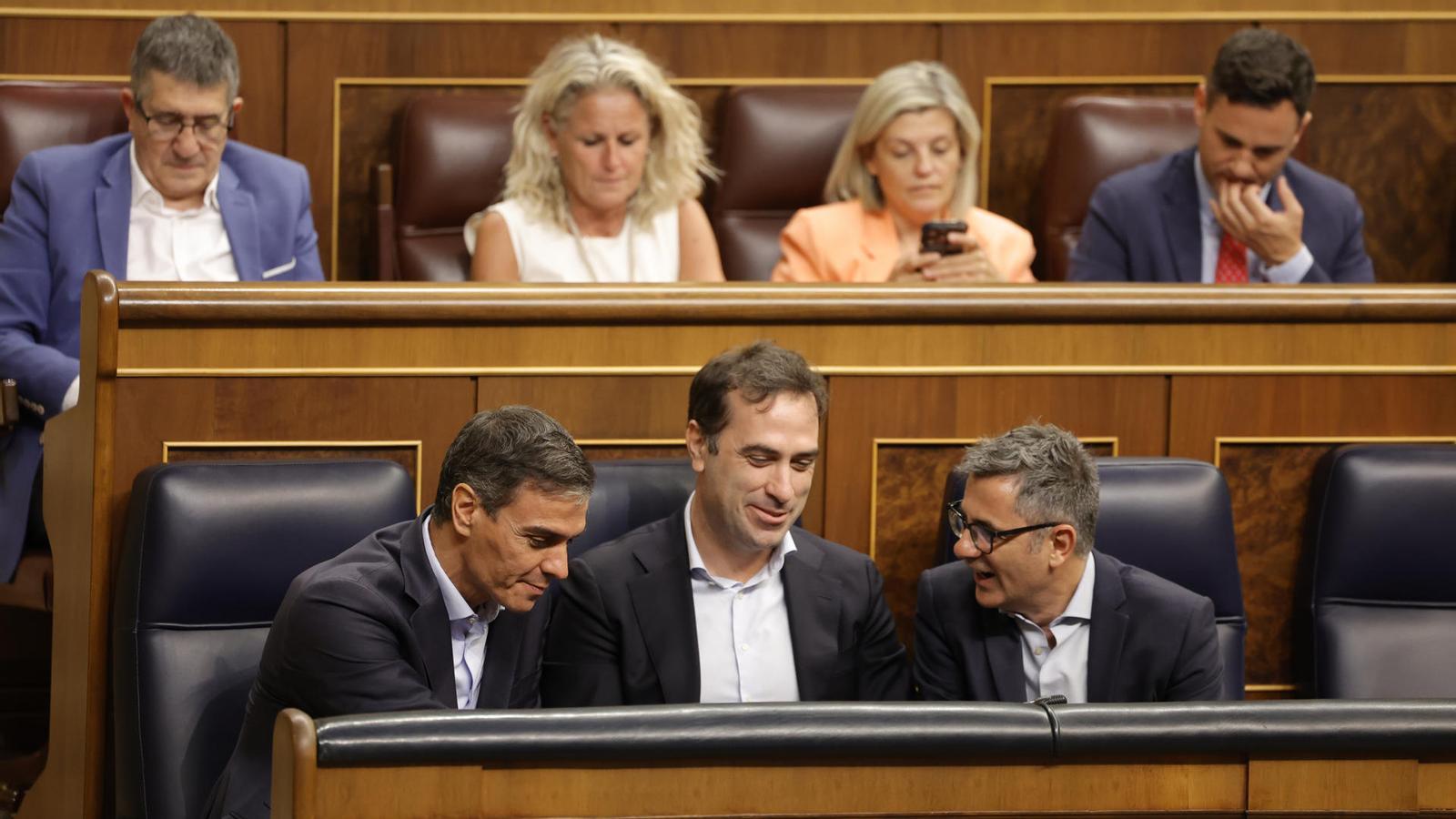
The socialist spokesperson in Congress, Patxi López, has claimed in the corridors of Congress that the legislature is still underway and has argued that in the last three years, 74 laws have been approved in Congress and "more than 40 are currently being processed." In this Thursday's plenary session, in fact, the last one before the August holidays, the lower house did approve the rest of the items on the agenda. The same sources from the Spanish government maintain that, despite all the bad luck comments, "the government is functioning normally and most of the things brought to Congress are approved." Setbacks, such as the stability path, make "noise," but at Moncloa they downplay their importance and Sánchez attended the end of the plenary to receive the applause of his bench in an image that seeks to convey that the legislature continues.
The session has coincided with the interview of the former socialist president José Luis Rodríguez Zapatero, which has set the media agenda for the day, and it was the day after Alberto Núñez Feijóo proclaimed that the legislature is over in his assessment of the political year. The PP leader waited to inflict further parliamentary setbacks on Sánchez to weaken him even more, anticipating that the judicial agenda surrounding the PSOE will become even more complicated between now and the Spanish elections. To achieve this, Feijóo said he was counting on Vox and Junts, with whom he has aligned himself once again this Thursday in the vote on the stability path, although the Junts have saved other measures alongside the PSOE.

Saved reforms
Sánchez keeps alive part of his legislative agenda and that of the plurinational majority. The Congress has approved the reform of the rules of procedure of the lower house, which aims to facilitate minority formations having their own parliamentary group. It is a modification driven mainly by the independentist parties, which lowers the requirements to constitute them (from 5 to 3% the percentage of votes at the state level and from 15 to 10% that of the provinces). It has also moved forward with the support of Junts and Podem, the other ally of the investiture that has most distanced itself from the plurinational majority, the new decree of measures for the outbreak of the war in Iran approved by the Council of Ministers on June 29. Another decree, which unblocks partial retirement for public administration workers, has been saved thanks to the abstentions of PP and Junts. The debt forgiveness has also overcome the amendments in their entirety from PP and Vox.
Furthermore, the lower house will send to the Official State Gazette (BOE), for its definitive entry into force, the law that modifies the neonatal screening program, known as the heel prick test to detect diseases in newborns early, to reduce differences between autonomous communities, as well as a reform so that mutualist registered professionals can transfer their economic rights to the self-employed regime (RETA). Upon returning from vacation, one of the next initiatives of the Spanish government that will have to pass the Congress's examination, with significant relevance, especially for Sumar, will be the decree extending rents until 2028, which will also include other fiscal measures and which the Council of Ministers will approve on Tuesday. Junts and Podem have already expressed that, as it is currently worded, it cannot count on their votes, but the Spanish government hopes that negotiations with the groups will allow them to claim a parliamentary victory in a matter as sensitive as housing in this final stretch of the legislature.
