Sánchez responds to the sentence on Ábalos with attacks on Feijóo and defying partners
The Spanish president distances himself from Ábalos, maintains confidence in Zapatero and denounces "persecution" of his family
-
CAT -
CAST
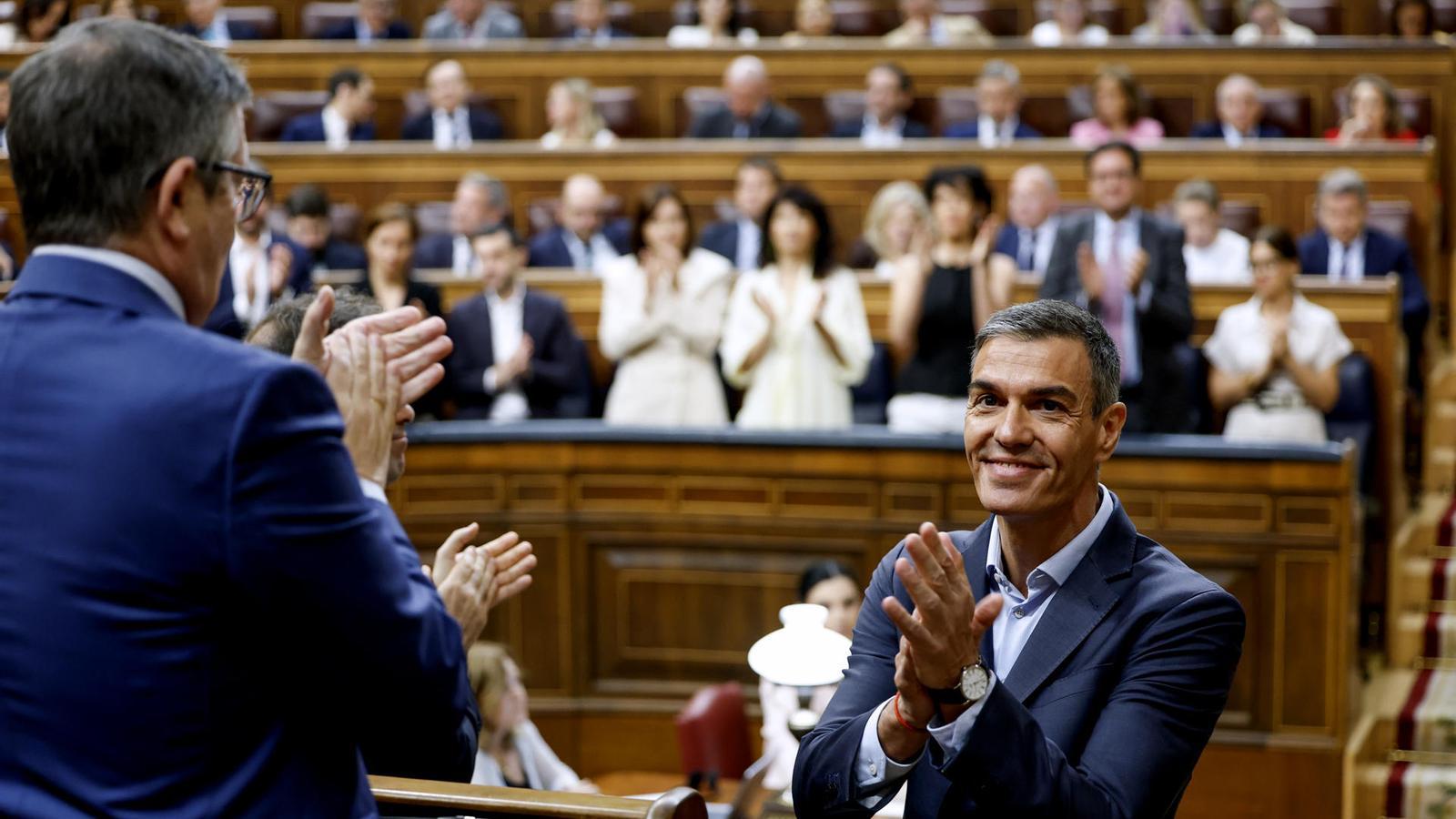
MadridIt has been almost a year since Pedro Sánchez was forced to appear before Congress to explain the judicial investigations that tarnish the PSOE. This Wednesday he has done so again in the face of the unstoppable trickle of cases that expand the list of suspects linked to the Spanish president and with a firm sentence for corruption against the former Minister of Transport José Luis Ábalos. Unlike the appearance on July 9 last year, in which the head of the executive presented a battery of anti-corruption measures to deal with these cases, on this occasion Sánchez has gone on the offensive against the leader of the opposition and president of the PP, Alberto Núñez Feijóo, and challenging partners like Junts to present a motion of no confidence. In an initial half-hour speech, the socialist leader distanced himself from both Ábalos and Santos Cerdán, his two former organization secretaries, defended José Luis Rodríguez Zapatero, and denounced "persecution" against his family.
Furthermore, the head of the executive boasted about his government's actions. "There should be no shadow of a doubt about the executive's actions," he proclaimed, and also defended that there has been no illegal financing of the PSOE. In a second intervention, Sánchez raised the tone with harsh attacks on Alberto Núñez Feijóo. The Spanish president once again resorted to the image of the PP leader with the trafficker Marcial Dorado and accused the Popular Party of turning a blind eye to Isabel Díaz Ayuso's partner. "They harass my wife to get zero euros and protect an individual who is becoming a millionaire at the expense of the privatization of healthcare for Madrilenians," he stated, and affirmed that Feijóo cannot boast of anything because he has neither "courage" nor "integrity." "You have done nothing," he sentenced, while the spokesperson for Sumar, Verónica Martínez Barbero, reproached him for having reached the presidency of the PP to cover up the corruption of the Madrid president and to the detriment of Pablo Casado, who had pointed him out.
Accusations that have angered the popular leader. "Don't give me lessons, Mr. Sánchez, I don't accept them." "You don't resign because you have no dignity – he added, visibly angry–. I have not had my political career paid for by a prostitution magnate," he added, alluding to the sauna business his late father-in-law had. Feijóo even referred to the PSOE spokesperson, Patxi López: "If your father got up, he wouldn't forgive you," words referring to the late Basque socialist leader Eduardo López. "He is a scoundrel," the same Patxi López replied later.
"I did not know these practices"
In line with the argumentation that Moncloa has already deployed so far, Sánchez has made a distinction between what he considers individual behaviors of people who had been of his utmost confidence, and the action of his executive. "I never knew nor would I have tolerated any of these practices," the Spanish president has assured regarding the mask plot, against which there is already a sentence by the Supreme Court against Ábalos of 24 years in prison, and that of alleged irregular awards of public works, still in the investigation phase and for which Cerdán is also being investigated. Sánchez has not discredited these investigations and has argued that he already acted by expelling those under investigation, renewing the socialist leadership, and promoting anti-corruption measures from the Spanish government – still pending full implementation. The Spanish president has asked to separate these "flagrant and serious" cases from the rest.
For Sánchez, there are three categories of investigations surrounding him that, in his opinion, are not comparable. The first, for which he "already apologized" a year ago, is precisely the one related to Cerdán and Ábalos. In a second tier, Sánchez has placed the investigation against former Spanish Prime Minister José Luis Rodríguez Zapatero "about which no one can draw conclusions yet." "He is presumed innocent," he reiterated. In a third category, the head of the executive has placed the cases against his wife, Begoña Gómez, and his brother, David Sánchez, which he has described as "a series of coordinated actions seeking to weaken the executive's action through personal attacks".
The Spanish president has predicted that in the coming months the trickle of information against his circle will continue, but has denied that it is a symptom of "political degradation." "What we will witness in the coming months is the persecution and purge of the right," he stressed. Despite this, Sánchez has assured that he has no intention of throwing in the towel and maintains that he wants to continue governing no matter what. "We are very calm and sure of what we have done," he insisted. "How can we not continue?" asked Sánchez, who argued that the alternative of PP and Vox will be even less effective in the fight against corruption.
PP and Vox once again demand elections
Both the Popular Party and the far-right have questioned the Spanish president's version and have once again called for elections. "You are the corrupting political link," Alberto Núñez Feijóo stated. Sources from the PP leadership emphasize that Sánchez cannot distance himself from the judicial cases of those around him, as they all "stem from him," and affirm that he appeared "with a guilty face." The popular leader has reproached the Spanish president for trying to "stretch" the legislature under these conditions. "What are you still doing sitting here? Aren't you ashamed?" Santiago Abascal, leader of Vox, asked him, warning Sánchez that no matter how much he makes "resilience" his "banner," "cockroaches beat you." From his seat, Abascal also showed a photomontage of Zapatero with his jewels. However, the PP and Vox once again face the impotence of not having the numbers to win a motion of no confidence that would definitively bring down a Sánchez determined to resist.

