Sánchez announces that King Felipe VI will visit Ceuta and defends Morocco: "The cooperation was instantaneous"
The Spanish president, who says he will finish the term and run for re-election, points to the "reactionary international," Russia, and Israel as the origin of the crisis
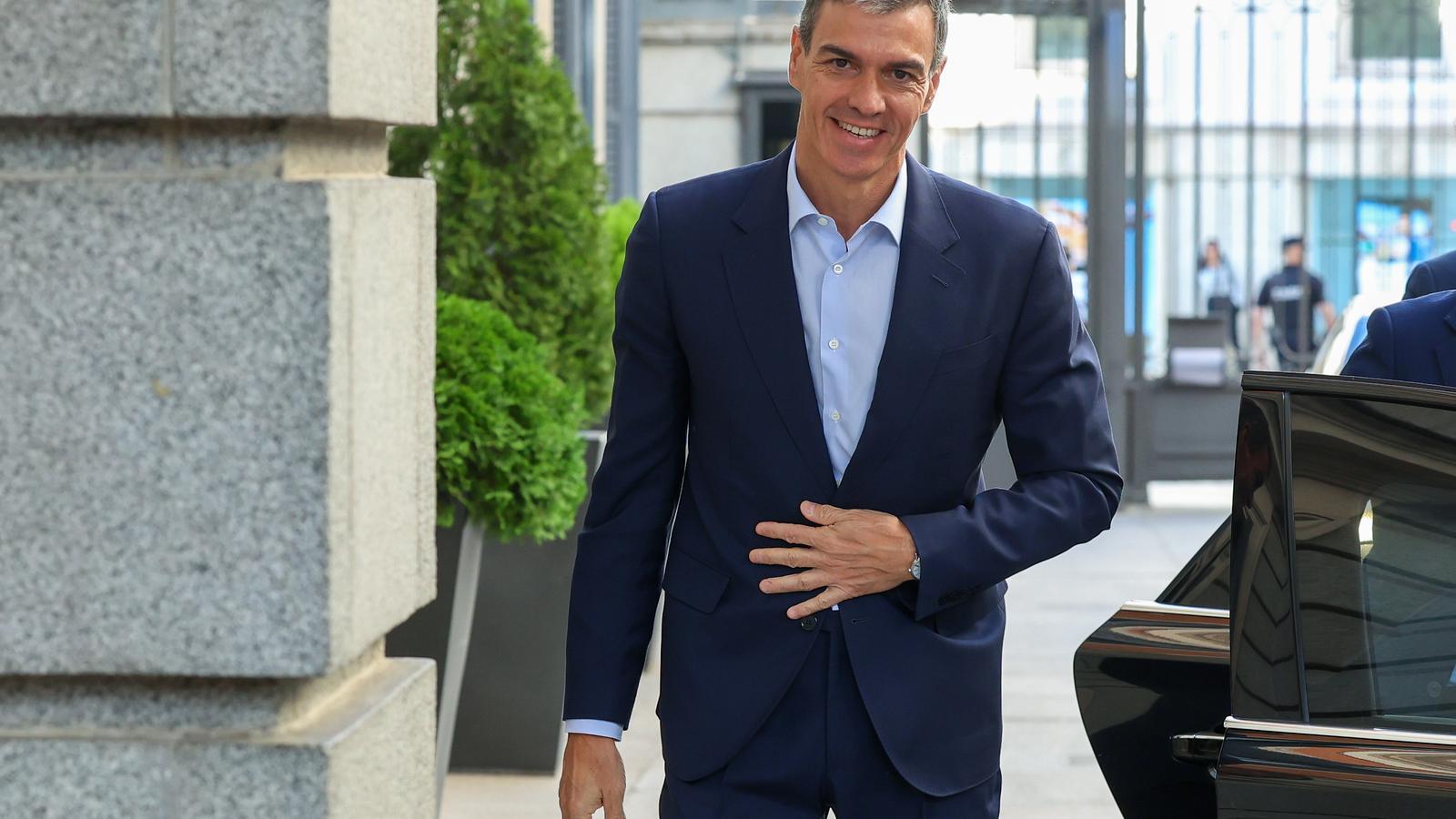

MadridThe Spanish president, Pedro Sánchez, broke his silence this Monday after a month without speaking publicly amid an unprecedented crisis in Ceuta and launched an announcement: he assured that there are "arguments and reasons" for King Felipe VI to visit the autonomous city for the first time. However, he did not specify on what date this trip would take place. "The visit will happen", he committed in an interview with the SER, in addition to defending the Spanish government's management and Morocco's "instantaneous cooperation" in facing the massive influx of migrants on July 30.
"Cooperation with Morocco is positive", said Sánchez, who added that thanks to agreements with the Alaouite country, irregular entries have been reduced, beyond what happened on July 30. Furthermore, he reaffirmed that without a fluid relationship with the Alaouite country, the crisis cannot be resolved: he said that the Moroccan government is willing to help both in the repatriation of adults and in the family reunification of minors.
The fact that the monarch visits the autonomous city is an exceptional matter and a fact that had generated controversy because the right wing insinuated that Felipe VI wanted to go there and the Spanish government did not authorize it. This Monday, the Spanish president wanted to dispel doubts about his willingness: he showed himself to be in favor of the king going there, considering that it has been twenty years since any Spanish monarch set foot there. The last and only time in democracy a head of state went to Ceuta was in 2007, with the visit of Juan Carlos I and Sofia, but it generated a clash with Morocco due to his claim over the territory and was read as a "provocation".

Sánchez waited until this Monday, after an escalation of tension in Ceuta, to give explanations about the Spanish government's management of the crisis. Despite the opposition's criticism, he assured that he had "worked" this summer and had been at the forefront of the situation, but he also defended his right to "rest" against those who reproach him for taking holidays. "It is a right that we politicians also have," he said, although he assured that a head of government "never disconnects and is 24/7 attentive to the country". Furthermore, he not only defended his management without self-criticism, but also showed himself willing to finish the term again. "It lasts four years," he recalled, without specifying whether the elections will be in the first quarter of 2027, before the municipal and regional elections, as some critical socialist barons demand, or later. He also reaffirmed his intention to lead the PSOE again in the next elections.
The origin of the crisis
The Spanish president began the interview by giving figures on Ceuta and talking about the origin of the massive influx of migrants: he said that around 72,000 people entered — of whom he said most returned in the following days thanks to collaboration with Morocco — and that currently there are 5,000 left in Ceuta, 1,200 of whom are minors. What Sánchez could not say is how many are currently being attended to. "In a short time we will have the capacity to welcome them," he said. In this regard, he said that the priority of the Spanish government is to return the migrants and resolve the cases in the autonomous city itself, without transferring them to the Peninsula.
After decoupling Morocco from the massive influx of migrants, despite that country controlling the other side of the border, Sánchez has admitted that he cannot currently determine the origin of the crisis. According to him, they are "investigating" the cause that led to more than 70,000 people crossing the border, but he has cited several relevant factors: a "misrepresentation" of the Supreme Court ruling rejecting pushbacks at sea, the role of mafias, and an amplification of fake news by the "reactionary international", Israel, and Russia. In Sánchez's opinion, however, there doesn't have to be a "state actor" behind it all.
Sánchez has pointed out that Ceuta and Melilla are two very complex places, as it is the only land border between Europe and Africa, a very unequal border, and whose security "cannot be guaranteed 100%". In fact, he has assured that "the majority of migrants who entered did so for economic rather than humanitarian reasons", so he has predicted that most people will have to return to Morocco because they will not be entitled to asylum.
The CNI's warnings
Were there or were there no warnings from the CNI to prevent the situation? Sánchez defended that there was no information about the magnitude of the massive entry of migrants. He stated that the CNI warned of a rebound in entries to Ceuta by swimming, but not of the magnitude of what happened, so the reinforcement that occurred at the border was not sufficient. "Nobody predicted that we would have an entry of those characteristics," he said, adding that in his opinion there is no contradiction between what Defense says — which said there were CNI reports — and Interior — which claims there were no warnings to interpret that a massive entry would occur.
At the same time, he wanted to emphasize that the Spanish intelligence services did not foresee the crisis, but neither did other intelligence services with whom the State usually collaborates. This Monday, the ministers of Youth, Sira Rego, and Equality, Ana Redondo, will also appear before Congress to account for their management in Ceuta, and this Tuesday the council of ministers will approve a new package of measures for the autonomous city. Sánchez defended the package of economic aid of 168 million euros to reactivate Ceuta. An investment that will be added, he specified, to a plan already announced by the Minister of Economy, Carlos Cuerpo, of 180 million. Moreover, according to Sánchez, the PSOE and Sumar government is the executive that has most committed to the autonomous city despite the current situation.
