Salvador Illa boasts in Madrid about Catalonia's "loyalty": "It is the first time there is no nationalist majority"
The president defends the new financing and that the amnesty be applied with "diligence"

-
CAT -
CAST
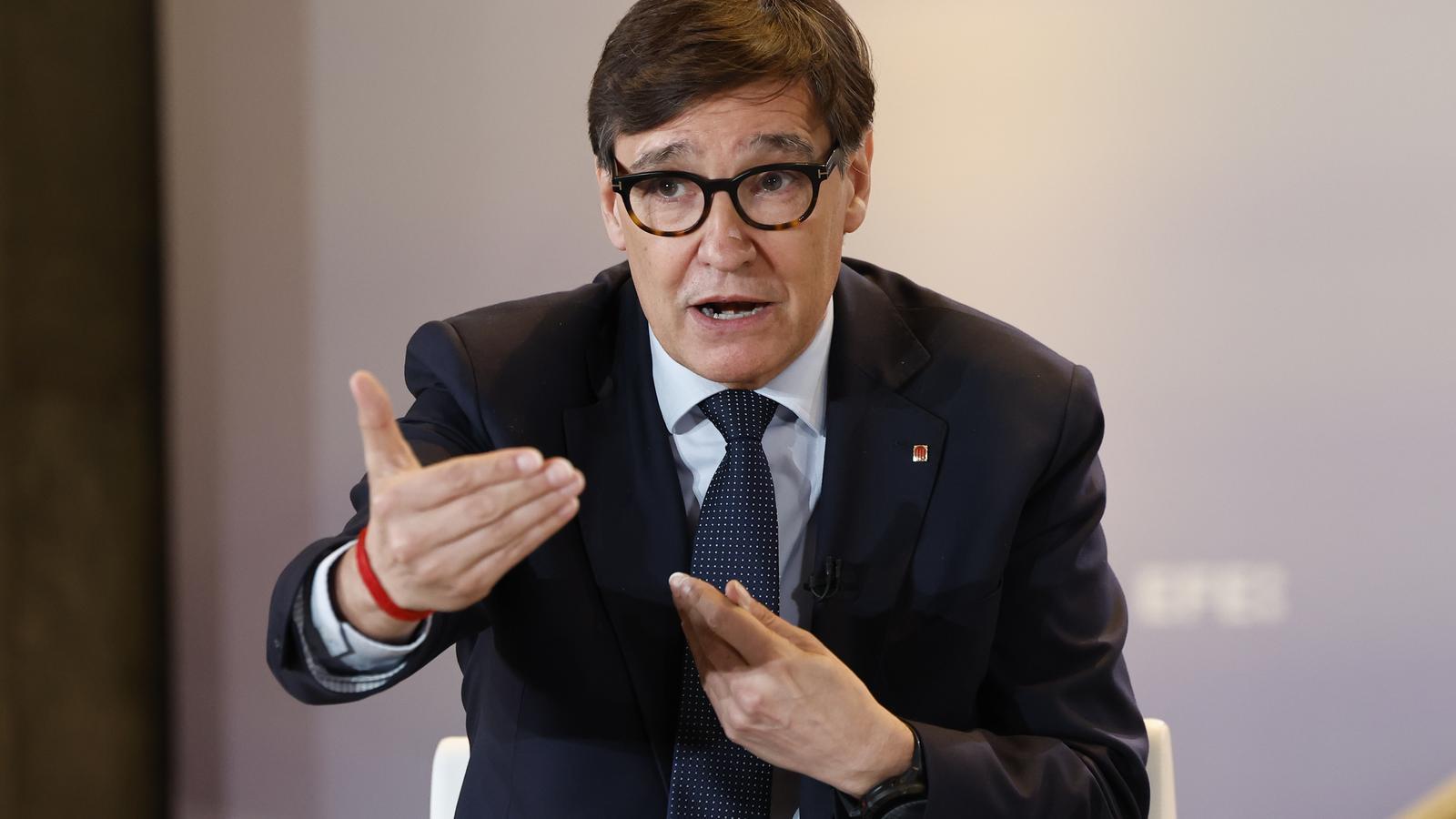
MadridA decade ago, when a President of the Generalitat landed in Madrid, it was to defend the possibility of Catalonia voting in a referendum on independence. Artur Mas did it first; then Carles Puigdemont, Quim Torra and, finally, Pere Aragonès. Ten years later, however, with new majorities in Parliament, the Catalan government presents itself as the best guarantee of "institutional cooperation" and "loyalty" to the Spanish government's project. The President of the Generalitat, Salvador Illa, starred this Monday in a press breakfast in the Spanish capital, organized by Efe and RTVE, in which he highlighted the moment that Catalonia without the Procés is experiencing: the Generalitat has budgets; it "leads" the new financing proposal where all autonomous communities gain resources, and it is synonymous with "stability". In addition, he has called for "speed" in applying the amnesty law, hitting a nerve with those like the PP and Vox who accuse the PSOE of reviving independence: "It is the first time in forty years that there has been no nationalist and independence majority. It has not revitalized, on the contrary [...]. I know what I'm talking about".
Illa himself recalled where he came from. In his opening speech, he said: "In April 2025, at the Círculo de Bellas Artes, here in Madrid, I committed that Catalonia would rise to the occasion and exercise its responsibility with Spain and Europe [...]. One year and three months later, I can affirm before everyone that Catalonia is fulfilling its commitment," summarized the President of the Generalitat.
In this way, Illa defended the Spanish government's strategy, in which the PSC has participated, regarding Catalonia, unlike the situation that occurred when the PP had an absolute majority, when he recalled that territorial tension was at its peak. With this track record, Illa has defended two key projects for the Generalitat: both the amnesty and the new financing model.
In relation to the ruling that the Court of Justice of the European Union (CJEU) is to make on the amnesty this Thursday, Illa expressed confidence that it will be a "clear" ruling and hopes it will lead to the law being applied with "diligence" and without "delay". Just as the judiciary asks, with "respect" and "independence", the president has called on the Supreme Court to respect the legislative power, taking into account that it has already been two years since the amnesty law was approved in the Courts with a "clear spirit" of putting an end to the criminal cases of the Procés.

Regarding financing, the President of the Generalitat has defended the proposal that Hisenda has put on the table, negotiated with ERC and PSC,, but which currently only has the vote in favor of Catalonia. According to the head of the Catalan executive, the PP's communities have no arguments against it because it increases the resources of all autonomies, even though those governed by the PSOE also do not buy into the model. "Enough of distrusting Catalonia. We don't have to ask permission to lead. Enough of criticizing proposals for their origin and not for their content. Those who do this are bad Spaniards," he stated. In contrast, the president of the Community of Madrid, Isabel Díaz Ayuso, has called the model a "trap" and "betrayal": "It goes against 14 out of 15 common-regime communities," she stated.
Message of optimism for the PSOE
From the front row of the informative breakfast, held at the Cervantes Institute in Madrid, was the Minister of Territorial Policy, Ángel Víctor Torres, who later endorsed Illa's statements to the media, as well as the top figures of the PSOE: the organization secretary, Rebeca Torró, and the deputy secretary for organization and electoral action of the party, Borja Cabezón.
In fact, at one point during the breakfast, Illa took it upon himself to lift the spirits of the PSOE, succumbing to the judicial vortex of the cases surrounding it. He asked to go to the "bottom" when there is corruption, but also warned that he believes "little in chance or coincidences," alluding to the flood of investigations. "We'll see what they end up with," he opined, and issued a warning to the judicial authorities: he assured that he cannot afford not to believe in justice, but asked the General Council of the Judiciary to look at the data, which reveal an increase in citizen distrust. "They should feel addressed," he concluded.
And, facing this panorama, are there still options for the PSOE to maintain Moncloa? Salvador Illa believes so. "Pedro Sánchez will run in the next elections, win, and govern," he proclaimed optimistically, thus ruling out that he himself could be a replacement and deactivating the existing rumors. "He is the best leader we have, the best we have had in democracy," he even said about Sánchez. In his opinion, one only needs to leave the country and see how the Spanish president is spoken of: he cited the positive macroeconomic figures, the "expansion of rights," or his leadership, he said, when denouncing the genocide in Gaza or confronting Donald Trump. "The only one who said no to the NATO summit in the face of the United States demanding an increase in defense spending to 5% was Pedro Sánchez," he highlighted.
"The alternative is regression," he continued, alluding to a government led by Alberto Núñez Feijóo, who "confuses temporary incapacity with cancer," he added, in relation to the controversy surrounding the PP leader for questioning sick leave. "Is this what awaits us?" he asked himself.
Interpellation to Junts
At this point, Salvador Illa has called out Junts, who are wavering between the left-wing majority and the PP and Vox in Congress. "They have to make decisions. We are not facing a conservative alternative, we are facing an involution, they want to dismantle, to undo... There is no middle ground, you are either on one side or the other," he stated.
In the president's opinion, this dilemma is also what is now on the table with the presentation of the State budgets, which tomorrow will suffer a first setback in the Congress of Deputies with the announced no from Carles Puigdemont's party to the budgetary stability objectives, because they believe that the communities should have more spending margin to budgetary stability objectives, because they believe that the communities should have more spending margin. Despite this initial rejection, Illa expressed confidence in the possibility that the 2027 accounts could move forward and denied that they were a "mere formality" or an "excuse" by the Spanish government to call early elections.
And now, with a touch of levity, he was asked about one of the topics of the week, the Spanish national team. "We will watch the match and we hope to win," he summarized. A different answer from the one given by his Basque counterpart, Imanol Pradales, in the same scenario when asked if he would like la roja to win the World Cup: "I would like the team that plays best to win. I am from the Basque national team".
