Pending Pedro Sánchez with the PSOE prepared for the elections
The president alters the official agenda while it is expected that he will communicate the decision regarding an early election
-
CAT -
CAST
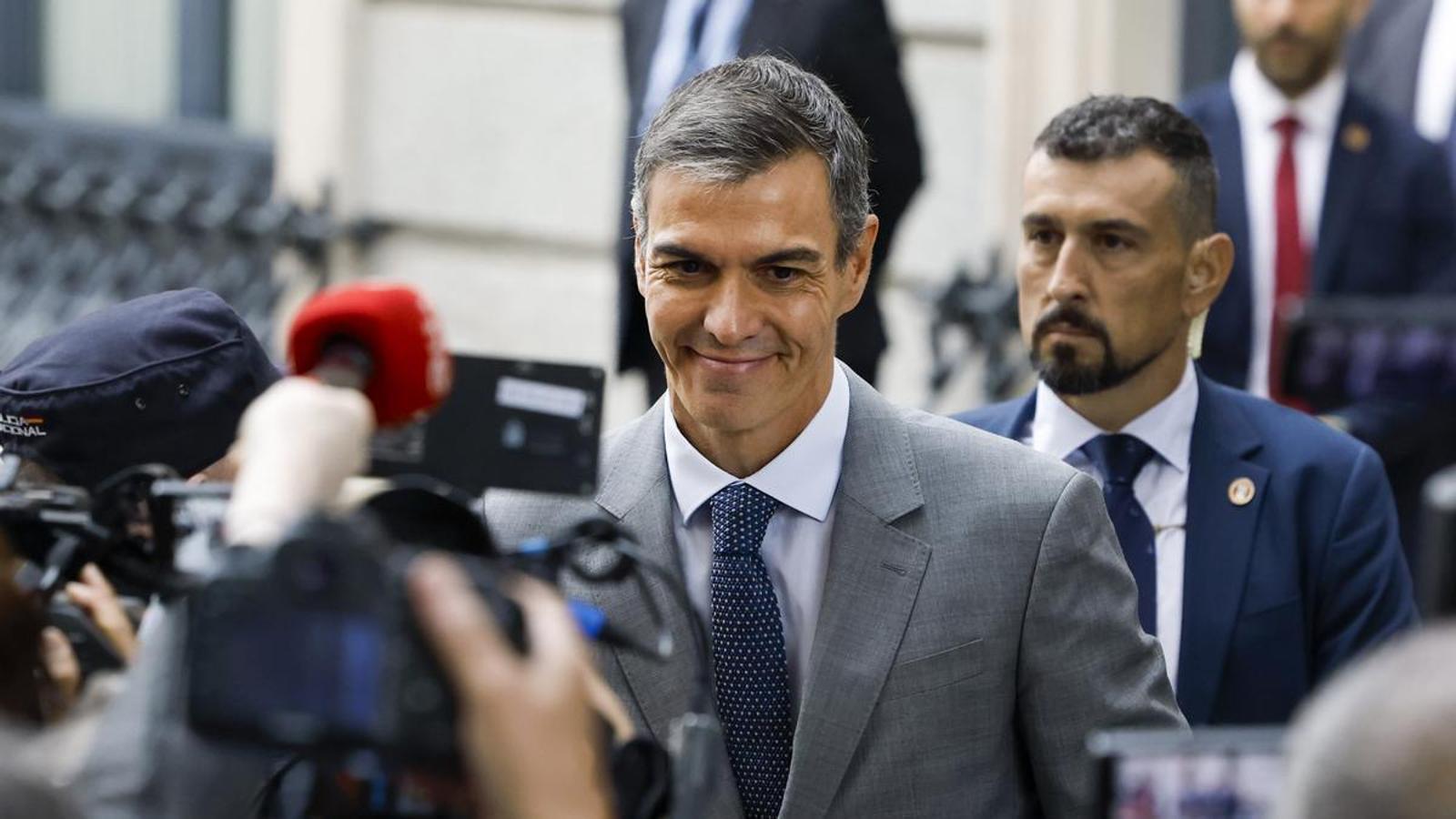
Barcelona / MadridThe last time he took a few days to reflect, Pedro Sánchez returned with "more strength", ready to "put a stop to the politics of shame". During those five days in April 2024 –in the middle of the election campaign in Catalonia–, everyone was pending his decision, which at the time had to do with the attacks his wife received, today about to be tried for embezzlement and influence peddling. Now things are slightly different: no one expects him to step aside, but everyone is waiting for him to make a decision. Will there be elections before the end of the year? At the PSOE they are prepared and with each passing day the voices pointing out that the legislature has ended are growing.

The weekend has passed, tens of thousands of people have taken to the streets to call for a general strike. La Moncloa announced yesterday that it was maintaining its official agenda, which was supposed to start at 9:30 a.m. with the inauguration in Madrid of the National Congress of Family Businesses, but at 8:00 a.m. this Monday it informed of a substantial change: the president will appear at La Moncloa at 9:00 a.m. Afterwards, he has the meeting of the PSOE's federal executive committee, but his decision will likely have been communicated before then, which will surely be the scenario he considers most interesting for the socialists. If he opts for the electoral route, the Constitution states that he would first have to convene the council of ministers to explain it and, afterwards, communicate it to the King, who is in charge of decreeing the dissolution of the Cortes, and who this Monday begins an official trip to Finland.
"History will judge them sooner and more forcefully than they imagine," said Sánchez to the deputies of the PP, Vox and Junts at the end of Friday's session, once the failure of the two housing decrees was confirmed. If they have to be on a Sunday (only the general elections of 1977, 1979 and 1982 were on weekdays, although in Catalonia they were also not held on a Sunday in 2006 or 2017), the earliest they could be is November 29. A scenario that would imply signing the decree for the dissolution of the Cortes this very Monday so that it would be published on Tuesday in the BOE. In any case, sources consulted by ARA have pointed out throughout the weekend that the decision had not been made and that it will be Sánchez himself who takes it, the only person with the constitutional power to do so.
Advice
During the weekend, sources close to the Spanish government acknowledge that Sánchez has held conversations about a hypothetical early election. In private, he has called to ask for advice and has also received it from people he trusts, both in the government and the PSOE. In public, he has seen how a group of barons socialists were pushing for an end to the legislature. At least the leader in Castile and León, Luis Tudanca, has done so, who yesterday requested that they be held "in November better than in December and in December better than in January"; the one from Castilla-La Mancha, Emiliano García-Page, and the barons from the Basque Country, Eneko Andueza, and from Extremadura, Álvaro Sánchez Cotrina. The one who has not taken a public position is the President of the Generalitat, Salvador Illa, who has a much closer relationship with the Spanish President. Sources close to the PSC leader explain that he will support the decision that Sánchez makes. In the background of all this, there is also a request that some barons socialists, and also mayoral candidates, have been pressuring the Spanish president for months, both in public and in private: that he should submit himself to the polls first so that the municipal and regional elections on May 23rd cannot be turned into a plebiscite on Sanchismo.
Until now, polls have not been kind to the PSOE, and even less so to the parties to its left. Only the CIS, presided over by the academic-questioned José Félix Tezanos, has consistently predicted it to be in first place. The PP has long been calling for elections, and the popular party members have continued to do so in recent days. Alberto Núñez Feijóo began on Friday, and this Sunday it was, among many others, MP Cayetana Álvarez de Toledo who challenged Sánchez: "Come on, democrat, dare to call elections".
The latest survey that has emerged is not, however, very promising for those who defend this idea. The poll of La Vanguardia about hypothetical Catalan elections reinforces the idea of a fall of the PSC –one of the main electoral supports of the PSOE– and a great rise of the far right, both of Aliança Catalana, which would rival the socialists for the first position, and of Vox.
The left tries to organize itself
The PP and Vox are eager to go to elections, even if the reason for calling them is housing. The Ceuta crisis is not yet overcome, cases of alleged corruption are piling up around the Moncloa, the government's weakness is becoming evident in Parliament, and even Carles Puigdemont is about to return. But the left arrives with more problems. ERC does not want elections because all pending agreements with the PSOE would lapse, as Oriol Junqueras has made clear. In Podemos, Ione Belarra has also positioned herself against calling an election because what needs to be done, she says, is to re-approve the housing decrees. Sánchez could do it even if he opted for a snap election: the Council of Ministers would have to meet this Monday urgently and approve them. In fact, it would no longer be the Congress plenary session that would have to validate them, but rather the permanent deputation, and in this body the PP, Vox, and Junts do not hold a majority.
But whoever saw everything as bleakest until now was Sumar and its satellites. Without having settled on either the candidate or the parties that should integrate the Broad Front with which they are christening the new electoral device, Yolanda Díaz's successors have called for the presentation of the candidacy for next October 17th. Then they will present their roadmap, but if Sánchez presses the electoral button, they will have to accelerate their period of reflection.
