Leave democracy done early in the morning

-
CAT -
CAST
BarcelonaA tense circle is forming at the doors of the Central Library of Santa Coloma de Gramenet, at that hour of the morning when the sun has not yet fully risen and you do not know if it is the day that will be cold or if it is a personal and constitutive cold, the internal revenge of all the bad decisions you have made throughout your life. I mean that at 7:30 on a Sunday at the end of November everything is very depressing and not even civic responsibility brings a smile to those chosen to form the polling stations. Despite the differences in styles, ethnicities and urban tribes, the common denominator is that no one has believed that November 29th is the kind of day in which it is worth showing off your best clothes.
When the door opens, the City Council staff, entirely female, with the air of veterans and a tone of not letting anything slide, reassures those who feared encountering the most infernal face of bureaucracy: everything will go smoothly. Three rooms have been set up: one totally soulless; the children's section of the library, but I regret to inform you that the little tables and chairs are not used to improvise a mini educational desk, and the press reading room, where it makes me happy to see the local newspaper spread out on the table, El Mirall, which on the front page is titled “7.7 million to finish the tower in the square” and explains that there will be “more police at night to stop the wave of assaults on the city’s businesses”: an ode to non-interpretative journalism that should be the basis of what is happening today. The space is gray, clean, linear and illuminated with fluorescent lights from eras when no one used the word care.
Once assigned to the respective tables, the ice is indeed broken, and it is immediately seen that the origin of democracy must have had more to do with sharing sorrows than illusions: variants of “I don't win the lottery, but I get this” triumph in all the circles. The proxies and observers tell me that the worst they have experienced are individuals under the influence of drugs who had to be sent home, and people who have been claimed to have failed in the constitution of the tables with stratospheric fines. Today things go almost perfectly: only one main member out of a total of ten tables fails (the corresponding substitute takes it with an exemplary smile and runs to park the car properly) and only one substitute arrives twenty minutes late, looking like they didn't have any luck during the night; they sign, I ask if they will vote and they look at me as if I had told a joke.
Among those who will spend the day together, the norm is the opposite: lots of political awareness, good vibes, and solidarity lubricated by resignation. The most fun thing to observe is the art of talking about politics without knowing where your interlocutor stands. The challenge, which is impossible, ends with a very strange triumph of the idea of “change,” adopted by people who will clearly vote for the right, but also by people who will clearly vote for the left, united by unassailable ideas such as “common sense,” “everyone is doing a terrible job,” and “I respect everyone’s ideas.” The president of one of the polling stations is the poet Jordi Valls, who tells me that “democracy lacks lyricism” and sends a greeting to Sebastià Alzamora. I perform an express exam: everyone knows the criteria to distinguish between a blank and a void vote, and the greatest hope is that someone, truly, will vote with a chorizo inside the envelope.
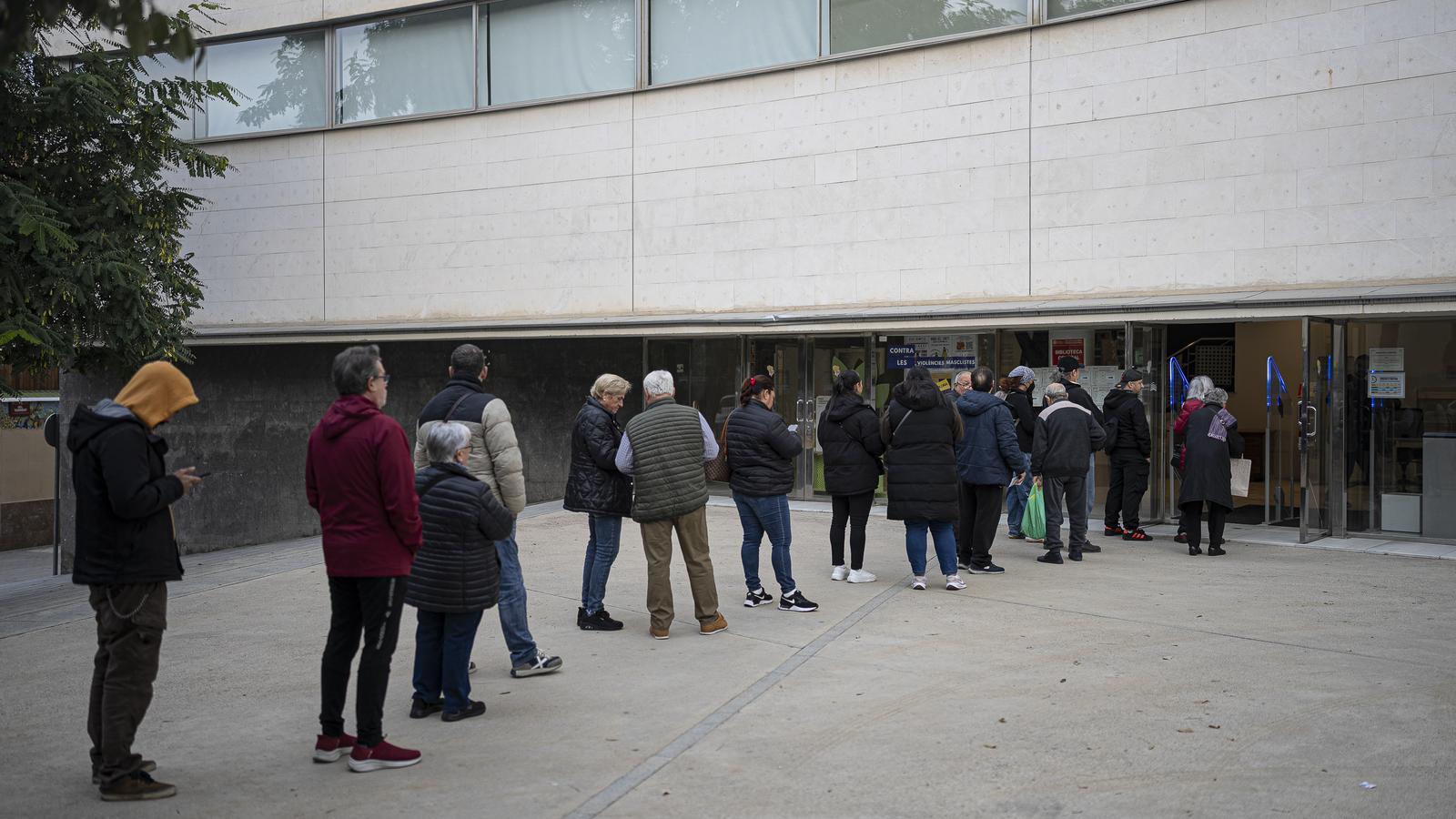
Five minutes before the door opens, there is already a considerable queue, at least forty people. The first are a pair of octogenarians: Estela, who tells me there is no merit to it because she always wakes up at 6, and Laura, who tells me she is afraid and that with her pension, she can buy fewer things every time. But they are overtaken by a man in a great hurry who heads flying towards the ballot he has in mind: he is wearing a black cap with the Spanish flag and a Cross of Burgundy, a historical symbol of the Hispanic monarchy and the tercios that today triumphs at Vox rallies. After this express vote that leaves a bit of discomfort floating in the air, Estela puts her ballot in the urn and gifts a toothless smile to the members of the polling station, who cross her name off the list and, the three of them in unison as if they had practiced it, shout: “It’s done!”
