How far will the National Court's investigation into the Ceuta crisis be able to go?
Experts anticipate that it will be unfeasible for any Moroccan authority to be investigated

-
CAT -
CAST
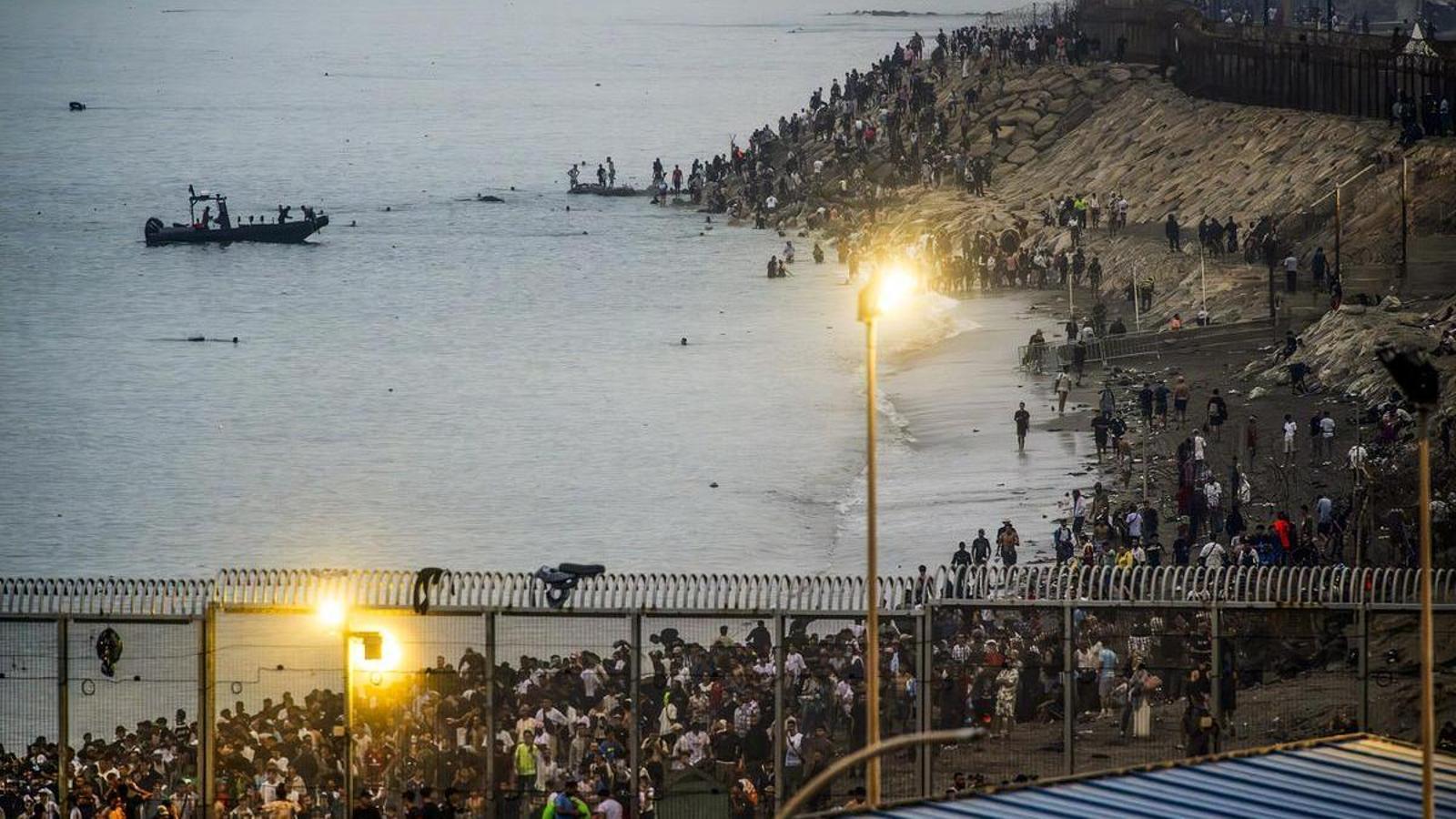
MadridA judge from the National Court will investigate the mass entry of immigrants into Ceuta at the end of July. After two initial reports from the Spanish police, which pointed to the passivity of the Moroccan security forces, María Tardón decided on Monday that she is competent to open a case and investigate the possibility that a crime against the peace or independence of the State, against the rights of foreign citizens, and a crime of criminal organization may have been committed. The first move she has made has been to request from the Ministry of the Interior all the documentation that the Spanish government declassified and made public. However, the experts consulted by ARA agree that the investigation will have little reach in ensuring that anyone assumes criminal responsibility. “It is a kind of toast to the sun, it is completely unthinkable that Morocco will collaborate,” says Manuel Cancio, professor of criminal law at the Autonomous University of Madrid. “The judge will run into a wall that will make it very difficult to move forward, Morocco will not collaborate and will not hand over Moroccan citizens,” adds Ramon Ragués, professor of criminal law at Pompeu Fabra University (UPF).
Both speak of the possibility that the National Court could investigate or try Moroccan authorities as alleged instigators of the mass entry. The wall in question is the Extradition Agreement between Spain and Morocco signed in Rabat in June 2009, which stipulates that “neither state” shall extradite its “respective nationals.” Therefore, the Moroccan government will not hand over any Moroccan citizen to Spanish justice. The agreement also adds that, in this case, Morocco would have to “commit” to investigating its citizens if they are crimes “punished” in both states and if Spain transmits a “request for the initiation of judicial proceedings” to it.
Therefore, Joan Baucells, professor of criminal law at the Autonomous University (UAB) of Barcelona, makes it clear that “the possibility of it ending in a conviction is zero.” The investigation could continue to be delayed and extended for as long as the judge deems necessary, but if there is no formal suspect, the case will be destined to end up archived sooner or later. Furthermore, for crimes with penalties exceeding two years, as is the case, a person cannot be tried without being present.
However, despite all this, some voices maintain that the investigation will not be sterile. Ramón Ragués believes that “it may serve to understand in some way how this came about”, although it will be “complicated” to continue “pulling the thread and discovering who is behind it all”. Joan Baucells agrees: “The only thing it can be used for, which is not minor, is to know what happened. When parliamentary commissions are held, they have the reach they have; it is very difficult to get to know the truth. On the other hand, a judicial process has more capacity to be able to objectively find out what happened”. In contrast, Manuel Cancio argues that the courts “are not there to investigate these types of issues”, but rather to “prosecute people who have committed crimes”.
The responsibility of the Spanish government
In the interlocutory order, María Tardón warned that “all actions” that took place in Spain would also be analyzed. In this sense, Eulàlia Pascual, a doctor in international criminal law, believes that “it may be that Spanish officials are implicated” and that “clear responsibilities” could be derived from Pedro Sánchez's executive. However, if the judge were to point to ministers or the Spanish president, she would have to refer the case to the Supreme Court because they have parliamentary immunity. On the other hand, Ramon Ragués maintains that “everything points” to a “possible negligence” and that, therefore, it is “very difficult to construct criminal liability” for Spanish leaders.
For his part, Manuel Cancio is very critical of the judge's reference to the crime that compromises the peace or independence of the State: he argues that it has to do with a “war context” or the “provocation of war,” a scenario very far from the current one. He believes it is a crime that intends to hold someone from the Spanish government responsible and is suspicious of it: “She chose it at random. It is excessive, it is completely out of place, it makes no sense and it is difficult to explain in legal terms,” he argues. “We can argue that there may have been inadequate management or that no attention was paid to the signs, but we are talking about whether someone has committed a crime and there is not much scope either towards Morocco or towards Spanish officials,” he concludes.
The international path
In another vein, Eulàlia Pascual points out that there would be an alternative way to investigate the facts, although it also has no chance of succeeding. It would be to turn to the International Court of Justice, but it is a step that must be taken by states and, therefore, it would have to be Spain that directly denounces Morocco, which is highly improbable seeing how the Moncloa has avoided holding the Alaouite country responsible for anything despite the evidence that has been emerging. Another path would be the International Criminal Court, but it remains deactivated because Morocco did not ratify the Rome Statute.
