Begoña Gómez hands the passport to judge Peinado
The controversial magistrate differs from Calama, the investigating judge in the Zapatero case, who leaned towards not applying any precautionary measure

-
CAT -
CAST
MadridThere is a comparison between two fashionable judges who are currently making a name for themselves: José Luis Calama, who is investigating José Luis Rodríguez Zapatero at the National Court, and Juan Carlos Peinado, who has sent Begoña Gómez to trial after a two-year investigation. It is obvious to everyone that the way these two major media cases in which they are involved are being handled is different. Indeed, high-ranking voices from Moncloa in the corridors of Congress admit that Calama "is not" Peinado, as shown by the fact that the investigation into the former Spanish president, still in its early stages, does not have the extravagances of the indictment of Pedro Sánchez's wife. The clear distance between the two has become evident, especially in two matters: the adoption of precautionary measures and the indictment of individuals who have previously testified under oath to tell the truth. Let's go step by step.
The withdrawal of the passport
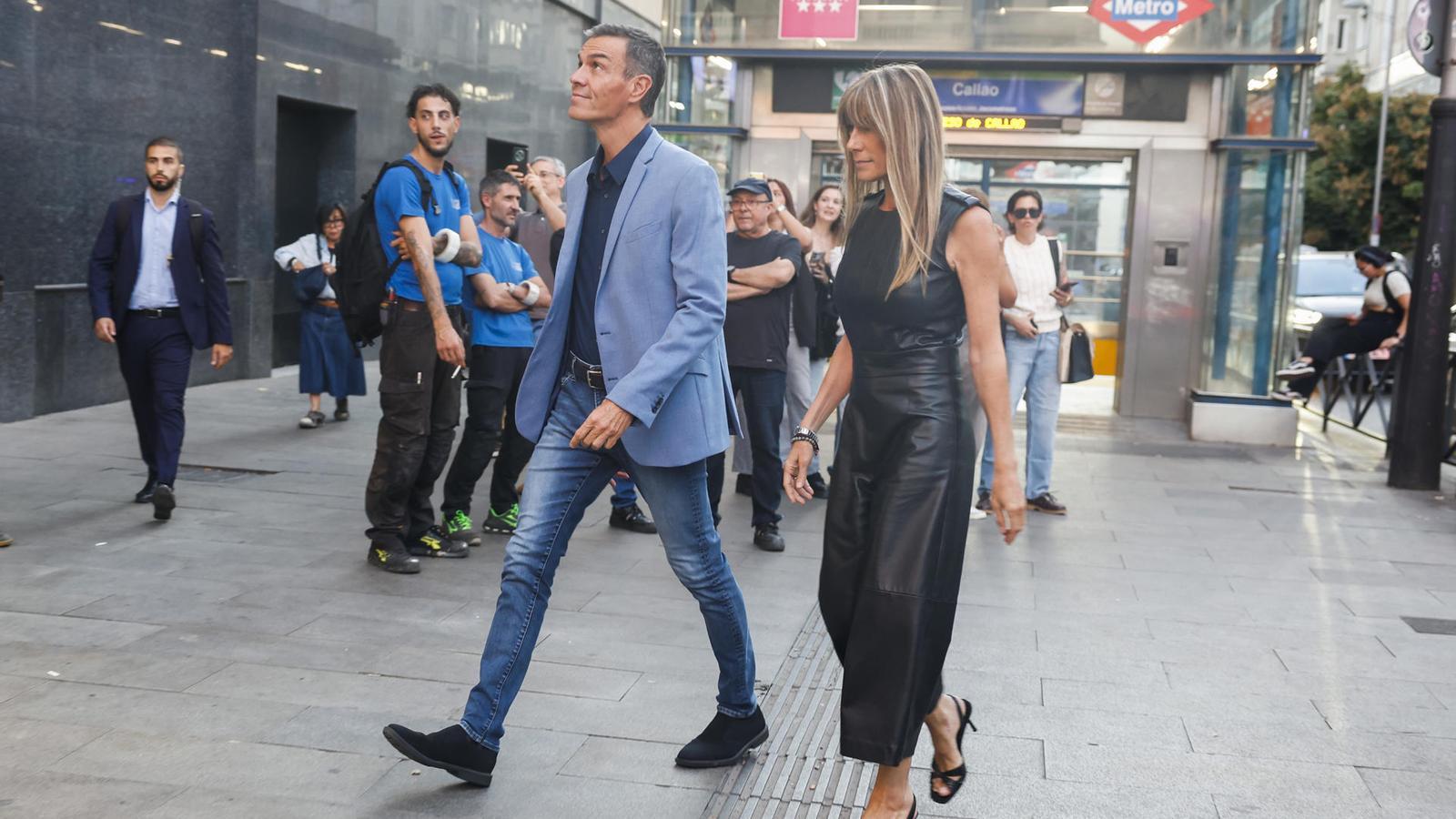
One of the big bombshells of recent days has been Judge Peinado's decision to revoke Begoña Gómez's passport and prohibit her from leaving the State. Sánchez's wife made the document effective this Wednesday afternoon, during a brief visit to the Madrid courts. What has caused the most controversy has been the justification that the National Police agents who act as her escort could help her flee on their "own initiative" or "following orders from their superiors." It is an insinuation that has put the police unions at loggerheads and has even led the General Council of the Judiciary to open proceedings to discipline the judge.open proceedings to discipline the judge.
His argument had just gone around when he added that, since Pedro Sánchez's presidency is "ephemeral" and "transitory" in nature, the agents' accompaniment "would disappear" and "further facilitate" a hypothetical escape. The origin of the risk was – simply – that the "possibility" of being sentenced to prison could lead her to want to "evade the action of justice." This was sufficient reason to prevent her from leaving Spain to avoid it.

Far from this justification, Judge Calama rejected withdrawing Zapatero's passport as requested by both the Anti-Corruption Prosecutor's Office and the popular accusations led by the PP. "The gravity of the imputed crime is not enough, an individualized analysis is necessary," he stated. This is a reason that fully refutes what Peinado would allege three days later.
The ruling also warned that withdrawing a passport cannot be either a "form of pressure" or a "covert punishment" and referred to Zapatero's "public visibility" and "manifest rootedness in the territory," combined with "the absence of any indication of evasive intent," to dismiss it. The last two factors also undoubtedly apply to Begoña Gómez. "It would represent an unjustified restriction, incompatible with the principle of proportionality," he added.
From witnesses to defendants
The other major decision by Judge Calama last week was to charge Zapatero's two daughters. And the argument with which he justified it is not futile. He alleged that, given their alleged involvement in the suspected events, summoning them as investigated persons was "necessary" to preserve their fundamental rights. And he called to "avoid any action that could place a person in a situation of forced self-incrimination" if there is a "reasonable possibility" that they may end up charged. In other words, having them testify as witnesses "would generate a risk" because the obligation to tell the truth "would irreversibly compromise" their right not to testify against themselves and not to confess guilt.
However, far from this caution, over two years of investigation, Judge Peinado has charged four people – and attempted to charge a fifth – who had previously testified as witnesses. The Prosecutor's Office even reproached him for showing "indifference or confusion" between the two statuses. The most blatant case is that of Cristina Álvarez, Begoña Gómez's advisor at Moncloa. He charged her a month and a half after she testified as a witness, even though nineteen days earlier – and without any new developments – he had rejected it.
His lawyer accused him of having "set a trap" for him and the Madrid High Court ended up annulling the testimony, making a reminder: "The requirement that, from the moment he is suspected of having participated in the punishable act, the accused does not testify as a witness," he recalled. The Madrid High Court has acknowledged that this "mutation" is "valid" if suspicions arise, but has made it clear that incriminating statements as a witness cannot be valued if they are not subsequently ratified and that recourse must be made to evidence obtained "autonomously and diversely".
The other affected parties were Juan Carlos Barrabés – an entrepreneur who will end up on the defendant's bench –, Joaquín Goyache – rector of the Complutense University – and Juan José Güemes – director of the IE Business School –. In the first case, the Madrid High Court reprimanded Peinado: "He should always have been heard as a suspect for the simple reason that his direct involvement was known from the start." The Madrid High Court exonerated the other two because the accusation had no basis. And Peinado also made the same maneuver with Minister Félix Bolaños, but the Supreme Court – which is competent to investigate him as a privileged person – stopped him for "the absolute absence of any minimally founded or plausibly credible indication".
