Feijóo's great opportunity
The PP will focus on projecting an image of "management and rigor" after the railway accident in Toledo
-
CAT -
CAST
Madrid / BarcelonaAt the beginning of this week, the PP planned to focus its pre-election speech on security. Hence, on the day of the Toledo train accident, Alberto Núñez Feijóo was in Barcelona. The Popular Party had called the media at noon to Plaça Urquinaona to visit the shops affected by the looting. The message, which he had already deployed the day before from Madrid, was that only a Popular Party government could guarantee "order" and firmness in the face of unrest. However, the crash between the AVE and the Iryo on the Madrid-Andalusia line changed all plans. Feijóo rushed back to the Spanish capital and at 4:15 p.m. summoned the press to the party headquarters on Génova Street to react to the tragedy.
The entire agenda of the Popular leader, not only for these days of mourning, but for the remaining weeks until November 29, has been altered. As has the party's strategy for the elections. Although in Génova they still avoid talking about the impact this accident might have on the polls, which puts the Spanish government against the ropes, it is clear that one of its political effects is that it improves the prospects of the right, which all polls, except for the CIS, already showed as the winner. The widespread finger-pointing at the Minister of Transport, Óscar Puente, one of the PSOE's main assets, added to the discredit of the Spanish president, Pedro Sánchez, in light of the "unacceptable" train accidents in Adamuz and Toledo, in his own words, represent Feijóo's great opportunity to defeat the socialist leader. Precisely when the latest polls pointed to a growth of the PSOE, which had regained ground.
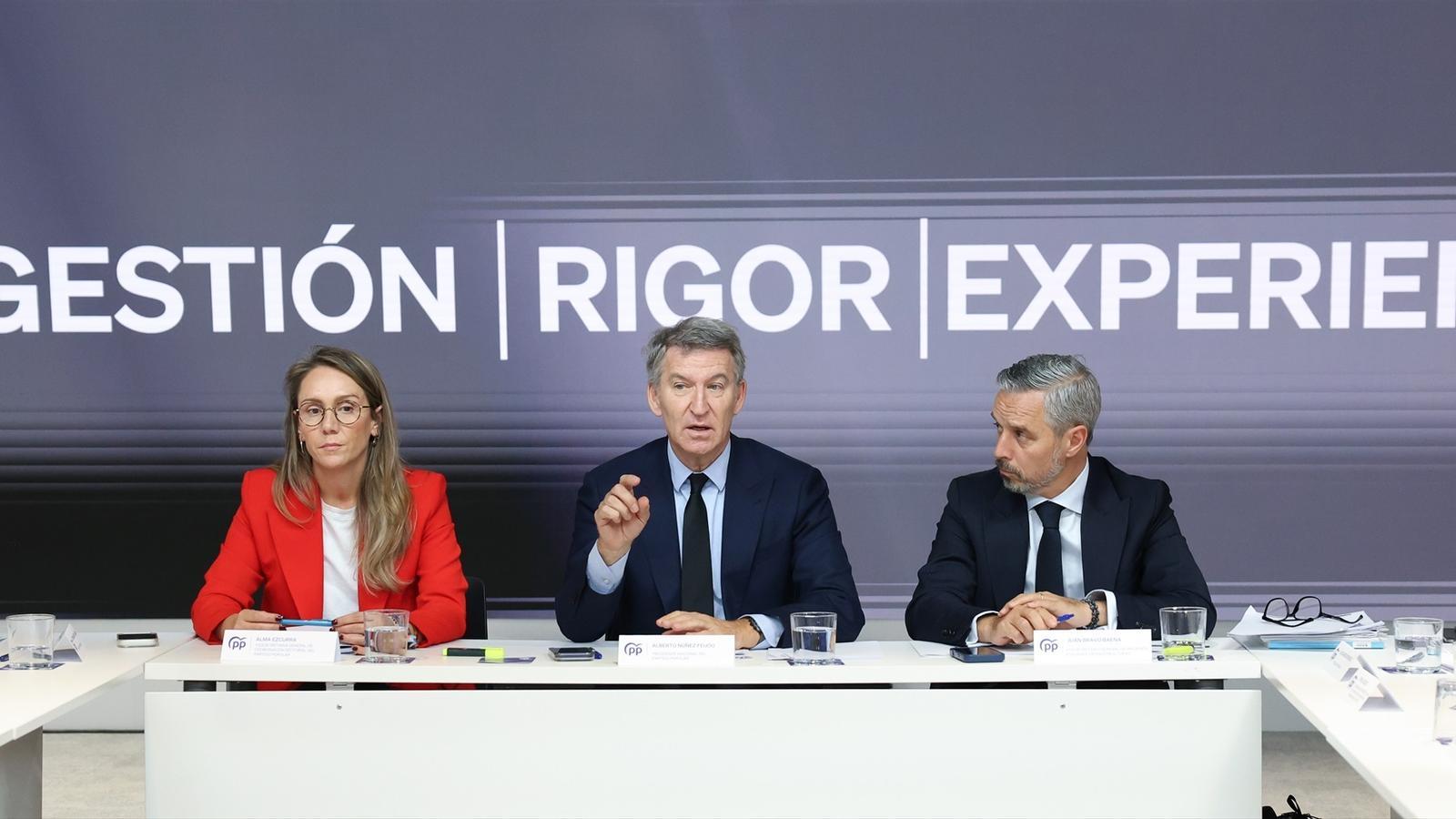
"The image now is management and rigor," explain members of the PP president's team regarding the approach after the tragedy. Feijóo will not resume his agenda normally until Monday. This weekend he is not participating in any rallies, and this Friday he did have an event, but it was focused on the accident and in a format designed to project this presidential image of sobriety. He gathered a group of experts in infrastructure and railway services at the party headquarters. At a lectern placed between two tables where some of the participants of the meeting were sitting, with the Spanish and European flags with black ribbons in the background, Feijóo stood as the guarantor of the "safety" of the railway system.
Génova sources remark that the goal is to make it clear to voters that on November 29th what is at stake is the choice of the next Minister of Transport. "Do they want Sánchez to appoint him again, with more than a hundred deaths behind him, or should Feijóo do it?" If until the moment of the accident the PSOE had bet on conveying an encouraging image with gestures like the kiss between Sánchez and his wife or the appearance on La Revuelta and on the feminist podcast Keep It Cutre, now in the PP they see how the strategy is turning against the socialists and they are reclaiming the more serious and, even "boring," profile of Feijóo. "Management, management and management". A framework with which the former Galician president feels more comfortable and which is the recipe to follow because, as they suggest in the PP leadership, the accident demonstrates that Sánchez has failed in what is truly important and that is that the State functions.
'Reset' starting on Monday
Feijóo will demonstrate that the Toledo accident represents a reset with the convening of the PP's national executive committee, the highest body between congresses, which the party's top leadership, including the territorial barons, will attend this Monday. It will serve to launch the party's new message after the tragedy overturned a campaign that Génova had already carefully planned and defined. Now it will be necessary to rethink it and see, as the days pass, where the PSOE might lose the most momentum and which seats fluctuate the most. Furthermore, this format also avoids the start after the mourning period being a rally in a context that is more conducive to "reflection" or "solitude".
Limited effects?
Ceuta marked the summer headlines and the eviction of Maricarmen Abascal created the opportunity for the PSOE to turn the page on the immigration issue and call elections at a time it thought could be more favorable. However, this has been overtaken, at least for the moment, by the shockwave of the Toledo tragedy. What remains to be calibrated is the effect it may have on the citizens' electoral behavior. Can it be compared, for example, to the 2004 Atocha bombings? Experts foresee an impact, albeit a minor one, on the campaign. Oriol Bartomeus, political scientist and researcher at the Institute of Political and Social Sciences (ICPS), assures that it will affect "the tone of the campaign, the agenda and the topics". Far from any festive character, the coming weeks, as the PP is already anticipating, will adopt "a solemn and contained tone".
There are similarities between the end of Sánchez's term and that of Aznar's second term: both reach the elections with open judicial cases and an event that sets the agenda. However, Bartomeus does not consider it a final point. Unlike 2004, when 11-M took place on a Thursday and the elections were held three days later, there is now one month left until 29-N. "News has the life it has and, although we are 48 hours away from the accident, the news will fade", he explains. The general strike, 25-N, the housing crisis or Blocus are other elements that will mark the campaign. The PP will use the news, but its impact "will attenuate over the days".
Neither Bartomeus nor Lluís Orriols, political scientist and researcher at the Carlos III University, dare to anticipate the electoral consequences. Orriols points, however, to a possible movement of between one and two percentage points of the vote. The management of the crisis and, above all, "the assumption of responsibilities" can condition public opinion. According to the researcher, the Toledo tragedy forces the PSOE to move from an offensive campaign to a defensive one, a fact that "affects the rhythms and the capacity for mobilization".
