Feijóo hands over the Catalan PP to Alejandro Fernández: "Change cannot be made against Catalonia"
The Catalan leader places Juan Fernández as general secretary and Lorena Roldán as spokesperson in Parliament

-
CAT -
CAST
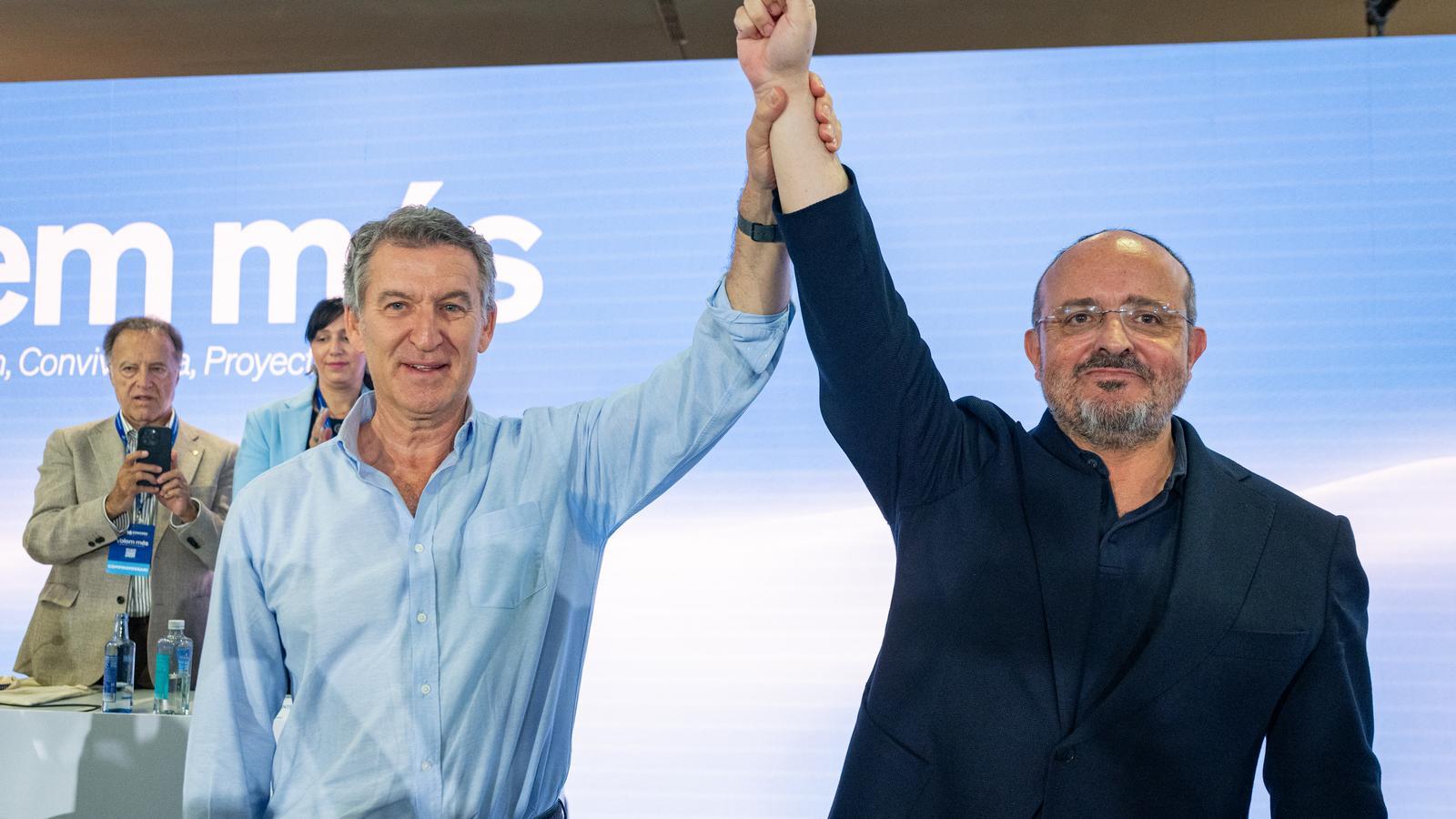
BarcelonaThe most common practice in democratic countries' political parties is to hold elections in governing bodies with a periodicity of usually four years. In the Catalan PP, however, this has not been the case. A four-year extension has allowed Alejandro Fernández to accumulate two terms in one: he was elected in 2018 in Sitges, but the party did not convene the congress planned for 2022. Four years late and despite multiple challenges and public clashes with Alberto Núñez Feijóo's state leadership, Fernández has managed to survive and this Saturday he has been re-elected with 97.51% of the votes in the formation's sixteenth congress, in an enthronement led by the Galician leader at the Hotel Grand Marina in Barcelona. Furthermore, he has managed to impose his entire plan thanks to Feijóo's full approval, but, according to the Catalan politician, this has been done "from unity." However, the state leader has asked him to look out for the party and has sent a message: "Change cannot be made without Catalonia and much less against Catalonia," he stated.
Alejandro Fernández announced in his speech that the current spokesperson in Parliament, Juan Fernández, will be the party's secretary-general and that the alejandrista Lorena Roldán will become spokesperson in the Catalan chamber. A move he desired because Roldán is the deputy most loyal to the Catalan leader, while with Juan Fernández, who is well-connected with the state leadership, he maintains fluid communication. The main tug-of-war in recent days has been for the general secretariat to replace Santi Rodríguez, who has said goodbye by extending his hand to collaborate in whatever is needed: there have been upheavals and alternatives to Juan Fernández had been considered, Alejandro Fernández's option, such as appointing Castelldefels' deputy mayor David Solé, the right-hand man of mayor Manu Reyes. In the end, however, the Catalan leader's plan has worked out perfectly for his interests and the internal balances have been reflected in the leadership.
Therefore, Feijóo sent a message to Fernández: "Any party official must know that they are nobody without their party and the duties are very clear: more mayors, councilors and deputies," he stressed, recalling the congress slogan "We want more." The head of the Spanish opposition has committed to responding to Catalonia's needs "out of conviction," not out of "blackmail," and has asked to open a new chapter after the Procés: "We want to turn the page, we will not forget what the people of Catalonia have suffered. We have learned the lesson and we will not repeat it," he said.
The new leadership
The party's brain, Juan Milián, will continue in strategic general coordination in the Catalan leadership and has received unanimity in the political committee – which "hardens the discourse" – while Solé arrives in the deputy secretaryship of territorial policy, a preliminary step to becoming a deputy in the future. The councilor from Sant Cugat and "alejandrista" Alfredo Bergua will be in charge of the key area of organization, while the chief of staff of the Barcelona councilor Daniel Sirera, Paris Grau, joins the leadership, as does former general secretary Daniel Serrano. In fact, Fernández has asked for explicit applause for Serrano.
A group of "alejandristas" have also joined, such as Fernández's chief of staff, Eduardo Bolaños; the councilor from Sant Feliu, Elisabet Ortega, or the young councilor from Barberà del Vallès, Raúl Collbatallé, and the former president of Societat Civil Catalana, Fernando Sánchez Costa, has been consolidated. On the other hand, deputy Hugo Manchón, close to MEP Dolors Montserrat, or the young councilor from Sant Boi, Natalia Ortega, have joined – the provincial presidents are also there, Montserrat will chair the electoral committee and María de los Llanos de Luna, the committee of rights and guarantees.
"Newspaper chronicles say it is the most placid congress in history," said Alejandro Fernández at the beginning of his speech, which he gave in Catalan and Spanish. In any case, he appealed for "unity," which he said was "essential": "If there were open wounds, they are more than closed; if I offended anyone here, I apologize; if anyone offended me, I swear I don't remember," he assured, with a call for harmony. In this regard, he praised the Spanish general secretary, Miguel Tellado, for "achieving a unity that had not been achieved for a very long time." He claimed affiliation with the PP and not with Convergència, and asked to "lead the change in Spain from Catalonia hand in hand with Alberto Núñez Feijóo" with the will to "rebuild" the Principality and the State – amid criticism of presidents Salvador Illa and Pedro Sánchez–. "Our lives, the nation and the future of all Spaniards are at stake," he stated. Tellado spurred him on, calling him the "best leader" and attacked "all the corruption in the world" surrounding Sánchez.
With the re-election, Fernández will be able to far exceed the reign of Alícia Sánchez-Camacho in the party, who with her nine years as president had been the leader with the most years in office – the current leader has almost eight, and in a year's time she would already surpass her–. However, it does not condition government action, unlike Camacho in the first government of Artur Mas or the also popular ex-president Alberto Fernández Díaz in the final stretch of Jordi Pujol.
From maximum instability to calm
The summer of 2023 Alejandro Fernández declared war on the leader of the PP, Alberto Núñez Feijóo, and rejected any contact or meeting with Junts. At that moment the state leadership had him sentenced, but it postponed the congress to avoid a pitched battle. The dispute continued, but in March 2024, surprisingly, Feijóo rejected other politicians he had sounded out and presented him as a candidate to the Catalan elections, where he quintupled the number of deputies. Last April, Fernández made a step further in a forceful book against the state direction in which it resumed the war, asking for autonomy from the Catalan PP and criticizing Madrid's historical position. Still in 2025, stood up to the Spanish PP congress to veto pacts with Junts, although he finally gave in with a generic wording on constitutional values.
In any case, in recent months he has managed to soften relations with the state leadership, with fluid contact with Tellado, and between this, the good results of 2024 with 15 deputies and that there is no one who wants to dispute his position, Fernández has achieved re-election. He became regional president in November 2018 with Pablo Casado's blessing to replace Xavier García Albiol after a setback, but his executive suffered an avalanche of changes amidst electoral and internal turbulence until the electoral turning point of 2023. Now the path appears more peaceful.
