China celebrates Pedro Sánchez
The Spanish president travels to Beijing to strengthen ties at a time of maximum confrontation with the United States

-
CAT -
CAST
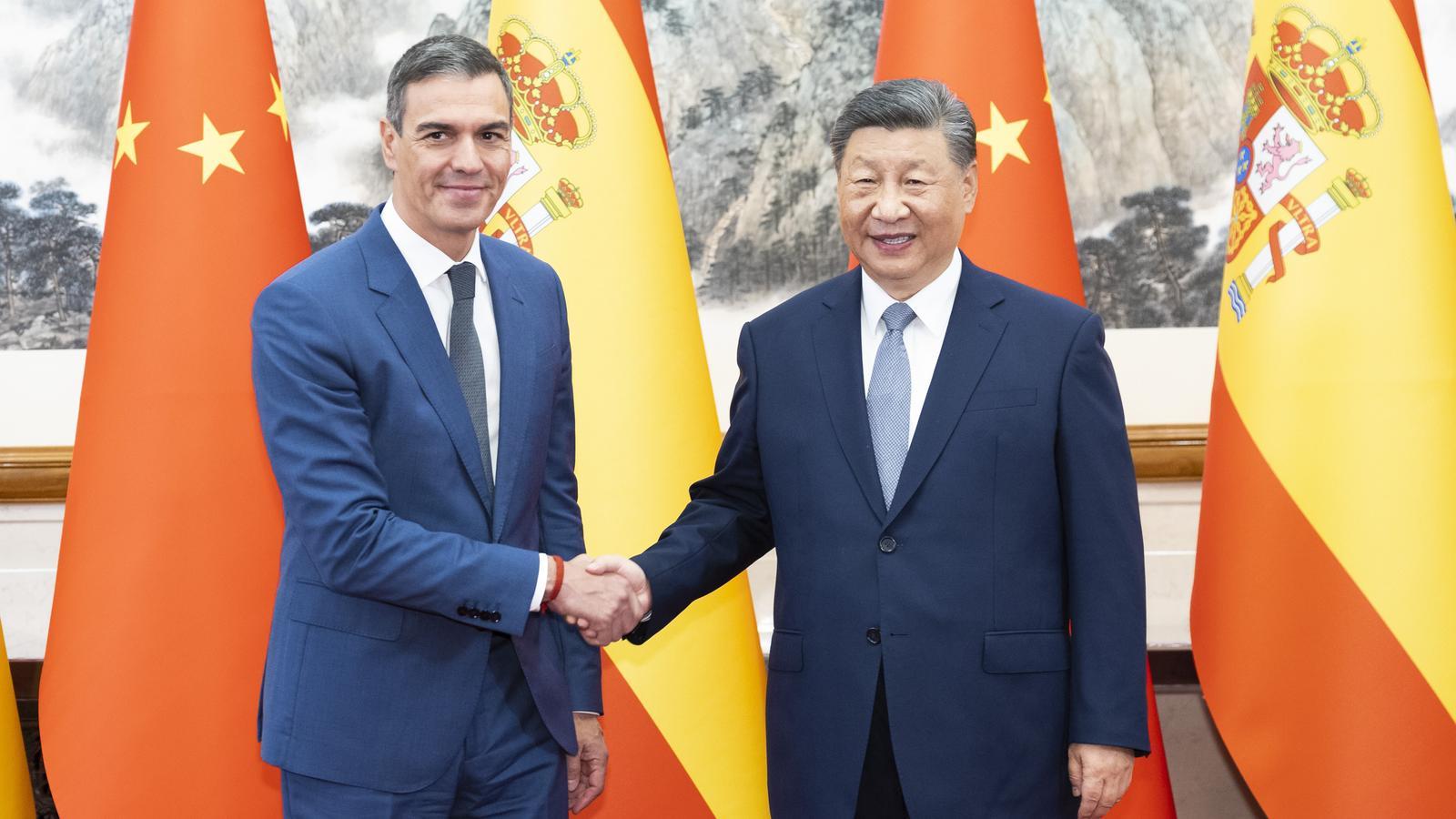
MadridThe visit that Pedro Sánchez is making starting this Monday to China is not like the previous ones. Not so much for the magnitude of the agreements that may derive from it nor because it is an exceptional visit –it is the fourth time he has been there in the last three years–, but for the treatment that the Chinese authorities will give him. It is an "official" trip, qualified as such in diplomatic terms, in which his wife, Begoña Gómez, has been invited and in which a banquet is being organized following his visit to the Great Hall of the People, where the most important diplomatic events take place. Ceremony is not trivial in Chinese culture: for Beijing, forms and staging are very important. The banquet will be the culmination of a visit that will begin on Monday with a conference at Tsinghua University and a visit to the tech company Xiaomi and the Chinese Academy of Sciences, and will continue on Tuesday with a meeting –and the banquet– at the highest level between Xi Jinping and Pedro Sánchez. In the evening, there will still be another meal in the same format with the Prime Minister, Li Qiang.
The Chinese embassy, consulted by ARA, emphasizes the relevance of the trip: "Spain is a key cooperation partner within the European Union –states the embassy– and is committed to continuously deepening mutual political trust and expanding pragmatic cooperation." Translation: more economic relations. For Moncloa, the reception that China will give to the Spanish delegation is also a sign of how the bilateral relationship has advanced –always in accordance with the interests of the European Union, they emphasize– in a climate of maximum confrontation with the United States. The Sánchez vs. Donald Trumpalready globally recognized.
Rafael Dezcallar, who was Spain's ambassador to China from 2018 to 2024 –already during the Sánchez government– and is a diplomat with a long career behind him, points out in a conversation with ARA that the Chinese are "very good" at treating visitors. "The reception banquet is a normal gesture when the Chinese want to be friendly," he clarifies, which reflects the good moment in Spain-China relations. However, he introduces nuances: "They are in a good moment, but there has been a good political relationship for many years now."
For Dezcallar, Spain cannot be swayed by "gestures" and must concentrate on "substance," which involves trying to open up Asian markets to the Spanish economy, a key element for balancing the trade deficit, which is currently very favorable to China. He gives as an example a phrase that Pedro Sánchez himself said when he visited the Boao Forum in March 2023, when he was still ambassador, and where he also met with Xi Jinping: "Let the East open up so that the West does not have to close." In other words, to avoid protectionist temptations, China must also be a market for Europe.
Sources from the Spanish government confirm this desire to increase trade flow. Although they do not reveal whether there will be concrete agreements during the trip, their request consists of asking Beijing to allow a higher volume of agricultural product trade –they make a very positive assessment of the agreements to export almonds and persimmons– and to explore new investments. In fact, the regionalization agreement signed in 2025 allowed the export of pork from free zones to continue despite the swine fever crisis in Catalonia.
However, the final balance is still negative for Spain: while in 2025 imports amounted to 50,250 million euros, exports to China only reached 7,972 million – according to data from the Spain-China Council Foundation. In fact, this is the source of the commercial tension with the European Union, which considers that China practices unfair competition. For this reason, Dezcallar interprets that the Spanish government remains in line with the EU. And he warns:
The meeting with the Chinese authorities, however, will not only be economic, but also comes at a key moment for the war in Iran. Beijing liked the position Sánchez has maintained regarding Trump's attack, but until now he has maintained a low profile. Taking into account that he got involved at the last minute in the truce mediated by Pakistan, Moncloa now expects the Chinese government to play a more active role, also in ending the war in Ukraine, and bypasses issues that may annoy the Chinese government regarding Tibet, Hong Kong or Taiwan. A relevant fact for China.
Sergi Vicente, founder of Compass Spain –a consultancy specializing in relations with China– and former TV3 correspondent for twelve years in Beijing, emphasizes that both countries seek the same thing: respect for international law and stability for trade.
How does it affect the relationship with the United States?
from November in the United States: if Trump emerges weakened, Moncloa can come out triumphant from a risky bet.
And it is that the gears of usual relations have been maintained. Recently, the United States has appointed a new ambassador to Spain, Benjamin León, who has already met with the vice president, Carlos Cuerpo. A meeting that, according to knowledgeable sources, went very well. As a point in favor, the new American representative is of Cuban origin –he went into exile in Miami–, does not have the language barrier, and maintains an emotional bond with Spain for being a descendant of Canary Islanders. Economic data also support normality despite Trump's tariff threats: the US is still the main investor in Spain and bilateral trade amounts to 70,000 million dollars. Yes, there has been an effect on public opinion: according to a survey by Politico, 51% of Spaniards believe that the US is a threat to Europe, while only 25% believe so with respect to China.
The framework of the European Union
Unlike the current situation, Rupérez was ambassador between 2000 and 2004 in the United States, during the time of José María Aznar and when Madrid had a better relationship with Washington – with the alliance for the Iraq War as the maximum expression. In this regard, although he blesses that there is a good relationship between Spain and China, he considers that the Spanish government would be mistaken if it were to place Beijing as a preferred partner. He advocates for waiting for the United States to set aside the "unpredictability" that characterizes Trump and to strengthen, above all, European strategic autonomy to turn the page on dependence. of November in the United States: if Trump emerges weakened, Moncloa will be able to emerge triumphant from a risky bet.
