Pedro Sánchez's new ace in the hole to try and reach 2027
Now the third longest-serving president in the history of democracy, he seeks direct confrontation with Trump and to advance key issues for his allies.


-
CAT -
CAST
MadridFrom the moment Pedro Sánchez arrived at La Moncloa, he has been living in a kind of extra time. The number of times his rivals have written him off or his own partners have issued ultimatums, leaving the legislature hanging by a thread, cannot be counted on one hand. But the PSOE leader is still there, to the point that this week he became the third longest-serving president in Spanish democratic history, behind only Felipe González and José María Aznar. If he completes his term, as he says, he would be second, only behind Felipe González's 14 years in government. However, those at La Moncloa are aware of the hostility they must contend with, especially in Madrid, and of the poor electoral results they will have to face in the short term. Pilar Alegría's disastrous performance this Sunday in Aragon And the outlook isn't good in Castile and León either (March 15th) or for María Jesús Montero in Andalusia (in June). To counter this reality—which has become even more complicated at the beginning of the year with the handling of the railway crisis—Pedro Sánchez's plan involves not only establishing himself as the leader of the left but also becoming the visible face of a kind of cross-party "democratic bloc." To understand the Spanish government's strategy, it's important to keep in mind that for Moncloa Palace, politics is no longer structured along the traditional right-left ideological axis, but is now divided between democrats and a kind of "modern fascism" represented by Donald Trump and the techno-oligarchs—who are in deep trouble. That's why Pedro Sánchez is no longer content with simply competing with Alberto Núñez Feijóo or Santiago Abascal, but is seeking the antithesis with the great leader of this whole wave: Donald Trump. Or Elon Musk (X) and Pavel Durov (Telegram) as representatives of the oligarchs who align themselves with the global far right to conquer Western governments.

This is the political game board that has been set up this week with the announcement, on the one hand, of a ban on social media access for minors under 16, and on the other, by promoting the regularization of migrants that the Spanish government has already approved. US media outlets have echoed this: the New York Times It has covered the decision to regularize half a million people and has also published an article by Sánchez defending the decision: "The West needs immigrants" was one of the key ideas.
Journalist Richard Quest also asked CNN this week why he was moving in the "opposite" direction to most governments on immigration. Sánchez responded: "There is a moral aspect, which is that we have been a country of migrants [...]. And a pragmatic aspect, which is that these people are contributing to Spain's economic success." A completely opposing philosophy to that of Donald Trump's ICE, which he hopes will mobilize the electorate to reverse the polls, which now predict a PP-Vox coalition in the next general election.
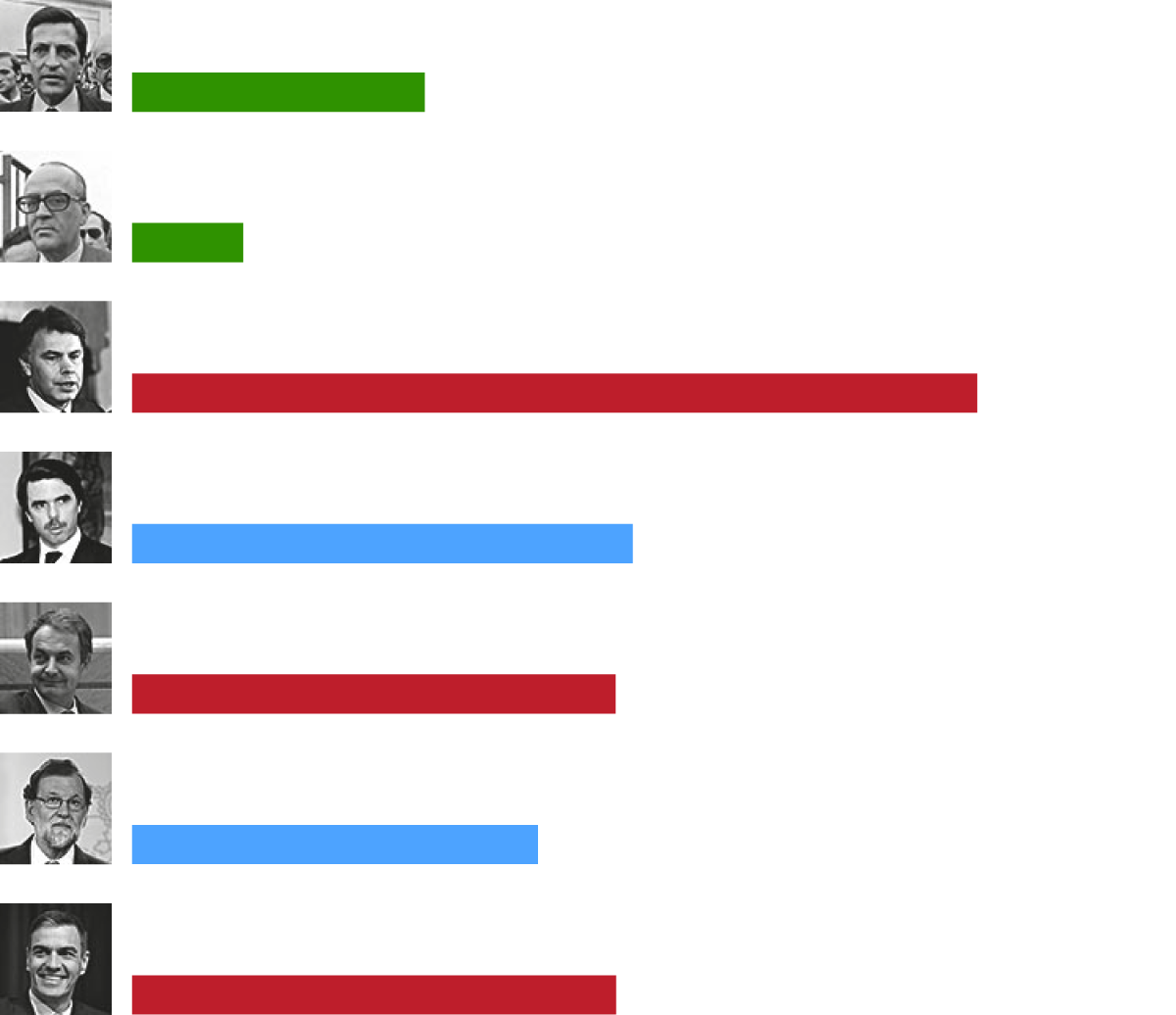
Adolfo Suárez
(UCD)
Del 5 de juliol del 1976 al 25 de febrer del 1981
1697 dies
Leopoldo Calvo Sotelo
(UCD)
Del 26 de febrer del 1981 a l’1 de desembre del 1982
644 dies
Felipe González
(PSOE)
Del 2 de desembre del 1982 al 4 de maig del 1996
4.903 dies
José María Aznar
(PP)
Del 5 de maig del 1996 al 16 d’abril del 2004
2.904 dies
José Luis R. Zapatero
(PSOE)
Del 17 d’abril del 2004 al 21 de desembre del 2011
2.804 dies
Mariano Rajoy
(PP)
Del 22 de desembre del 2011 a l’1 de juny del 2018
2.354 dies
Pedro Sánchez
(PSOE)
Del 2 de juny del 2018 a l’actualitat
2.808 dies
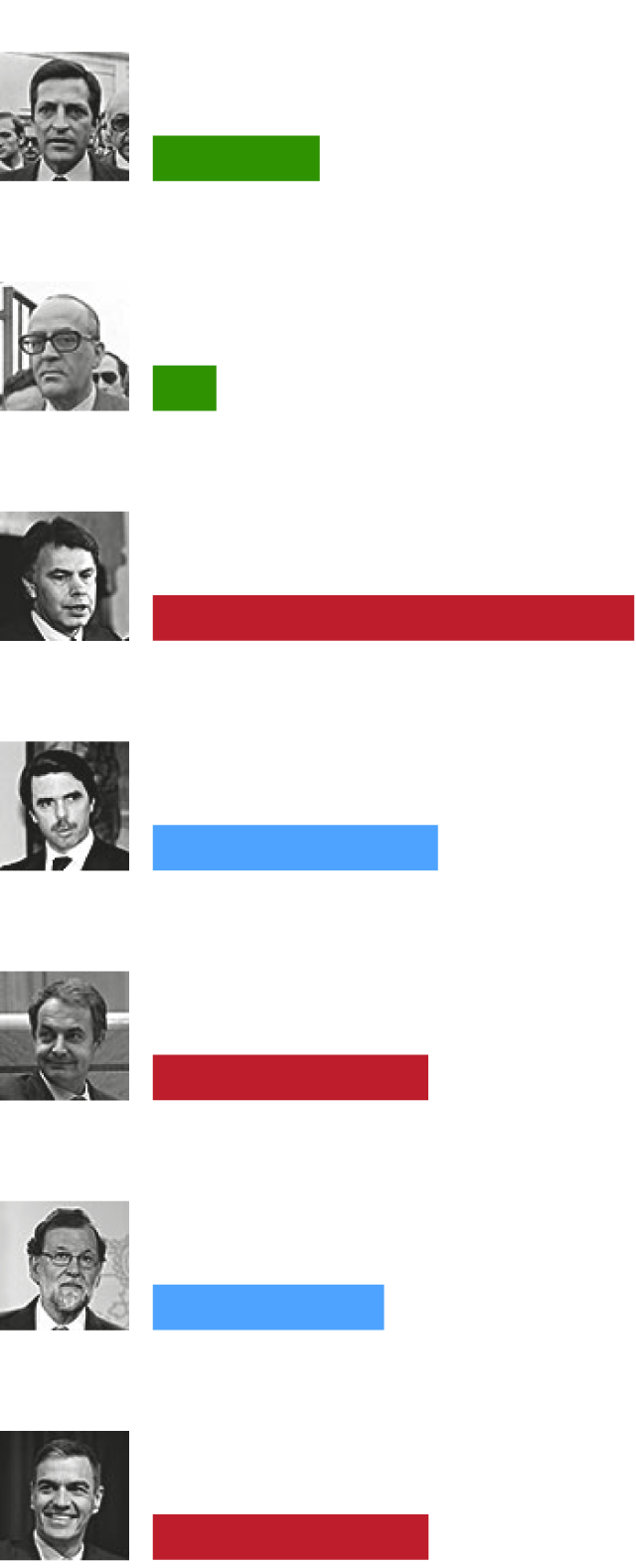
Adolfo Suárez
Del 5 de juliol del 1976
al 25 de febrer del 1981
1697 dies
UCD
Leopoldo Calvo Sotelo
Del 26 de febrer del 1981
a l’1 de desembre del 1982
644 dies
Felipe González
Del 2 de desembre del 1982
al 4 de maig del 1996
4.903 dies
PSOE
José María Aznar
Del 5 de maig del 1996
al 16 d’abril del 2004
2.904 dies
PP
José Luis R. Zapatero
Del 17 d’abril del 2004
al 21 de desembre del 2011
2.804 dies
PSOE
Mariano Rajoy
Del 22 de desembre del 2011
a l’1 de juny del 2018
2.354 dies
PP
Pedro Sánchez
Del 2 de juny del 2018
a l’actualitat
2.808 dies
PSOE
Adolfo Suárez
Del 5 de juliol del 1976
al 25 de febrer del 1981
1697 dies
UCD
Leopoldo Calvo Sotelo
Del 26 de febrer del 1981
a l’1 de desembre del 1982
644 dies
Felipe González
Del 2 de desembre del 1982
al 4 de maig del 1996
4.903 dies
PSOE
José María Aznar
Del 5 de maig del 1996
al 16 d’abril del 2004
2.904 dies
PP
José Luis R. Zapatero
Del 17 d’abril del 2004
al 21 de desembre del 2011
2.804 dies
PSOE
Mariano Rajoy
Del 22 de desembre del 2011
a l’1 de juny del 2018
2.354 dies
PP
Pedro Sánchez
Del 2 de juny del 2018
a l’actualitat
2.808 dies
PSOE
Innovation with Together
Beyond the rhetoric, in practice, the key ingredient for trying to finish the term is the parliamentary partners. Sánchez is accumulating no small number of problems with the plurinational majority: those in Moncloa are aware of the difficulty of coordinating a majority with many ideological differences, and the clearest example of this has been this week with the separation of the omnibus decree for the increase in pensions and the anti-eviction measures, which are still not guaranteed due to Junts's opposition.
However, at the beginning of 2026, Sánchez has tried to revive key issues for the parties that support him. At the beginning of January, he posed for a photo with Oriol Junqueras and presented the financing model agreed upon with Esquerra; he has reached an agreement with Podemos on the regularization of migrants, and next week he will push through the law against repeat offenders that Junts has been demanding for some time. This law, moreover, has already generated a lot of anticipation at the local level: both a delegation of mayors from Junts and from the PSC will be in Congress to advocate for it, since they all have an interest in capitalizing on it in the lead-up to the 2027 municipal elections.
It is with Carles Puigdemont's party that the PSOE... Since the Junts party decided to sever ties with the Spanish government last October, there have been no direct negotiations. This has forced Pedro Sánchez's team to innovate in parliamentary politics: finding indirect interlocutors—primarily the Basque Nationalist Party (PNV)—or floating trial balloons in the media to gauge how Miriam Nogueras's party reacts to certain announcements. They also try to gauge which measures, ideologically speaking, Junts might welcome, or they follow the playbook of the Brussels agreement (with all the outstanding issues) to determine which buttons to push to appease Puigdemont's party. A formal communication channel does exist, however, through which the Secretary of State for Parliament, Rafael Simancas, relays information to Nogueras regarding parliamentary initiatives.
This type of indirect flirtation, where the PSOE clearly understands what Junts wants and the Junts members simply wait for the other side to make moves, is the same system they will follow regarding the delegation of immigration powers already agreed upon by the two parties, a move that defeated Podemos in Congress.
With the regularization announced by Sánchez, Ione Belarra's party is now open to discussing it again, despite having labeled the proposed law "racist." Does this mean that a traditional negotiation is underway? No. Sources within Podemos explain that their commitment to the PSOE was to demonstrate their willingness to negotiate in exchange for the regularization of migrants, while Junts demands that Podemos retract its position and explicitly defend the position that Catalonia should assume these powers without altering the wording of the law. So, how will this impasse be resolved? The PSOE assumes that they will engage in a new indirect dialogue. They are confident that if they manage to secure the delegation of powers and Puigdemont's return in the spring is possible, in addition to making progress on financing with Esquerra Republicana – which will benefit Salvador Illa in the Catalan government with a budget in Catalonia – they will be able to give the legislature the necessary veneer of stability to reach 2027. Even if it means not approving the national budget.
No alternative
Sources at Moncloa Palace don't hide the difficulty of dealing with the realities of this legislature, but they are convinced that their partners have no option but to support Sánchez. The alternative offered by the PP and Vox is far worse for their interests, they emphasize. This is illustrated with a graphic metaphor: regardless of where the groups of the plurinational majority come from, they must all pass through the same roundabout, which is the PSOE, to continue advancing their program. Because—returning to the beginning—the Spanish government interprets all the groups of the plurinational majority as part of this "democratic bloc" that Pedro Sánchez wants to lead.
