Can the leaders of the Procés be pardoned for a second time?
The Supreme Court's refusal to amnesty embezzlement reactivates the path of a second clemency measure to lift the disqualification of the former ERC president
-
CAT -
CAST
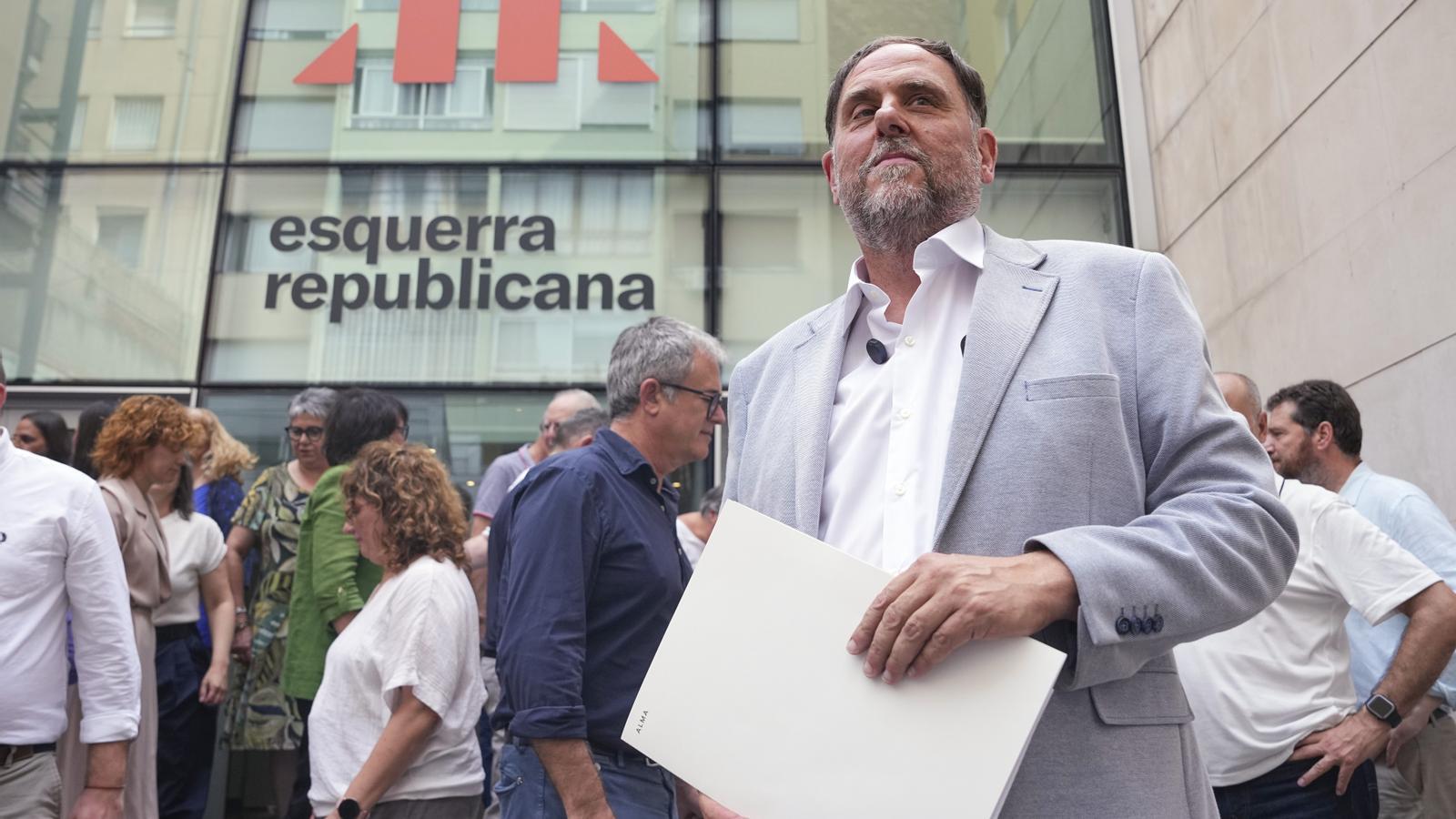
BarcelonaThe uncertainty about the application of the amnesty law to the leaders of the Procés has left a judicial labyrinth open. Waiting to see if the Supreme Court will apply the CJEU ruling, within this labyrinth there is a path that is still unresolved and leaves an open question: in case of a hypothetical non-application of the amnesty, is it possible to open the file for a second pardon to erase what was left pending? At the time, the Spanish government partially pardoned the leaders of the Procés – it was the only possible way after the sentencing court opposed the measure of grace – that is, they forgave them the prison sentence, but kept intact the disqualification penalty that affected Oriol Junqueras, Jordi Turull, Raül Romeva and Dolors Bassa, who were also convicted of embezzlement. This disqualification, for example, prevents the current leader of ERC from running in an election –as he has shown himself willing to do– or to teach.
A private individual requested a second pardon for the four former councilors, a request to which the Supreme Court has already opposed, but which the Ministry of Justice must resolve. According to jurists and academics consulted by ARA, the answer does not allow for many nuances. Josep Maria Tamarit, professor of criminal law at the Open University of Catalonia (UOC), is blunt: "This issue, from a legal point of view, is quite clear. Yes, he can be pardoned again." However, the mechanism to do so does not consist of a simple correction of the past. Tamarit clarifies that "pardoning him again would not be a modification or an extension of the pardon, but rather the government can and in any case should do, if that is the decision it makes, is another pardon decree".
The legal framework governing the right of grace in Spain is almost a relic. The pardon law dates back to 1870, in the 19th century, and in practice does not establish any limit on the number of applications that the same person can make. Thus, as the consulted experts rightly point out, the Council of Ministers has "no limitation in establishing a pardon", beyond complying with the procedural and formal requirements of this century-old law. Among other issues, a new file would have to be processed, reports (non-binding) requested from the sentencing courts, and it would have to be approved by decree.
This executive decision, however, can be appealed, as was done in the case of the pardoned Catalan leaders of the Procés, to the contentious-administrative chamber of the Supreme Court. Tamarit details that the reasons for annulling it "would be basically of a formal nature", and adds that "if it is justified and there is a purpose that is adequately motivated in the decree, there would be no reason for the Supreme Court to annul it".
The usual partiality
Experts agree that the figure of the pardon is scarce. "The pardon is a prerogative that is not given too much," states Josep Lluís Martí, professor of philosophy of law at Pompeu Fabra University, "and, furthermore, it is frequent to pardon partially, although it does not mean that the majority of cases are."
Thus, in the case of Junqueras, by not extending the pardon to the entire sentence, the Spanish government ensured a direct political effect: "Surely there was the idea that he could not pursue a political career for at least the years he was disqualified," states Martí. A practice that the expert highlights as "frequent in many cases of political corruption".
The police precedent
The figure of the double pardon, however, is not new to the Spanish prison system. The State has a precedent where two pardons were granted to the same individuals to adapt to the "needs" or "interests" of the moment. This is the double pardon of four members of the Mossos d'Esquadra, in which, according to other consulted sources, Josep Antoni Duran i Lleida, then spokesperson for Convergència i Unió in Madrid, was heavily involved. In 2009, the Supreme Court had convicted them of torture after they beat a citizen in 2006, threatened him, and put a gun in his mouth, mistaking him for a robber.
In February 2012, the Spanish government (led by the PP) granted them a first partial pardon that reduced their sentence from four years and six months to only two years in prison, hoping that, having no prior convictions, they would avoid incarceration. However, the Barcelona Court ordered the execution of the sentence for reasons of "social alarm" and prevention. To avoid this, in November 2012, just a few weeks before entering prison, the Council of Ministers granted a second pardon to the police officers. This time, their sentence was commuted to a fine of 7,200 euros (ten euros daily for two years). An episode, described as a "huge scandal" at the time, which demonstrated the use of re-pardoning even though the Court had warned it could be a "fraud of law".
