Can elections be manipulated in Spain?

-
CAT -
CAST
Barcelona[This analysis was originally published on May 11 and has been updated on October 6, once Pedro Sánchez has already called for elections and the PP and Vox have once again warned of the risk of electoral fraud]
The short answer to the title of this news story is no. The long one allows for nuances, such as, how much money and infrastructure does the politician or party that wants to manipulate the elections have? To alter the results, there is only one remotely viable option and it is not the one that both Vox and Isabel Díaz Ayuso have been insinuating for some time. The path would be to buy enough elected deputies to turn the election results around. But, of course, electoral fraud would be extremely difficult to hide. Can you imagine ten PSOE or PP deputies voting against their candidate?
We will never know –but we will always suspect– what happened in the Madrid Assembly in 2003, when two socialist deputies abstained in the decisive vote to make the PSOE candidate, Rafael Simancas, president. "I didn't get paid anything," Eduardo Tamayo, the great protagonist of the tamayazo, has been repeating ever since, which led to the repetition of the elections and Esperanza Aguirre ending up as president of the community. If the PP had wanted to manipulate those elections –the popular party members have always denied it–, the best moment would have been precisely that one: they needed exactly two socialist deputies to renounce their party.
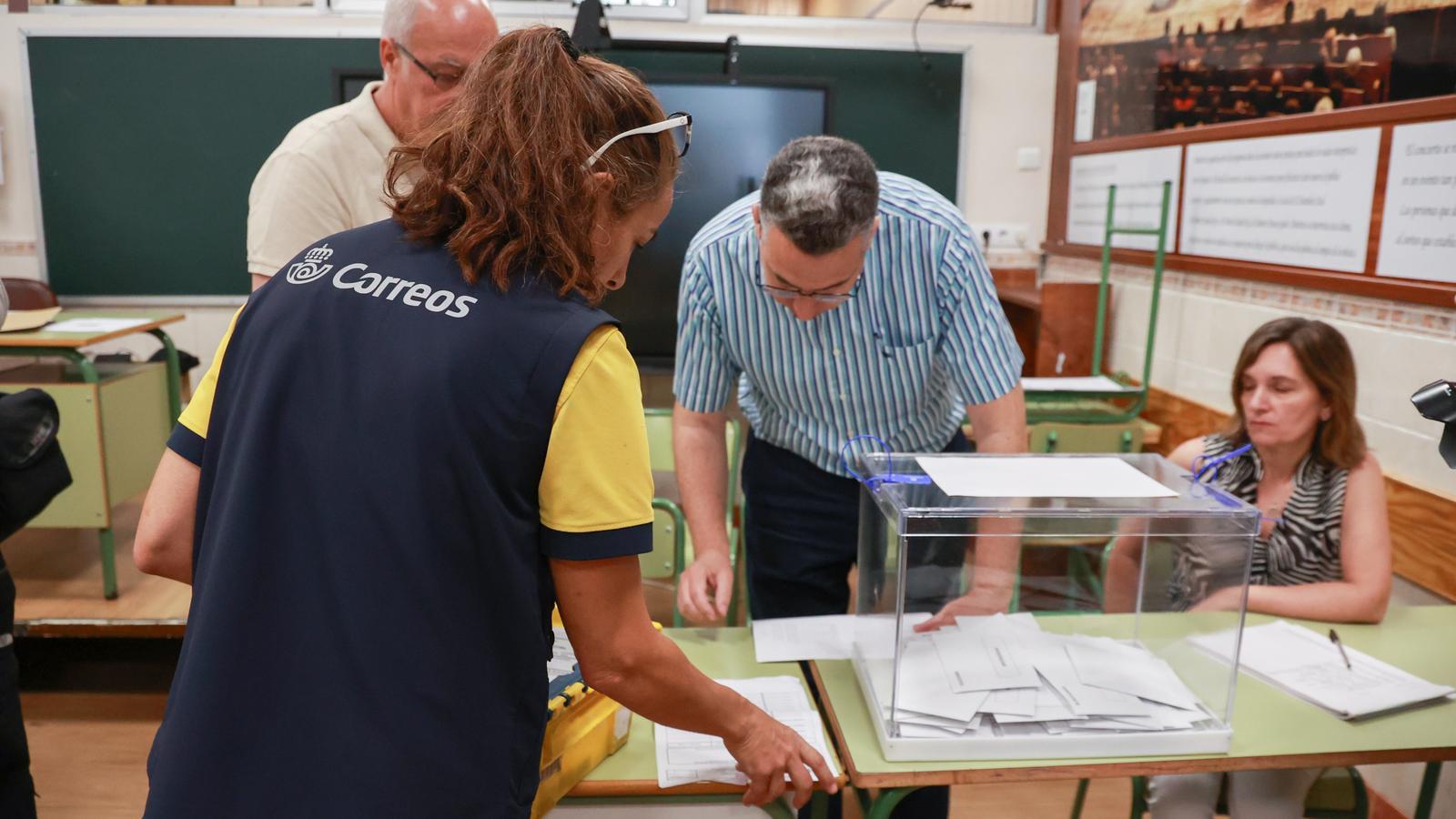
But this is not what the PP and Vox are talking about today, as they point out that Pedro Sánchez might be preparing to "buy" the next general elections. How? They say by altering the electoral rolls with the massive incorporation of immigrants or by controlling mail-in voting. Is this possible? "The elections are absolutely secure," explains Ismael Peña-López, the former head of Electoral Processes of the Generalitat, to ARA. How can he be so sure? In the first place, because "the postal service (Correos) is impregnable." "Changing one vote might be easy, but many more would have to be changed, and to do it with 1,000 or 30,000 there would have to be so many people involved that it would be noticed," he explains. Mail-in voting, moreover, tends to be a small part of the total. Be that as it may, Ayuso has recommended to her followers that "they shouldn't even think about voting by mail."

Regarding the regularization of migrants, the extraordinary process opened in the State does not grant nationality and, therefore, neither the right to vote. And in the case of the naturalization of up to 2.5 million relatives of those exiled by Francoism (basically in South America) thanks to the Democratic Memory Law, it is a way to obtain a European passport. The electoral participation of expatriates –especially those who were not born in Spain– is minimal and the possibility that they do what Vox insinuates –that hundreds of thousands who do not even know each other strategically choose the constituencies where they register to alter the results– is little more than science fiction. Furthermore, if the postal vote represented 10% of the total in the 2023 elections, that of residents abroad did not rise above 1%. How can a general election fraud be built with 1% of the votes?
Thousands involved
And concentrate electoral fraud in polling stations or in the company that centralizes the data? Buying votes from voters en masse would be so expensive that no party could afford it, but furthermore, since the vote is secret, they wouldn't even have guarantees that their investment would be profitable. In Catalonia, a polling station can manage between 500 and 1,000 votes. How many dozens of polling station presidents and members would have to be bought for it to be efficient? In each school, moreover, there are observers and representatives from each party who, in theory, would also have to be in collusion.
And Indra, the company that centralizes the information from the stations, receives it in an encrypted database that it cannot edit. Error or manipulation on a small scale would be possible. Doing it with enough force to change the results is entirely impossible. "Those who insinuate the manipulation of elections are part of anti-democratic movements interested in sowing things that they believe they will be able to harvest later," opines Peña-López. Casting doubt on the credibility of institutions is the first step.
The details of the week

This week details have begun to be given about the Pope's visit to the State. At the headquarters of the Episcopal Conference, in Madrid, a journalist from Rac1 asked the Archbishop of Barcelona, Joan Josep Omella, about the Camp Nou, generating a whisper and some grumbling among the rest of the journalists. It was not because it was the Barça stadium, but because the question had been asked in Catalan. "I think that almost all of you understand Catalan when it is spoken by an Aragonese like me," replied Omella, eliciting some laughter in the room.
Borja Sémper, the "moderate" of the PP, has reappeared this week after overcoming cancer. At the event, there were some retired politicians, such as Albert Rivera and Begoña Villacís from Ciudadanos. The former candidate for Madrid was seen being very effusive greeting journalists, entering arm in arm with Cuca Gamarra and, in the end, sending an audio explaining that she was very happy to have returned to politics for a day.
