Ayusism gets tangled up with Catalan at the Círculo Ecuestre
The deputy spokesperson of the Madrid PP joins forces with the Catalans Fernández and Milián

-
CAT -
CAST
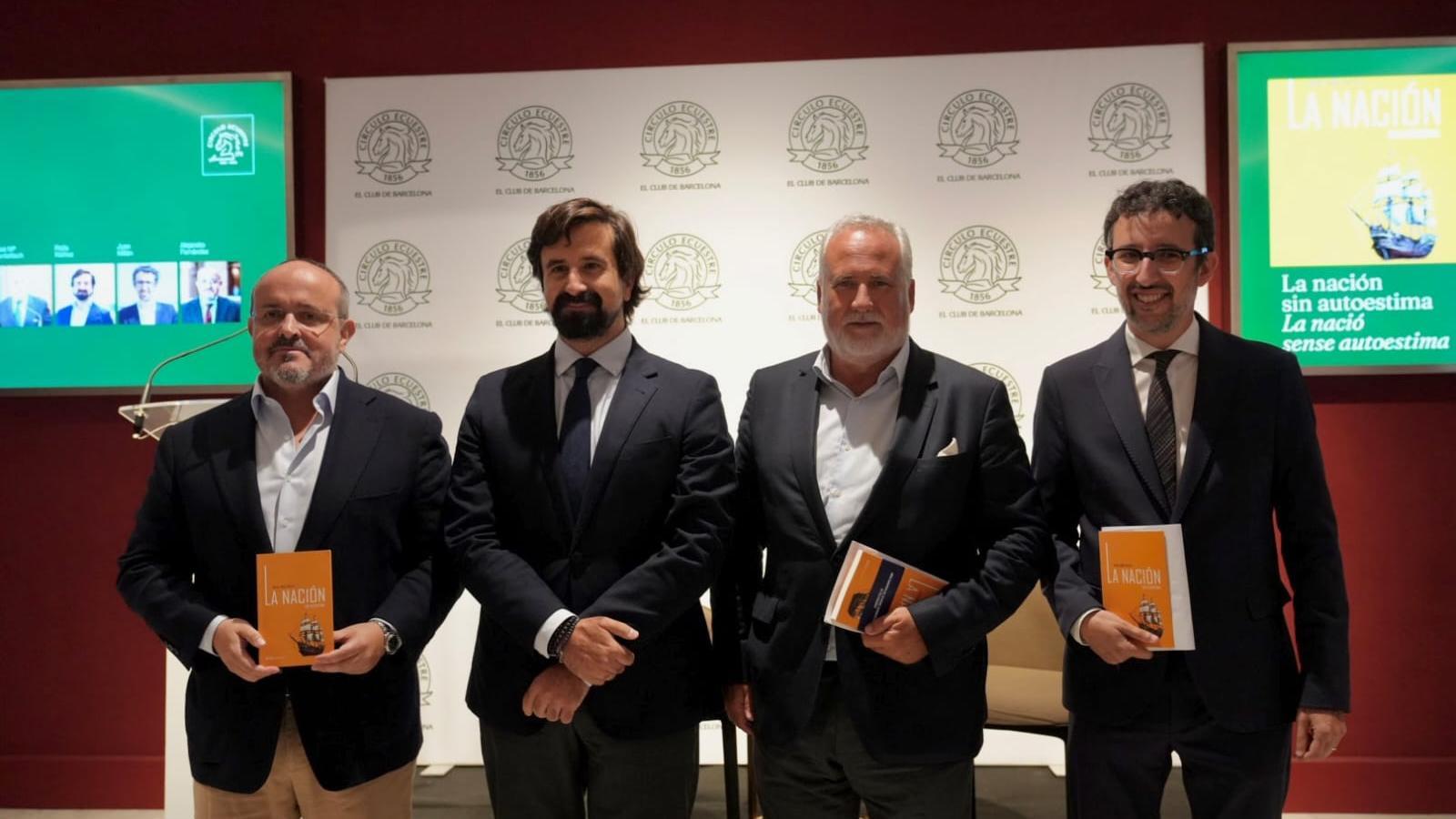
BarcelonaSpain, the lack of self-esteem and Spanish nationalist fervor marked this Tuesday's colloquium at the Círculo Ecuestre, where languages were the protagonists. "Ayusism" fully permeated the Barcelona club in front of about sixty attendees, and served to comment on the existential obsessions typical of a nation-state that is not France and refuses to be Switzerland. It did so with a key person from the Madrid president's inner circle, the deputy spokesperson for the PP in the regional Parliament, Rafa Núñez, who created the Vox brand but was signed in 2022 by Isabel Díaz Ayuso. He was accompanied by the leader of the Catalan PP, Alejandro Fernández, and the party's brain and senator Juan Milián.
Núñez has released a book, La nación sin autoestima (CEU Ediciones), and took the opportunity to present it in Catalonia with the help of Catalan "Ayusism," the Spanish-leaning liberalism embodied by "Alejandrism." This has caused the eternal debates to emerge, especially the linguistic one. It happens that Núñez is Valencian and a "Valencian speaker," and when he spoke of languages other than Spanish, he only mentioned Catalan, Basque, and Galician, which implies that he assumes the unity of the language, which only radical "blaveros" deny for political reasons. Even so, he chose to use Spanish.
"Spain is not France; it is very diverse," he warned. And he went fully into the language issue, which, in fact, was the main concern of the members committed to Spain, several of whom declared themselves Catalan speakers. Núñez defended his "opposition to separatism," but also to "cultural homogenization," and admitted that it is necessary to promote the so-called "regional languages." However, he made reference to the fact that their "use," "to the extreme," can lead to "separatism" and admitted that there is "a debate to be resolved regarding languages in Spain" in the face of the multilingual challenge.
After the "authoritarian, hostile, insensitive, Castilianist" stage and the "homogeneous conception" of Francoism, he relates that "the State has accepted linguistic plurality more than the autonomous institutions such as Catalonia, where there is only one language of power". But he has admitted that "Catalan is de facto just as Spanish as Castilian" and that all in all, really, "it is a highly complex debate due to the mistreatment that was inflicted upon regional languages during the dictatorship", but also due to "the almost pornographic use that separatism has made of languages" and which makes things "more difficult", in his view. More complicated in the steps towards multilingualism.
Beyond this mess, he made a fierce defense of Spanish "patriotism", with a lexical game: "Let us make the concession that I would be a Spanish nationalist; in this political dispute, my nationalism is superior to Catalan nationalism because it is inclusive, and the other is exclusionary", he said. The crux of the difference would be that his "nationalism" encompasses "heterogeneity" and not the uniformity that he attributes to Catalan nationalism.
Be that as it may, the obsession of the Valencian-Madrilenian is the propaganda of Spain through cultural products, and he analyzes all the great ills of the State through the prism of "lack of self-esteem". Torrente, the TIA from Mortadelo and Filemon, and other clichés are some of the ills that prevent Spaniards from fully believing in their potential, according to Núñez.
Fernández has also vindicated the "well-understood patriotism" of Núñez –who has declared himself an admirer of the Catalan leader–, and has criticized "those who want to buy people's souls with handouts". He has also applauded English and French patriotism, which has no "fear of being called fascists", and has delved into the Transition to admit "a vision of the nation of free and equal people stripped of identity". The "black legend", according to Núñez and Fernández, has been one of the great evils that has affected Spain, its self-esteem and projection –that is to say, the narrative about the Spanish genocide in America.
More right-wing
The Círculo has become "more right-wing" thanks to Núñez, who has claimed the rightward shift of Milián as his own success. After Milián highlighted that they have reached consensuses in the think tank they share at the national leadership on Génova street, Núñez summarized the gradual turn of the Catalan senator. "In reality, he is saying that I have made him more right-wing," he let slip with a half-smile, while the Catalan admitted that he has become more "conservative." But, in the end, the "patriotic" vision of Ayusism always returns: "If we exclude Lithuania from the history of the world, nothing happens; if we exclude Spain, everything changes," he concluded.
