United in difference

-
CAT -
CAST
"United in difference, we are unstoppable", stated Juan Carlos Rivero at the closing of RTVE's broadcast of the match between France and Spain, considered by many to be the true World Cup final. Beyond the fact that this grandiloquent cliché seemed to be part of the string of responses with which the governmental orbit reacted to Rajoy's few-hours-old sincerity about the French, it is worth asking to what extent this appeal was not only about football but also about politics. In this second scenario — worse things have been seen — and taking for granted the existence of an "us" that allows us to go "united in difference", perhaps we should ask ourselves: to do what? Only to reinforce the sense of belonging? Perhaps it would be better to unite to improve Rodalies, to complete the Mediterranean Corridor or to achieve, once and for all, railway interoperability. Or are we to unite to colonize institutions, protect relatives or raise walls against immigrants, against the right, or against anyone who aspires to a political alternation in Spain? I confess that doubts are piling up.
Let it be known — call me naive — that I am one of those who think that, in the end, football is football and that any attempt to extrapolate what happens in a stadium to the realm of politics is a manipulation as crude as it is old. I have enjoyed the Spanish national team's game as much as anyone; it is as true as that, before seeing them make a fool of themselves in the World Cup, I was a fanatic of Messi and Argentina. And for that reason, I do not like Milei's excesses, nor do I stop considering that, in general, Argentinians are as handsome as they are annoying. One thing does not take away from the other.
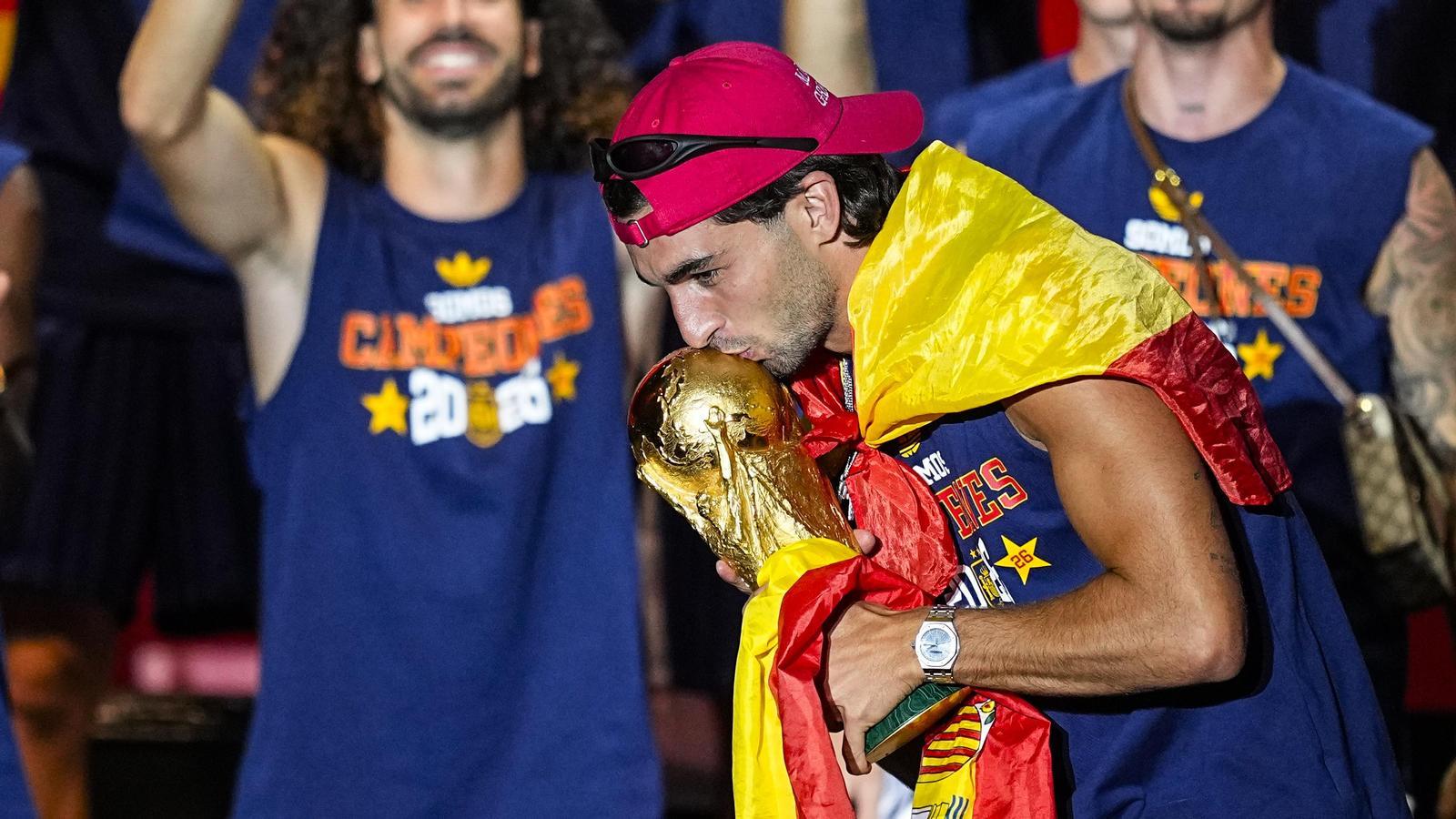
If what is at stake, on the other hand, is to use the Spanish national team's good footballing moment — and the fact that eight of its twenty-six players are from Barça — to take another step in the eternal project of Spanish nationalization, I honestly think we should unmask the plotters. Being part of Spain, like any other country in the world, must be a reasoned and desired decision, not a sentimental induction.
I am fully aware that my position carries an inherent contradiction, since the years of the Process, if not from the first day I was born. Much as I would like to be part of a national community united solely by civic friendship and the purpose of leaving this world better than we found it, I find no one who defines their nation solely by voluntarist criteria: as simple consciousness and will to be. And even less so from a humanist purpose. However rational and pragmatic we may be, cultural —tribal, if you prefer— reasons and, even more so, self-interested motivations —economic, political...— end up prevailing. It happened during the Process in Catalonia; it is happening with Spain's Ibex and with the MAGA in the United States. You start thinking big, convinced you are living a foundational moment. And you end up raising walls of resistance, sweating behind a banner in Fossar de les Moreres. Or, even worse, in Colón square preaching nonsense or, like Rajoy and the members of Aliança Catalana, showing their xenophobic shame.
Assuming these limitations, I believe that political Catalanism should persevere in the virtues that have historically distinguished it: pactism, pragmatism, respect for institutions, and the conviction that the progress of all requires shared responsibility. Always on the side of talent and of a society that thrives through work; admiring individual genius, but aware that the general interest is a collective construction. In fact, isn't that also what has made this selection a winner?
The slogan "United in difference" is only convincing if there is a shared project, because difference, by itself, is not a political virtue; it is a pre-existing and persistent reality. What turns a diverse society into a community is the existence of a common purpose. Without this horizon, the phrase is reduced to an advertising slogan. We will see who will continue to defend it when football results turn sour or when the balance of power in Congress no longer makes political Catalanism essential for governing. I will continue to believe that it is better to unite not so much for what we are as for what we want to be.

