The true railway problem of Spain

The accident in Adamuz, in Andalusia, in January and the one a few days ago in Toledo are different. With the reservations imposed on us by the urgency of the analysis, we can say that the first was caused by insufficient maintenance of the infrastructure, of the rail, while the second occurred due to a human error in the emergency system, that is to say, what is usually called procedures and practices.
In recent years, of the annual investment in high speed, the percentage dedicated to maintenance in Spain is close to 16%, while in France, Germany and Italy it is between 34% and 40%. It would be necessary to know what the investment per kilometer is in Spanish high speed and in that of these similar states in order to reach conclusions, and it is to be expected that Minister Puente will mention it in his appearance before the Courts on Tuesday. But we know that for the railway network as a whole (high speed and conventional trains) Spain invested 95,857 euros per kilometer in 2022, when the European average that year was 191,092.
It is not acceptable for the safety level of the emergency system, which is what replaces the standard system when it fails, to be lower. Human error must be impossible. It must be prevented by the automatisms that remain in operation when the main safety system has failed. It seems that there is a deficiency in the emergency protocol on this point. The level of safety must be the same, not lower than in the standard system, as the Toledo accident has made clear when a train was cleared for departure that was just a few kilometers away from another that, as its driver warned, could not move.
However: the Spanish railway system, which serves three different and differentiated needs (medium and long-distance passenger transport, freight transport, suburban/commuter rail), has different organizational, investment, and operational problems, but it must be said clearly that none of them have to do with the Toledo accident. Let us try to analyze it.
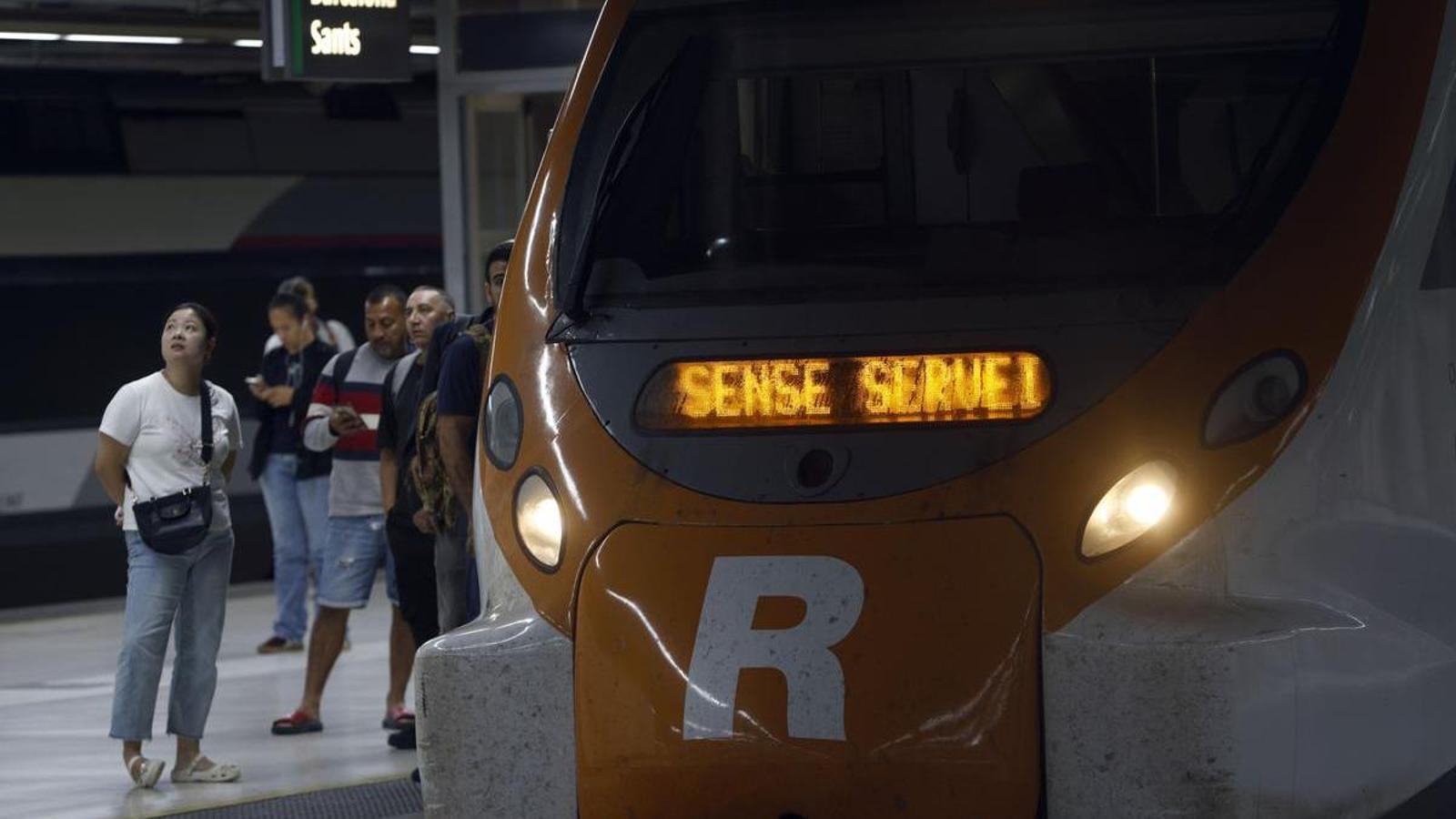
Regarding medium and long-distance passenger transport, the EU requires that the administration of the infrastructure (tracks, overhead lines, and security systems) and that of the trains (rolling stock) be under different authorities. Hence Adif and Renfe. This allows trains of public ownership such as the AVE and also private ones such as Iryo to circulate on a single public infrastructure, in free competition and for the benefit of better service and lower cost. Well, one of the problems I want to point out is that applying this principle to Rodalies is absurd. In Rodalies, having competition is not important, but good service, punctuality, and safety are. Collaboration between the management of rolling stock and that of infrastructure is necessary and constant. Traffic conflicts, more frequent than in medium and long-distance travel, make it advisable for both management functions to be under a single authority. This is how it is done at the Ferrocarrils de la Generalitat, to the full satisfaction of passengers and public administrations. The question is, therefore, if this works and logic recommends this organization, why will Adif and Renfe be maintained when the service is transferred to the Generalitat? Who forces this is the sole corporate union for each of these companies, which controls the activity by more than 90%. The union's strength derives from its control of the activity, which it does not want to lose.
In Spain, rail traffic, port stevedoring, and air traffic are three services with very similar characteristics. The groups across Spain consist of about 7,000 people for each. In Catalonia, about 500. They control a critical activity that, if stopped, can paralyze the country. Hence their strength. The threat of strikes has always paralyzed the reform to free the service from the union's conditioning, under both right-wing and left-wing governments. In fact, in the transfer of Rodalies to the Generalitat, Adif and Renfe were initially not to be maintained, but the union's strike forced the central government and the Generalitat to change the model to follow the union's dictates, maintaining Adif and Renfe even though we know demonstrably that it is not the best management model. This allows the union to maintain control of the service as it does now. It is what it wants, and it has achieved it.
The uniformity of the railway gauge with Europe for freight and long- and medium-distance passengers is necessary to facilitate circulation (so as not to have to change trains). For Rodalies (commuter rail), this gauge change is not necessary, because it is a service independent of the general network. In the cases of Catalonia, Madrid, and Valencia, this is the case.
Maritime traffic coming from Asia through Suez passes through Gibraltar to reach European ports located in the north of the European Atlantic coast: Antwerp, Rotterdam, and Hamburg. Three ports that are located at the mouths of three great European rivers, the Scheldt, the Rhine, and the Elbe, which allow for river traffic that distributes goods to the center and south of Europe. This traffic could stay in Algeciras if there were a direct railway connection with France, a Mediterranean corridor from Algeciras to Portbou. But it has not been done. Morocco has built modern ports in Tangier and Nador that today have a traffic of 15 million TEUs (the standard and universal unit of measurement for maritime transport; as a reference, Barcelona moves 3 million TEUs per year). Spain has lost this traffic in 20 years for two reasons: stevedoring in Spain is inefficient, because the cost is double that in Morocco, and we do not have a direct railway connection with France, which means there is no advantage in the port of discharge being in Europe (Algeciras) over Africa (Tangier).
The railway is the solution for land transport in Europe. We need it to be efficient, safe, and with little impact on the environment. After more than 40 years of service, we must invest in improving and maintaining it. On the Waterfront, the film about the mafia-like behavior of a stevedores' union in an American port, is from 1954. Misunderstood corporate and trade union policies should be a thing of the past.
