"You can lose your marbles": A walk with Gabriel Rufián
We walk with the candidate of Esquerra through the city where he was born, Santa Coloma de Gramenet
-
CAT -
CAST
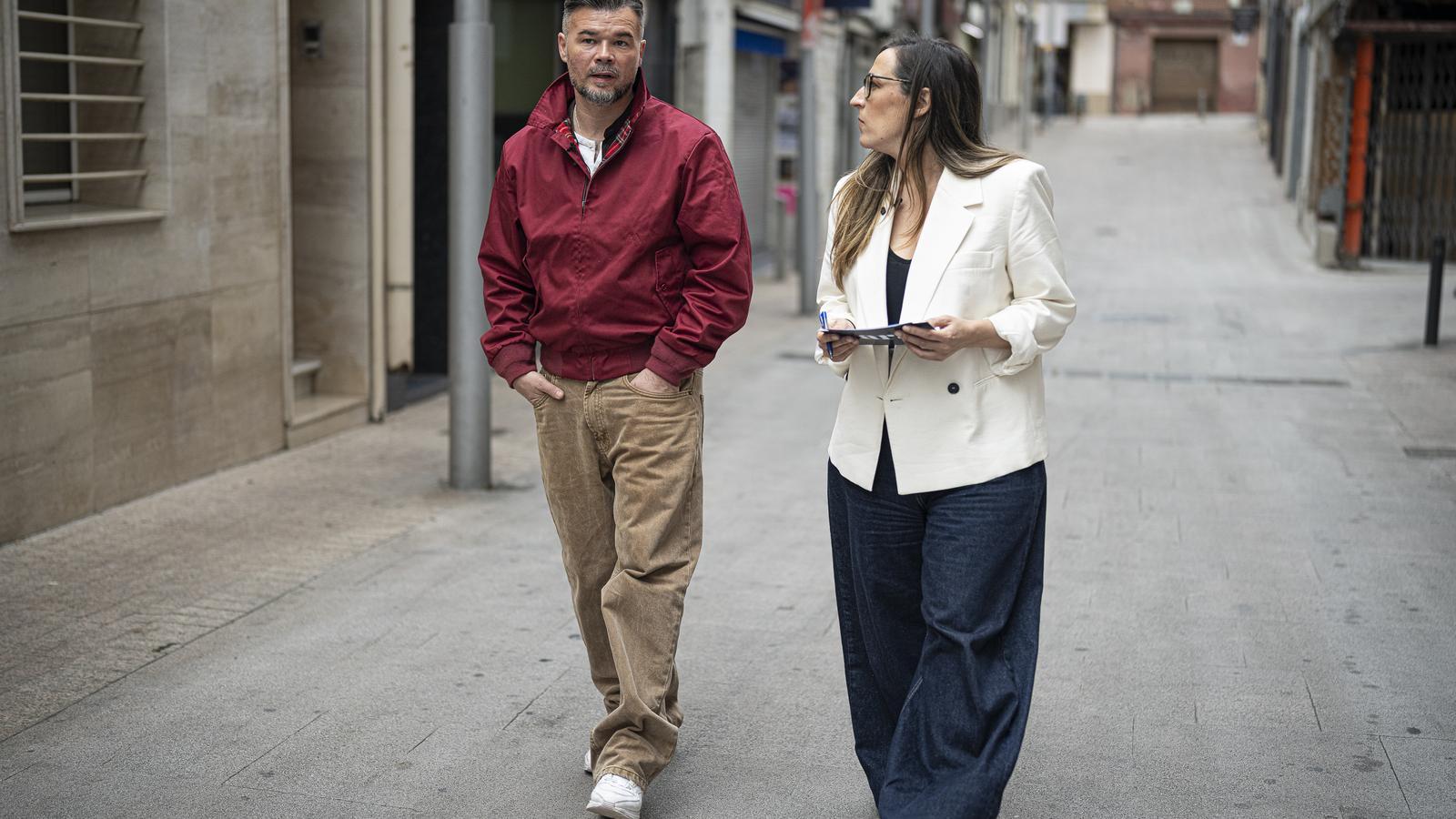
Let's be clear; none of the politicians we have interviewed so far get stopped the way he does. As we walk through Santa Coloma, the city where he was born 44 years ago, a woman comes out of a fruit shop: "What a joy to see you, Rufián." "Now they'll think this is staged," he replies. Another asks for a photo. Even the youngest ones, who with most candidates look like they don't know who they are, pull out their phones to record him. "You're a bit of a rock star", I tell him. "I go to and from work and I live surrounded by normal people. Otherwise, you could lose your mind," he responds.
We are in the Town Hall square. Today, a concrete esplanade with terraces and a playground. Years ago it was a large dirt area where Gabriel Rufián spent many hours playing. He was often accompanied by his paternal grandfather. "Look, they lived right there," he says, pointing to a nearby street. His grandfather was a bricklayer, the other grandfather –his maternal one–, a taxi driver. And the grandmothers worked at home, like so many women of their generation, in unpaid labor. They were all from Andalusia. He explains that his parents had a sewing workshop, and adds smilingly that "it was a clandestine workshop, where they made fur coats for the rich men and women of Barcelona".
We walk through one of the streets next to the town hall. He talks about school, about how his classmates called him Juanga, because his name, the one on his ID card, is Juan Gabriel, and he admits to us that yes, he hung out with the troublemakers but he got good grades.
Did you hear Catalan here? No, here Catalan was only the academic language. In fact, he explains that in Catalan classes they asked the questions in Spanish. "But today it is the language I speak with my children. And I am translating, you know? While I speak I am translating from Spanish. But I have chosen to speak it."
He has two children: one Basque and one Catalan. "Where do you live exactly?" I ask. Answer: "On the plane." I try to be more precise. "But do you come here, to Santa Coloma?" He makes a face that shows he doesn't like this topic. An expression he will repeat later in the strictly political conversation. "My aunt lives here, and my cousin, whom I see every other day, does too. I already know what is being said, and I don't care. So many things are said." I imagine that "what is being said" is that he lives in the Basque Country. He wraps up the conversation by saying that he has family in both places, and that where he has never lived is in Madrid.
In the Spanish capital he often has to endure the ultra-agitator, Vito Quiles, who follows him with a camera to make viral videos. “He is a harasser and a provocateur. And on top of that they say that I am delighted and that I am of cronyism with him…”, he laments.
“Have you ever been afraid?”. He answers very quickly yes. And he explains that he has been hit three times. “Who?”, I ask. It is not known. He has never reported it. “Why should I do it?”, he asks himself. I tell him that, if it is not reported, there cannot be consequences. He says that he has also explained it to the press, and let's see if this time it gets published.
We head back towards the square. We pass by the fruit stall, and he explains that he takes care of himself because, otherwise, he has a tendency to gain weight. And that he does a lot of sports, especially running. “I memorize speeches while I’m running. I have learned speeches by Companys, by Macià, by Seguí, by Pujol…”. Pujol. I think about the image from the year '88. Some protesters demanding improvements in public transport threw stones at the car of the then-President of the Generalitat. He got out and confronted them. Specifically, a man who was wearing a red sweater and whose name was Gabriel. What coincidences, life.
We sit in the middle of the square to begin the political interview. Two girls who are in the square approach with their mobile in hand. Yes, yes, it is him. Without a doubt, the rock star of the electoral candidates.
