Ceuta and demographics
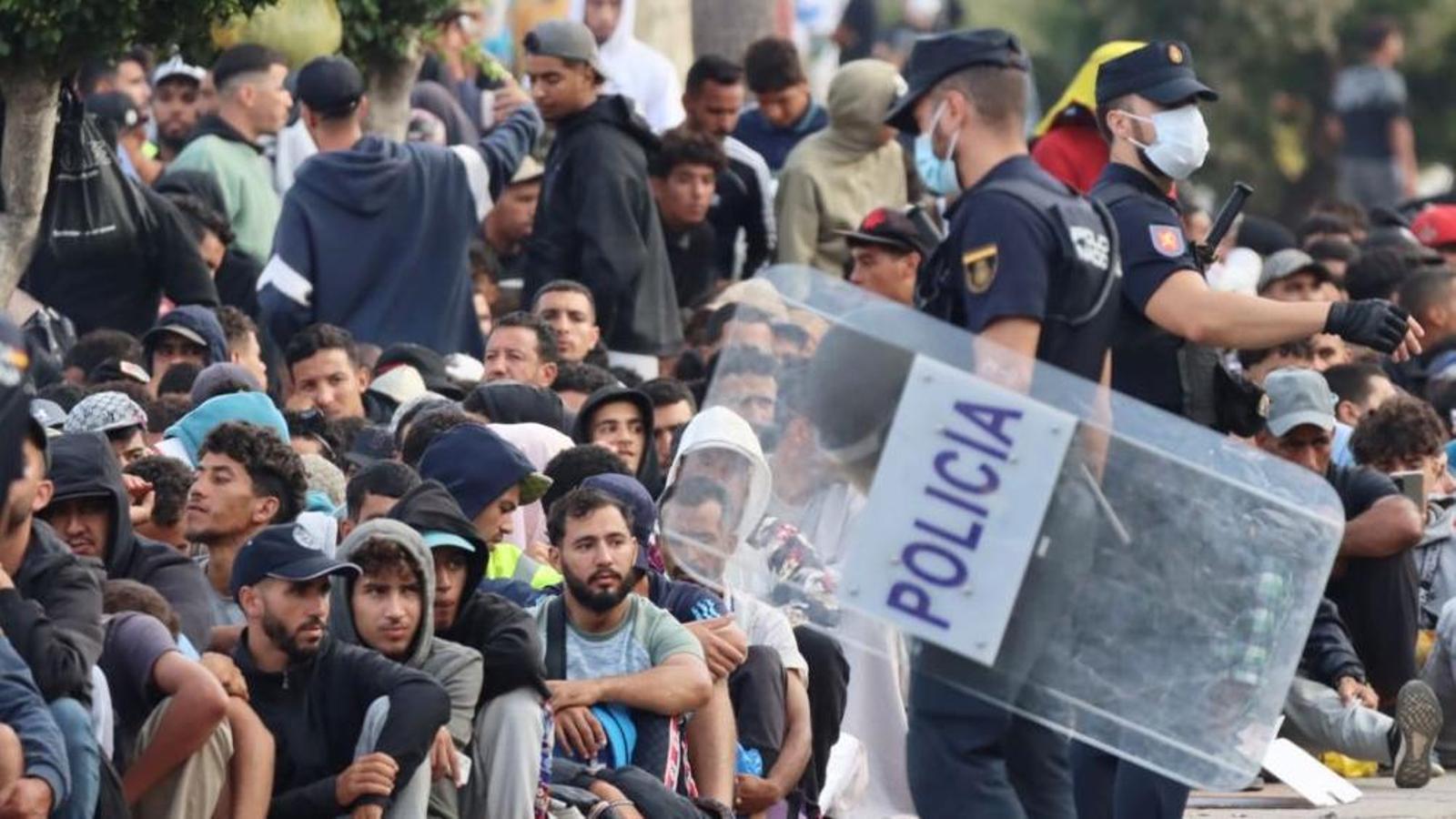

The situation in Ceuta is not the result of any “migratory crisis”, as the left maintains, nor of a “sovereignty crisis”, as the right affirms. These two readings — one focused on the humanitarian drama; the other, on border pressure — are ideological and convenient interpretations. They do not take into account demographic dysfunction: the structural fracture between two realities advancing at completely different paces. On one side of the border, the risible birth rates in Spain and other European countries, such as Italy; on the other, the fertility of some regions of the Maghreb (4.63 children per woman in Mauritania, for example). Ceuta is, in this sense, a tense point of contact between two demographic systems that can no longer balance themselves. Everyone knows how tectonic plates work (we've had a few examples this summer): there comes a point when, underground, friction and pressure eventually generate an earthquake.In Spain, the fertility rate has remained below replacement level for decades. There is an accelerated aging, with an age structure that tends towards contraction and requires migratory flows to sustain the labor market, the pension system, and even the most basic social vitality. In Morocco, on the other hand, despite the significant decline in recent years (even more pronounced in Tunisia), the birth rate remains high compared to European standards, and the demographic pyramid is expansive. The average fertility rate in the Maghreb is 2.86 children per woman; in Spain, it is 1.10, and with an average age of maternity of 32.6 years, one of the highest in the world. This asymmetry generates an inevitable pressure: a young, abundant population, often without solid economic prospects, looks towards a neighboring country that continues to be fantastically perceived as a space of opportunities.Due to its condition as a physical and symbolic border, Ceuta has become the showcase for this tension. When thousands of young people crossed the border a month ago, they were not experiencing a "migratory crisis" in the classic sense, nor an attack on Spanish sovereignty, nor an invasion. They were corroborating in an abrupt, but non-violent, way the relentless logic of the imbalance that has been developing for decades in that precise context (it doesn't have to be this way in others). Administrations can try to contain it with honeyed speeches or threatening fences, but the underlying vector is subterranean: the difference between societies that are growing in population but not in resources, and societies where the opposite is happening.
Ever since he predicted the fall of the USSR in detail a decade before it happened, demographer Emmanuel Todd has insisted that these kinds of dysfunctions are not spurious phenomena, but serious indicators of far-reaching geopolitical transformations. When two neighboring regions evolve demographically in different directions, the result is not just migration: it is the reconfiguration of power and the displacement of centers of gravity, that is, the redefinition of cultural and political borders. Todd has shown how changes in fertility or family structure anticipate mutations that later manifest as crises, wars, revolutions, or territorial rearrangements. In this sense, Ceuta is not an isolated episode, but the symptom of a process that is unreservedly challenging the European Union, not just the city of Ceuta or Spain. In Brussels they understood this from the outset: Europe finds itself facing an African belt that continues to grow demographically, but not economically. Divergence generates a pressure that no migration policy can ever fully neutralize: borders are points of contact, but also, inevitably, of friction. What we are seeing in Ceuta, in short, is the materialization of a demographic gradient that, sooner or later, will force a rethinking of the relationship between Europe and its southern neighbors.While public debate focuses on immediate management —whether to reinforce the border, whether to welcome, whether to (re)negotiate with Rabat, etc.—, the real problem is that Europe and the Maghreb no longer share the same vital rhythm. A world that is aging —unsustainable even in the medium term— facing another that is rejuvenating cannot maintain a stable border without tensions. Ceuta is, therefore, a warning: it reflects European fragility. And, as Todd would warn, when demographic imbalances become persistent, they end up transforming the geopolitical order.
