Anna Vallejo, Enna Vera i Eloi Orihuela: "We must stop conceiving of the intervention of lawyers as an exclusive service"
Lawyers and partners of Era Cooperativa
-
CAT -
CAST
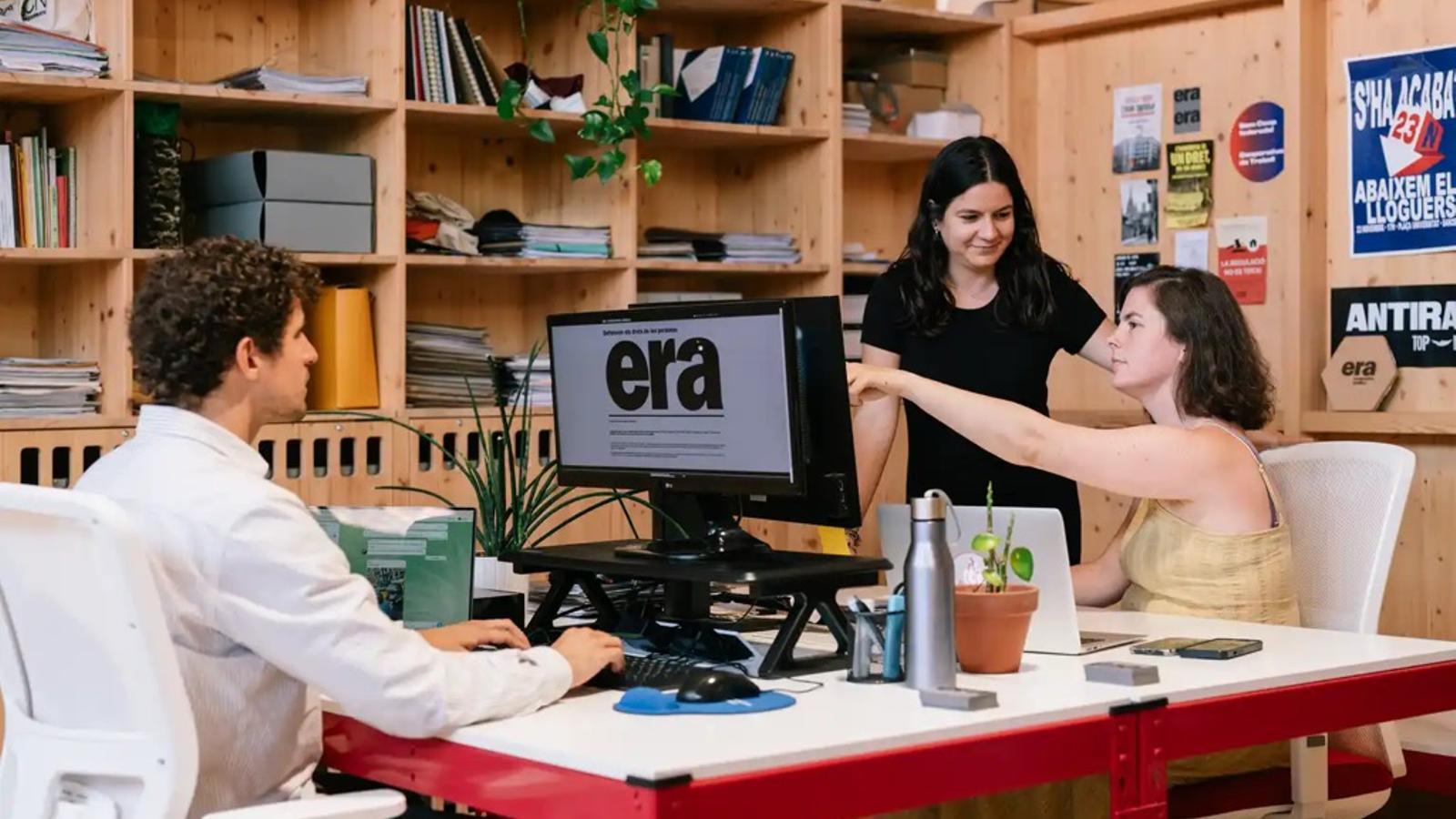
Era Cooperativa Jurídica was born in 2021 from the concern of two lawyers who not only wanted to focus on the technical and strategic part of their profession, but also wished to give it a social imprint and, at the same time, humanize the figure of the lawyer. Anna Vallejo and Enna Vera have not only achieved this goal, but with the recent incorporation of Eloi Orihuela to the team, they have further consolidated the three areas that focus their activity: housing law, workers' rights, and the fight against gender-based violence.
What were the social deficits linked to the profession that acted as the spark for the project?
— We missed a vision of the profession from a social point of view. More than a role of a very formal, technical, distant and, ultimately, inaccessible person, the lawyer's role needed to be a social figure. If we wanted to do something different, we had to constitute ourselves in a different way, and we found the answer in the cooperative format. We sought to collectivize our work in every sense and to do so through a horizontal structure. The objective of Era Cooperativa was not to obtain dividends and distribute them among ourselves, but to be able to focus on people and for them to have access to quality and proximity legal advice.
Why is this democratization of law crucial and why should this law be clear, close and understandable?
— Because we need to stop conceiving the intervention of lawyers as an exclusive service, an image to which the dress codes within the profession, the highly technical language, etc., have historically contributed, and ensure that legal support is a universal and accessible right for all citizens. We fight head-on against this, because we know that we can act with the same professionalism but in a more accessible way. We also advocate for working closely with our clients, as we provide the necessary tools to resolve the legal conflict. But the conflict belongs to the clients and sometimes it greatly affects their lives. We need to accompany them and ensure that they understand what is happening to them in order to find a solution together. More than the role of a very formal, technical, distant, and ultimately inaccessible person, the lawyer's role should be that of a social figure with all the legal knowledge.
Does this concept of the profession make you more selective when choosing cases to accompany?
— Legal advice acts as a social tool when it transcends the mere resolution of a specific conflict and seeks to transform unjust structures. A person needs a roof, needs a salary, and needs care, which are the three areas that focus our activity and from which many other branches derive, such as family law. And these are areas in which we must position ourselves. And this does not mean that we want to set ourselves up as an example of morality for anything, but there are situations in which we, obviously, always know which side we are on, and in the face of conflicts that are structural, we try to act as part of the solution and not the problem, whether it is defending the homes of tenants, the jobs of workers, or the lives of people suffering from male violence. Being able to say no to taking on certain things is a privilege we enjoy due to having our own project, and also a responsibility resulting from linking our work to the social sphere.
And what does this social responsibility you print in your work imply?
— We focus our strategy heavily on the problem: we highlight and contextualize the person's entire journey. We ask ourselves where the conflict originates and analyze the problem from this perspective. Law becomes the tool that allows people to be citizens in the face of conflict, because it is the final point in resolving this conflict.
What are the short-term challenges you are facing?
— We believe that the challenge for any cooperative in a capitalist society is to consolidate itself and not disappear. In the end, we are a very small project fighting against giants who precisely use all possible tools to have more profit. We try to survive and have a salary for the partners, all equal, with conditions for a working day that is adaptable to each one's situation without abusing the situation of any of us, trying not to take on issues that are detrimental to the common right of society. And this has a cost because projects are often less profitable. The challenge after five years, therefore, is to continue contributing to weaving alternatives to the dominant economic model, generating decent employment and putting legal knowledge at the service of the common good.
What social impact would you like your work to have, in this regard?
— We would like to become a cooperative that people turn to when they need legal advice, and also to contribute to ensuring that everyone has access to knowledge and the protection of their rights. We, as a cooperative, are aware that society improves when there are places where people can go to get advice, organize, and collectivize everything, not just in terms of housing, and that is where we want to be present and collaborate.
