Prades embraces astrotourism
The success of a town dedicated to the observation of the night starry sky

-
CAT -
CAST
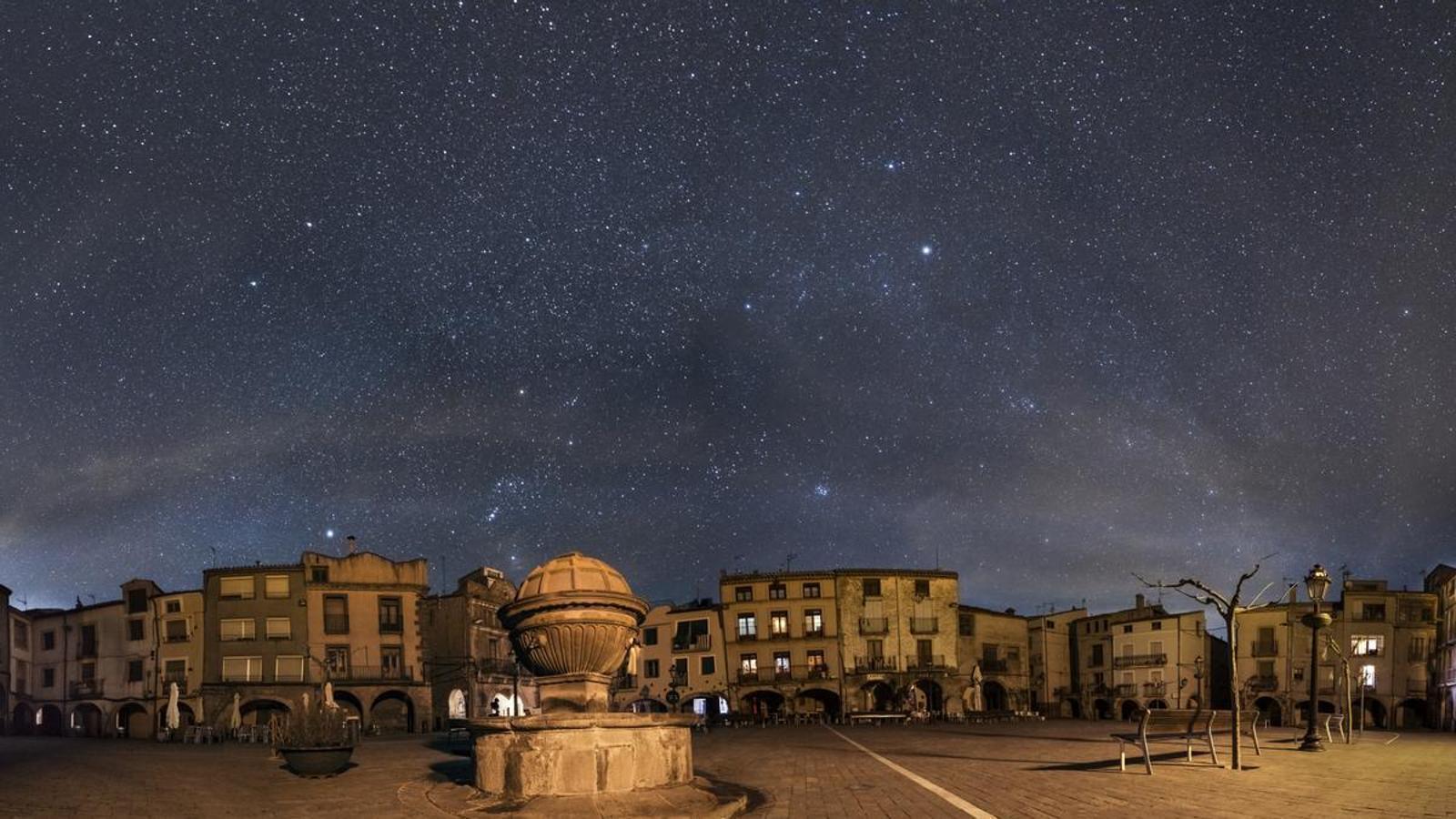
PradesWhen he was little, Aleix Roig was fascinated by observing the night sky. In the library of the Sabadell Astronomical Association, he found – and devoured – a book about how to build a telescope with simple materials. He didn't think twice: with a long drainpipe and some mirrors, he built his first window to the universe. Aleix began to study physical sciences, but he left it half-finished: "I wasn't motivated to spend my whole life in front of a computer," he says. Then he studied teaching. He worked for a few years as a primary school teacher. With his students, he often did practical astronomy exercises.Aleix didn't dislike taking classes in Catalan, Spanish, Art... In addition to science classes. All this stole his time to cultivate his hobby. Until he thought that hobby and profession could not only be compatible, but also add up.Then he began to search with his partner for the best night skies in Catalonia to set up an observatory. "One of the areas we liked the most is the Prades mountain range," explains Georgina Serven, Aleix's professional and romantic partner. "Here we are at almost 1,000 meters altitude and there are no other elevated points around. We are on a kind of plateau, which provides good image stability (seeing), day and night. Imagine you are inside a swimming pool and looking out with glasses. If the water is dirty or disturbed, you see nothing. Here, in Prades, it's as if we have clear and calm water," explains Aleix Roig, who is a Starlight auditor, of dark skies, that is, skies with no light pollution. What a beautiful job, to travel the world certifying the best night skies!Aleix and Georgina didn't have it easy to make the Muntanyes de Prades Astronomical Park a reality. Just when they were about to open it, the world stopped: the pandemic arrived. This was not the only setback: the town was illuminated with white lights, which are the ones that cause more light pollution. They managed to get the City Council to replace them with less polluting ones. The council also supported them with the proposal "Prades turns off the lights and turns on the stars". This idea of turning off the streetlights (how beautiful they are with hanging flowers!) in the Plaça Major so that it would be very dark... the mayor, of course, saw it as a dark prospect. But in the end, she decided to go ahead with it. And it was a great success. Seeing the starry sky (with telescopes) from the Plaça Major in Prades is a real privilege. "Prades turns off the lights and turns on the stars" is an activity that is still carried out from time to time.The promoters of the Muntanyes de Prades Astronomical Park have also set up a sky brightness measuring device, SQM (Sky Quality Meter), at the Tossal de la Baltasana – the highest point in the region – and at the Prades center, at the Astrocat Observatory, a meteor detection station, which studies, among other things, comet tails.Furthermore, they organize a lot of courses in astronomy, astrophotography, trips to different points on the planet to see auroras borealis or dark skies, dinners with stars – with a waiting list of three or four months–,a night photography contest, observations with telescopes and sessions in a 360° planetarium. Today I was able to get to know the sky of Prades from this modest planetarium, located in the center of the village (they also have two inflatable ones that travel around Catalonia). Right after, we headed towards a sky observation point. It's getting dark, and just as we pass by a dirt road, some little lights magically turn on on either side. As we advance, the houses disappear and we enter the darkness. At the observation point, we lie down on some loungers and enjoy a very starry sky.Finally, with Aleix we take a walk through the town, quite lively. The element stellar is the main square. It is certainly large, this arcaded square, considering the dimensions of the municipality. It shows that the market and cattle fairs were important. Of course, Prades was located at a crossroads of trade routes. Celestial elements are very present here: the fountain with four spouts – the most characteristic of the Catalan Renaissance, made of red stone, popularly known as the "grinding stone" – is a terrestrial globe. And next to the square, on Sant Martí street, which opens onto it, there is a magnificent drawing of a telescope, made by Pilarín. It is one of the main attractions of Prades, and of course, the telescope is not missing. Yes, Prades and astrotourism make an excellent tandem.10,000 visitors per yearThe set of activities at the Muntanyes de Prades Astronomical Park attracts around 10,000 visitors a year. "Of the visitors, I imagine there are quite a few foreigners, right?", I ask Aleix. "Well, not many," he replies. "Almost all are Catalans... and some Basques, who usually come for Easter and in the summer. There are also French people." When the Muntanyes de Prades Astronomical Park enters the international tourism circuit, this small town could have a crowd for a good part of the year.Prades is a charming town situated on one tip of the Baix Camp region, which has little in common with Cambrils and Reus, from the same region, and more with some from Priorat.In addition to the astronomical park and the valuable cultural heritage of the village of Prades, there are two heritage elements that I consider essential to visit: the hermitage of l'Abellera, located under a rock, and the Roca Foradada, next to a lake.
