48 crucial hours to contain the Madrid and Avila fires
The weather conditions are adverse, but in the coming days they will be worse due to the increase in temperatures

-
CAT -
CAST
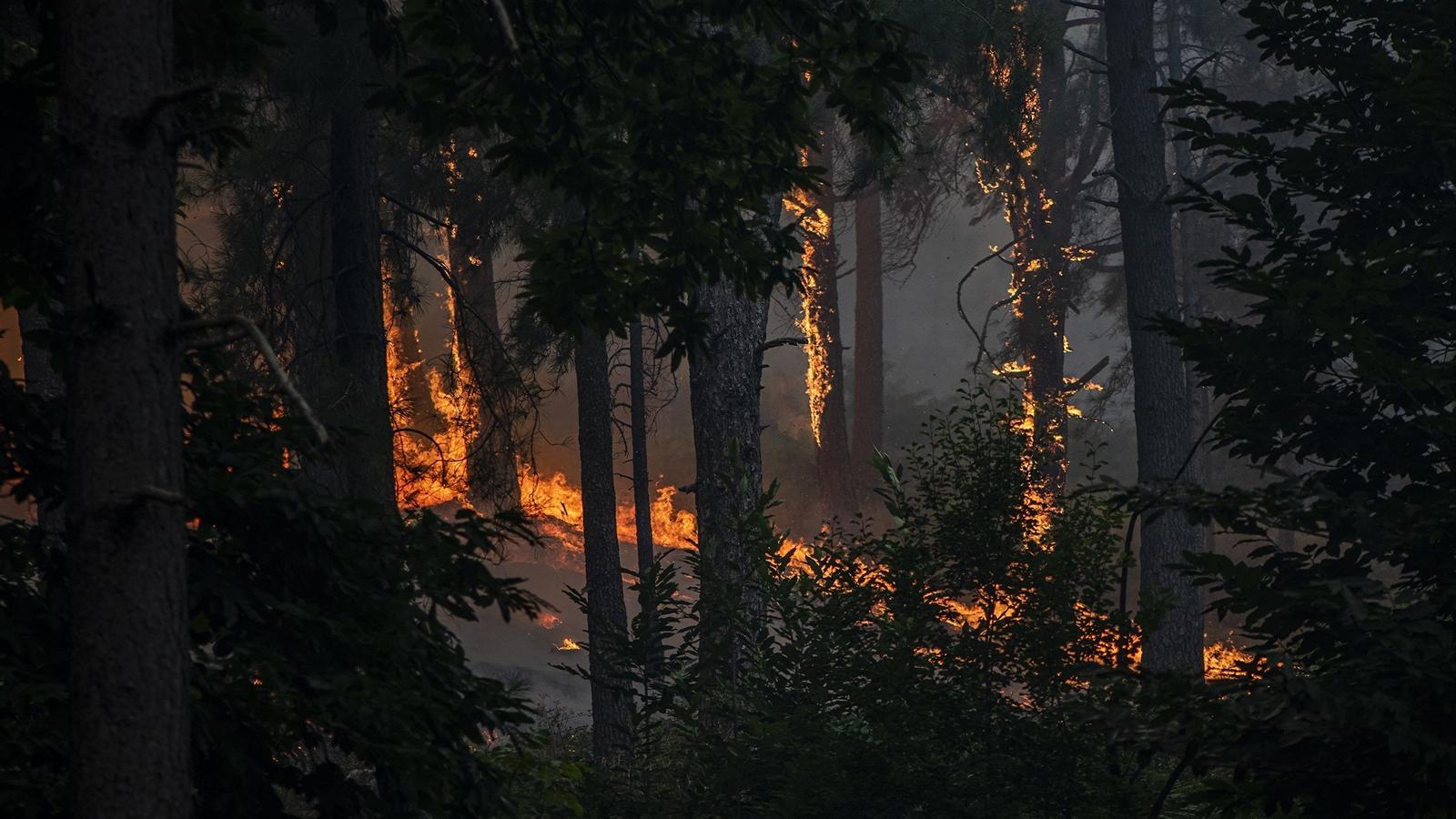
MadridThe fire in Ávila, Madrid and Toledo, which has burned more than 80,000 hectares and affects 91,000 people – there are 63,000 evacuated and 28,000 confined – continues to burn amidst meteorological conditions that do not help to extinguish it, due to high temperatures and low humidity, but which are more favorable than those that will occur from Wednesday onwards. From the advanced command post in Navalcarnero, the Minister of the Interior, Fernando Grande-Marlaska, has emphasized the importance of the next 48 hours: Monday and Tuesday will be two "absolutely central" days, because afterwards the forecasts are "really negative" and will complicate – even more – the possibility of putting an end to a fire that has been burning since last Wednesday. “Two days are coming that will not have the conditions we would like, but we can be proactive in advancing the control of the fire,” he added.
Despite everything, Fernando Grande-Marlaska assured this Wednesday first thing in the morning that, for the moment, the fire is evolving favorably thanks to the night work this Tuesday. Despite this open window that has allowed ground to be gained against the flames for a few hours, an exacerbation of climatic conditions is also expected today, which could turn the situation around again.
Also, Wednesday a new heatwave will begin and Aemet warns that there will be a “rise in temperatures” that will “skyrocket” the risk of fires to “very high or extreme” levels in most of the State. The episode will last at least until Sunday. Later, and with a message of “moderate optimism”, the Spanish government delegate in Madrid, Francisco Martín, expressed himself in the same terms: “The work is being carried out with maximum intensity to take advantage of this window of opportunity that we have, not because the conditions are optimal, but because the conditions in the coming days will be worse”.
For its part, the president of the Community of Madrid, Isabel Díaz Ayuso, has spoken of a "serious and devilish" situation, with "negative and adverse" weather conditions, and has pointed out that the Ávila fire "constantly threatens" that of Madrid. From Vall d'Uixó (Castellón), where this Monday she visited the advanced command post of the fire that has burned more than 7,000 hectares, Pedro Sánchez has said that for the state as a whole, "difficult and complex hours" are coming, as a result of the "increase in temperatures" in the coming days. Likewise, he has asked citizens for "patience and understanding" and has called for "extreme prevention and caution".
Early this Monday, at the closing of the event presenting the state network of climate shelters, where he announced aid of ten million euros to finance a thousand new ones, the Spanish president linked the fires to climate change: “It is not a succession of isolated episodes, it is the most painful expression of the climate emergency,” he said. And he reiterated the call to all parties to unite in a state pact: “This is indeed a national priority, future generations will judge us”.
On the same note, this Wednesday early on, Minister Marlaska also emphasized the paradigm shift in forest fires, which, he assured, "are of a completely different nature than what occurred in previous years and, therefore, require extraordinary means to confront them". "Compared to last year on this same date, there are six times more hectares burned," he stated.
In the case of Ávila, the 55,000 hectares burned place the fire as the most extensive in Spain's recent history. It is 160 kilometers of blackened land that was previously green, houses and businesses saved by centimeters and ash everywhere. In Madrid, 28,000 hectares have been burned in the worst fire in the region's history, and what Ayuso has presented as the “greatest natural catastrophe in the history of Spain” due to the natural heritage that has been devastated.
In this context, Minister Marlaska will meet remotely on Wednesday with the autonomous communities within the framework of the National Civil Protection Council. The meeting was convened on July 13 for another purpose, but it will also serve to address the fire situation. Specifically, during the meeting, an attempt will be made to approve four general planning guidelines in the state, regional, and local emergency plans.

The fight against the flames
“We are working, we have control over the emergency and we have the means, but we are going little by little because the climatic circumstances are not helping us at all,” said the Minister of the Interior. Currently, there are 3,000 personnel working directly and almost a thousand land, river, and air vehicles. Early this Monday, the Spanish government delegation in Madrid reported that during the night “the progress” of the fire has decreased, which “remains active and unstabilized,” and Fernando Grande-Marlaska highlighted that the emergency units have been able to be “more proactive” from five in the morning, after a night with high wind gusts that have hindered firefighting efforts.
The front that causes the most concern – of the three identified – is the one at the Sant Joan reservoir, where a large part of the emergency teams' efforts continue to be concentrated to prevent the flames from advancing north and penetrating around the Sierra de Guadarrama. “We hope to be able to advance substantially to avoid this danger,” said the minister. At midday, an ES-Alert message was sent to evacuate the municipality of Valdemaqueda, which had been confined since Friday.
However, there have also been some small pieces of good news: the Escorial campsite, which was evacuated on Friday, has been able to reopen; the elderly residents of the San Martín de Valdeiglesias residence have been able to return, and farmers have been allowed to access the affected areas to feed their livestock. Marlaska announced tonight that residents of eleven different municipalities in Toledo who had been evacuated due to these fires will be able to return home. The minister explained that during the afternoon it was difficult to work with aerial firefighting means due to the smoke cloud, and although the Mijares and Casillas sectors have improved, the evolution in the northern area of the San Juan reservoir is particularly concerning.
On Monday afternoon, Minister Marlaska temporarily suspended harvesting operations with agricultural machinery in Madrid, Ávila, and Toledo. The Ministry of the Interior justified that it poses a significant risk factor and that the danger of new fires appearing must be minimized.
Extraordinary benefit from the Spanish government
At this Tuesday's cabinet meeting, the Spanish government will declare the territories hit by the fires as areas seriously affected by civil protection emergencies. For the moment, Moncloa is finalizing the details and is not providing further specifics. In parallel, the Ministry of Labour is preparing a package of strictly labour-related measures for the companies and workers affected by these serious fires, according to sources from the ministry headed by Yolanda Díaz.
The same voices indicate that one of the labour measures will be a new benefit for extreme emergencies that will be borne by the ministry. Therefore, the cost will not be passed on to employers and workers will not see their salaries reduced. Thus, the Spanish government will assume the cost of salaries and contributions for inactivity caused by the climate emergency and the right of individuals to be absent from their work when they cannot access their homes as a consequence of the fires will be recognised. This aid will be added to structural measures already in place, which only need to be activated, such as climate labour permits, reports Núria Rius Montaner.
