The threat to cities from fires that cannot be put out

-
CAT -
CAST
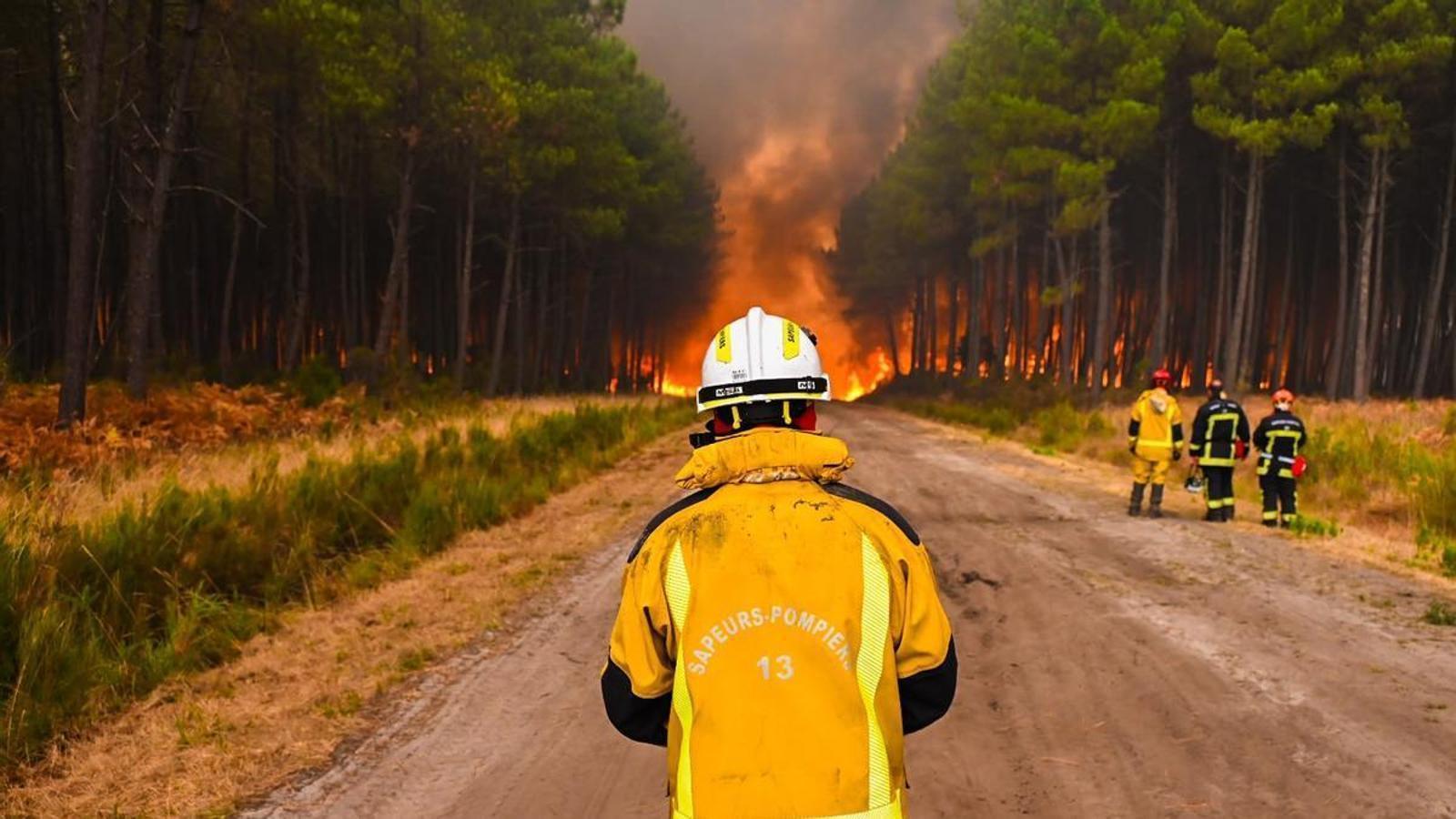
Tourists are fleeing Bordeaux and its inhabitants have been breathing in the smoke from fires burning just 15 kilometers from their urban conurbation for days. For now, it has already been declared the largest that France has suffered in the last fifty years and yesterday the news was that a senior fire official stated on television that it could take "weeks or months" to be declared extinguished. More than 200,000 people have had to be evacuated from various towns in Gironde, but for now there are no plans to evacuate Bordeaux. However, those who can are leaving.
The Bordeaux fire is stabilized but still uncontrolled. The same goes for those in Spain. The one in Ávila is also the largest ever declared in the State so far. 50,000 hectares burned, and with the continued danger of it joining with those burning in Madrid and Toledo, also of large dimensions. And the one in the Sierra de Espadà, in Castellón, also continues to burn. In all cases, the firefighters, who are relying on a small respite in these days before the heat returns on Wednesday, point to similar circumstances: a lot of forest mass, extreme heat, wind that favors expansion, and forest management that is between terrible and improvable. The same has happened in Catalonia, and although there is a truce now, we have had two very intense months and the maximum alert continues.
In the images we are seeing these days, the most striking are those of burnt houses and cars, fortunately so far without fatalities, as happened in Almeria. Fires burn forests, but increasingly also human habitats. For years, we have been warned that these types of fifth and sixth generation fires are not like those of the past, and that is why many are uncontrollable. According to experts, if a fire exceeds the radiation threshold of 10,000 kilowatts per linear meter of front, the firefighter who intervenes will suffer burns to their skin. It is the survival threshold, they say.
The professionals who face them know what needs to be done and it is very important to listen to them, but what can be asked of the population, and of politicians, is responsibility. Personal responsibility is, above all, to avoid any risky practice, however minimal. As we explained recently, between 1986 and 2026, only 15% of fires registered in Catalonia have been caused by natural causes and one in four were intentional. But there is also another responsibility, and this is a national one. It is clear that with the climate crisis, the danger is increasingly greater. We must prepare to face it, but far more is invested in extinction and subsequent regeneration than in prevention. Clearly, there is a lack of budget for all the bodies responsible for prevention, but we also need to rethink how our territory is organized, with dispersed urbanizations that hinder control and extinction. We will have to look at how its management should change and how to minimize future probable damage. Not only in the forest, but also around population centers that will be increasingly threatened. It is not alarmist to open the debate now about how we could act and what would happen if a fire of this type occurred in Collserola. Before we, like Bordeaux, smell the scent of scorched earth.
