The fork, a communication tool before mobiles
Capdella: the first hydroelectric power plant in Catalonia, which continues to operate

-
CAT -
CAST
It is a very simple pitchfork. It has a thick wooden handle and two iron prongs. It was used to load and unload bales, straw or hay. TIt is currently used very little. But where I am now, in the Vall Fosca, it also had another function. That is why it is exhibited at the Capdella Hydroelectric Museum, which I am visiting today.The funicular driver was touching the two electric cables of the line that ran parallel to the funicular track with both ends of the fork, and with this action he made a bell ring at the stations to to speak with the workers who operated it. This was the code: with one bell it indicated that the operator should stop it, with two bells, that he should go up, and with three, that he should go down.
This communication system began to be used in the 1910s, when they didn't even have walkie-talkies. And many decades would pass before mobile phones arrived. The other mobiles – the objects hanging by threads that move in the air to distract babies – had not even become popular yet: they are said to have spread starting in the 1930s, with the abstract hanging objects by the artist Alexander Calder.
The funicular climbed two kilometers on a steep incline (45%) and carried workers, some visitors, and materials to build the pipes that were to collect water from the lakes to enlarge them and turn them into dams. It started from an altitude of 1,100 meters, reaching 2,150 meters. From here, a 5-kilometer narrow-gauge railway – pulled by animals! – which also transported materials – and workers – went to Lake Gento.
This little train, after a few years, was motorized –it started running on diesel – and was active until the eighties of the 20th century. Even today, the tracks of the little train are still there. Its route coincides with the canal that carries water from fifteen lakes.
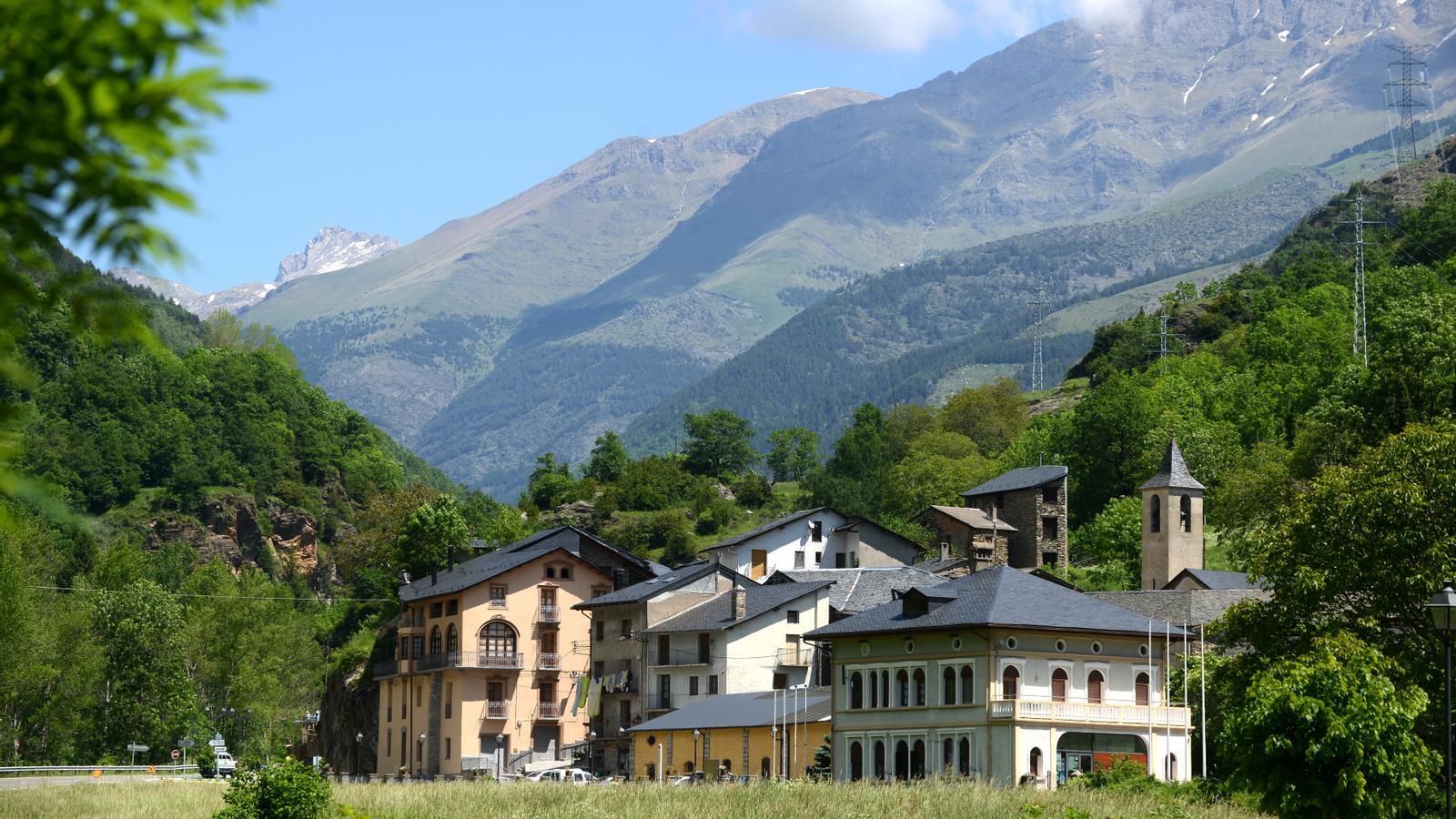
With the construction of the hydroelectric power plant, Capdella received machines and technologies hitherto unknown, such as the funicular –which ran on electricity– and the large turbines of the hydroelectric power plant. They were symbols of a new world that profoundly transformed the valley. Everything was newstates: roads, hotels... Even the night disappeared, for some, because they were working. And a few foreign languages could be heard. To welcome the newcomers – from Spain and Europe – two population centers were born – Capdella, at the top, and Molinos, further down – and there were all sorts of services.
It was not easy at all to explain the advantages of all this to the inhabitants of Vall Fosca. The writer Pep Coll, in El segle de la llum, explains that some thought that the light bulb could set their houses on fire. "Certainly, it was not a piece of cake, this business of convincing all those ignorant mountain people of the need for electric light. Foreseeing the difficulties, the company paid some houses, one from each village, to let them install the light in their homes. Think about it, giving them light for free and even giving them money! But it was not enough. 'If for centuries we have lived without light, we can also live now,' grumbled the elders".
"Capdella is the first hydroelectric power station in Catalonia, which is still in operation," Martí Boneta, a teacher and historian who knows the history of this valley like the back of his hand – he explains it in the book La Vall Fosca: els llacs de la llum–, tells me as we walk through the museum, which allows us to understand in detail, through the pieces that have been used, how the power station works. We are inside a large building, with plenty of natural light – thanks to large windows –, which housed the medical clinic, the management office, and the warehouse of the hydroelectric power station.
We move to the power station, which works like the first day. The machines are the same as always, but now they are automated: they are controlled by computer.
Until a moment ago, there were only two of us on the visit. Now a noisy large family – with three children: enough for them to be considered a large one – makes us raise our voices a bit. In summer, there are no school visits, of course. On the other hand, during the rest of the year, schools are one of the main clients of this center. Since the beginning, many children have been able to learn how a power station works. A group of children from El Raval had this privilege.
The Franco-Swiss company Energía Eléctrica de Cataluña – founded in Barcelona, hence its Spanish name –, owner of the power station and the camp for workers and their families, sponsored 25 children to spend a summer camp here in the years 1917, 1918, and 1919. Enjoying nature, careful hygiene, and good food brought them well-being. These camps were directed by the teacher Artur Martorell. He wrote some memoirs that have recently been published. The children went on excursions, played games, did gymnastics, sang... they discovered this hydroelectric power station.
An initiative by a journalistEmili Riu, a journalist and politician from Sort, who led the initiative to build the Capdella power plant, had everything very clear: the project, how to overcome the difficulties... From the end of the 19th century onwards, he observed the growing demand for electricity in Barcelona and its surrounding area, mainly due to public and private lighting and the first electric trams, as initially the trams were horse-drawn and in Barcelona it wasn't until 1907 that they were all electrified.

