Research doesn't have to be useful
The Museum of the Miquel Crusafont Catalan Institute of Paleontology, an open door to the past

-
CAT -
CAST
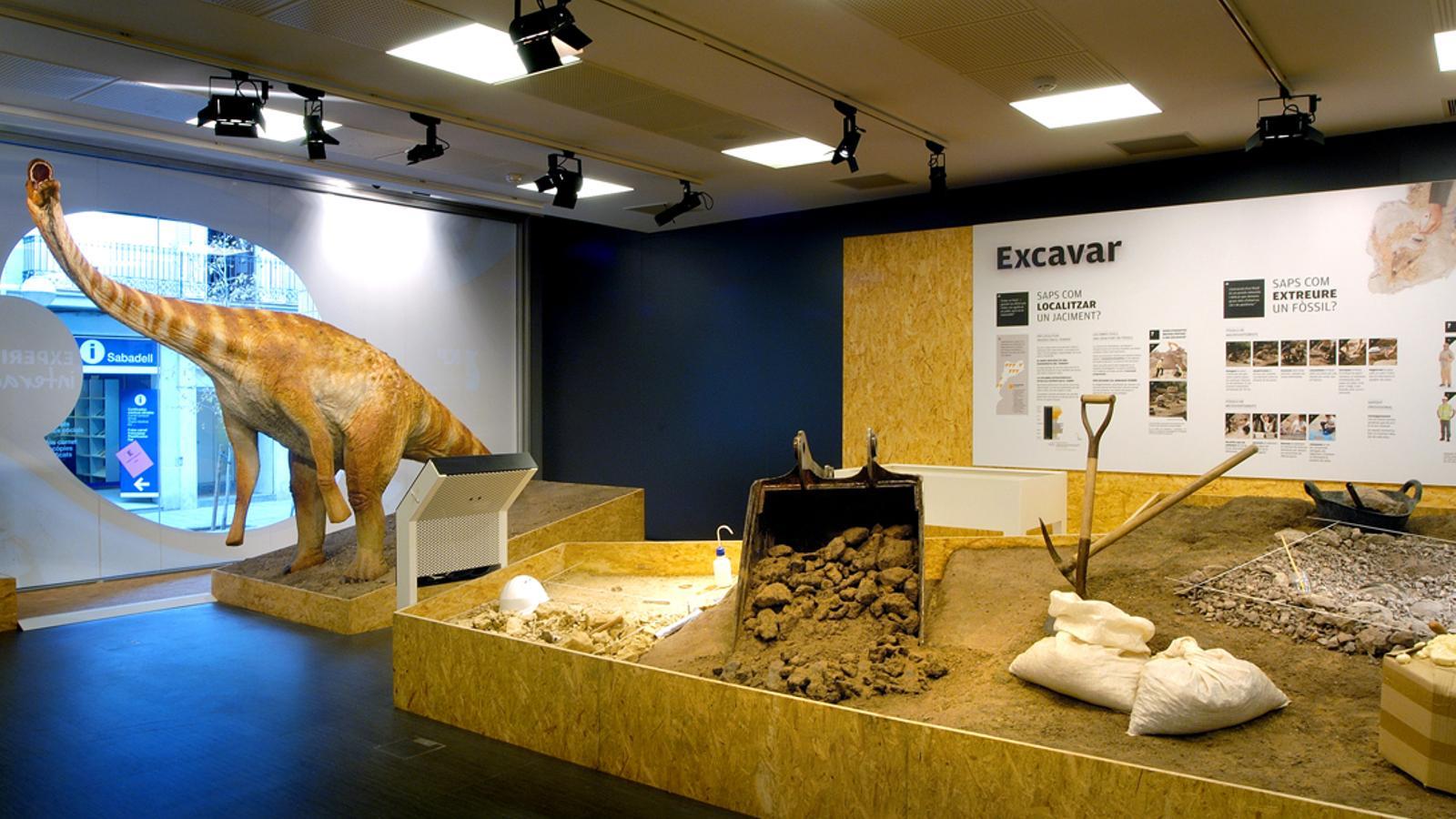
After the pandemic, there have been many "desires for nature," to go on excursions (which is why there are more rescues than ever) and a boom in searching for fossils, as if they were mushrooms. But there is a state law – from 1985 – that establishes that fossils cannot be collected in nature without the administration's permission.There are fossils that have a lot of value. Most of them. "How can you know their value?", I ask Àngel Lujàn, head of the Museum of the Miquel Crusafont Catalan Institute of Paleontology. "It's not easy at all if you're not an expert. If you find one, you must report it immediately. As if it were a fire." You must note its location. And report it to the ICP Museum (Catalan Institute of Paleontology), which has gathered thousands upon thousands for many years. They arrive in many ways: through fortuitous discoveries, through paleontological interventions related to research (mostly) or preventive (to a lesser extent) related to excavations. "If there are outdoor works on land where there may be fossils, they have to notify us," he tells me. "And do they?" "Almost always. They have the obligation to do so!", remarks Josep Maria Robles, head of the Collections Management Area of the ICP Museum.We are at the ICP Museum, named after Miquel Crusafont, the father of the Catalan school of vertebrate paleontology. Crusafont founded the Provincial Institute of Paleontology, where he worked until his death. He was a great worker – and a heavy smoker (sometimes he would fall asleep with his cigarette lit and leave a burn mark on the sheets), which affected his health and cost him his life–. He enjoyed searching for fossils, not for collection, but for collective research, in Catalonia and beyond (he participated in paleontological expeditions in Tunisia and Morocco). Fossils also arrived thanks to friendships. For example, on one occasion a shepherd picked up a stone to throw it to herd the flock, but he realised it was not like the others, but rather a fossilized jawbone. He kept it and later it ended up in the hands of Crusafont. It turned out to be of great interest: it was the jawbone of a primate.The museum, located in the heart of Sabadell, is very educational: there are well-made panels with explanations of aspects of paleontology and some interactive element. But it has few "real" pieces on display. I notice a photograph of a titanosaur dinosaur. "Here, in Catalonia, there has been a lot of tectonic movement. That's why dinosaur fossils are not whole at all, as they are in the United States," comments Àngel. "Besides, in general, the dinosaurs here are smaller."We go down to the basement, where the storerooms are, and enter a T room (for Typotheca). It is the space intended for conserving type fossils, that is, specimens that serve to define new species. There are fossils from all parts of the vertebrate skeleton. The teeth are especially important. They tell us a lot about the animal. I will now visit, with a car ride, the headquarters of the ICP Museum, the Miquel Crusafont Catalan Institute of Paleontology, on the UAB Campus. David M. Alba, the director, receives me. And he introduces me to different researchers. One of them, Isaac Casanovas-Vilar. So he opens the door to his workspace and offers me a wide smile, I notice some bags behind the door, on the floor. "They are full of sediment, and mixed in the sediment are rodent fossils, which I will sort out with a sieve," Isaac comments to me, for whom rodents have a special attraction because they evolve very quickly.In another office, a team of researchers is dedicated to computational biomechanics studies. "Engineers, when determining if trucks can cross a bridge, perform a computer calculation," he says. "Similarly, we can calculate jaw strength, for example; this allows us to know more or less what animals ate," he tells me."And what is the use of all these searches?", I say. "Research doesn't have to be useful, the generation of knowledge is a good in itself", David tells me as we enter the large warehouse, full of fossilized land tortoises. I have the impression of being inside the movie Raiders of the Lost Ark. I finish the visit to the fossil preparation laboratory, where its head, Xènia Aymerich, receives me. "You can't take photos of this!", Xènia warns me. She is referring to a fossil of great interest that they have not yet revealed. Xènia is concentrated separating a rather large fossil from the matrix (the sediment that surrounds the fossil and fills its cavities). She does it with a micro-percussor. "Everything here is manual," she says. Many tools from other disciplines are used: tweezers, scalpels... Once the fossil is separated from the earth, she will consolidate it with synthetic resins. The criterion, always, is minimal intervention. Xènia shows me a drawing with the twelve months of the year. It is a representation of Earth's history compressed into one year. On January 1st, the Earth is formed. It is not until March that the first simple forms of life appear. In November, the first vertebrates arrive. On December 19th, the first dinosaurs arrive, and on Saint Stephen's Day they go extinct. And we – humans – arrive practically at the last moment of December 31st.A great diversity of fossilsThe ICP Museum has a great diversity of fossils, mainly from Catalonia, but also from all continents. They are well preserved and classified. From a compact cabinet, they show me a box full of plastic bags, each with its catalog number. The code is on a radiofrequency tag. A gun similar to those of cashiers in supermarkets allows the fossils to be located easily.
