Probably the first popular science book in Catalan
We visit the Mentora Alsina experimental physics laboratory, at MNACTEC

-
CAT -
CAST
In the scientific field, it is often risky to confirm the authorship of an invention. There have been –and still are– as many disputes as you like between a scientist or a team of scientists and others over who has been the inventor of something. Therefore, I prefer to be cautious and say that the magnificent book I have in my hands, which for a long time has been known as the first scientific popularization book in Catalan, is probably the first scientific popularization book in Catalan. This publication, which is located at the Documentation Centre of MNACTEC (National Museum of Science and Technology of Catalonia), is titled Noves científiques (Novas científiques, says the original). It is written by the politician, economist, textile technician, and great science popularizer Ferran Alsina, in pre-normative Catalan. Reading it, I find a few stumbling blocks: ab (with), aixís (so)... After a while, I get used to it.
It is a book from 1904. I do a quick search, to place myself in that year, about what was happening: I read that telephone lines were beginning to extend outside Barcelona and that in this same city, tests of aerial navigation with hot air balloons were being carried out, when it was not yet clear that airplanes would become the best means of transport through the sky.
Alsina wrote Noves científiques with the intention of presenting it to the Royal Society, the national academy of sciences of the United Kingdom, one of the most prestigious scientific institutions in the world, founded in London in 1660. But it is not known if he ever presented the book to this institution.
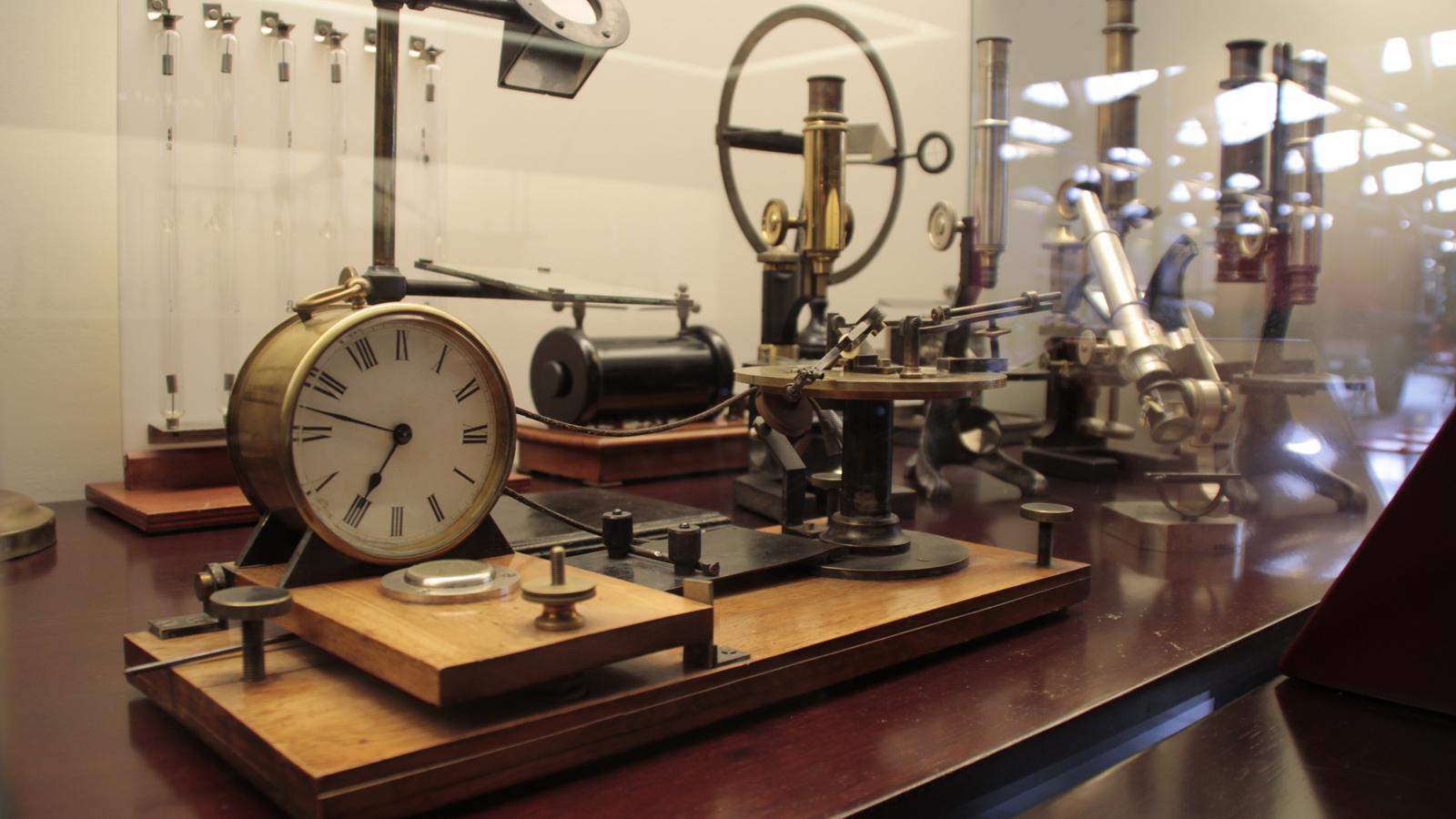
Alsina was quite humble: "It cannot surprise us that our work is imperfect," he says in the book. For him, what he explains is a modest step in a collective process of seeking natural truth.In Noves científiques, Ferran Alsina first presents false concepts and then "new just and natural concepts", which demonstrate certain principles or behaviors of matter through experimentation or observations he made with scientific and technical instruments he acquired in England and Germany. The objects ended up forming a magnificent collection. I have a few pieces in front of me that are on display. I'm reviewing them with my eyes. I think it's a success that they haven't been repainted. They are as they were. I also think it's great that workshops are held with some replicas of these objects. They are held on top of a long, enormous wooden table. For a few moments, I imagine it set up for a good meal. A crowd would fit there! I have never dined at such a long table.We are now accustomed to science museums where experimentation is fundamental – CosmoCaixa is a prime example–. The Alsina collection was a pioneer in this line. It contains objects from very diverse disciplines: mechanics, pressure, hydrostatics, optics, acoustics, and electricity. They were already designed to be manipulated and operated. Some were used in research centers, and still are. This is the case of capillary tubes (tubes with a diameter of a hair, which allow the analysis of microvolumes of liquids in biology or analytical chemistry). Others are no longer used, but they are the basis of current ones. There are also some that are reduced-scale replicas. For example, the steam engine, which is precisely the reason for my existence: the textile factory Aymerich, Amat i Jove, which a few years after its closure became a museum, MNACTEC.The Mentora Alsina experimental physics laboratory has suffered several vicissitudes, among them the misfortune of its creator. "Alsina had poor health: he founded this physics cabinet in 1907 and, just one year later, died of tuberculosis. He was able to see it open to the public for a very short time," explains my host, Vanessa Vicente, curator at MNACTEC. Good thing Alsina had hired a collaborator. One day he put an ad in the newspaper to see if anyone was willing to do a "special job". Ramon Llobregat, after finishing high school, had enlisted in the Cuban War – driven by a whim to escape his priest uncle, who had insisted on him entering the seminary ––. Tired of the war, he deserted and returned to Barcelona. He saw the aforementioned advertisement and it changed his life. Mr. Ramon became Alsina's right-hand man and also the soul of this extraordinary collection: he acquired new objects and even made some, always with great precision. The collection passed to the hands of the Barcelona City Council, and for some years it has been located at MNACTEC. The Tibidabo building by Ferran Alsina, where the collection was initially located, became empty, and squatters moved in.If you attend one of the workshops in which some of these objects are set in motion, you will be fascinated. You won't know if you're seeing magic, science, or both.I'll tell you one, to finish. It's an apparently empty pedestal. But... as you get closer, a clock will appear. Inspired by this experiment, the poet Joan Brossa created a visual poem for the lobby of the Teatre Poliorama in Barcelona. Ferran Alsina, the ideologue of Colònia Güell"Ferran Alsina invented a loom for manufacturing stamped fabrics which he patented and sold to Eusebi Güell, with whom he participated in the founding and design of Colònia Güell, in Santa Coloma de Cervelló", explains Vanessa Vicente, curator at MNACTEC. Previously, Alsina had managed the Vapor Vell in Sants (where, due to labor conflict, he suffered an attack).

