Do you know what Coca-Cola was before a popular drink?
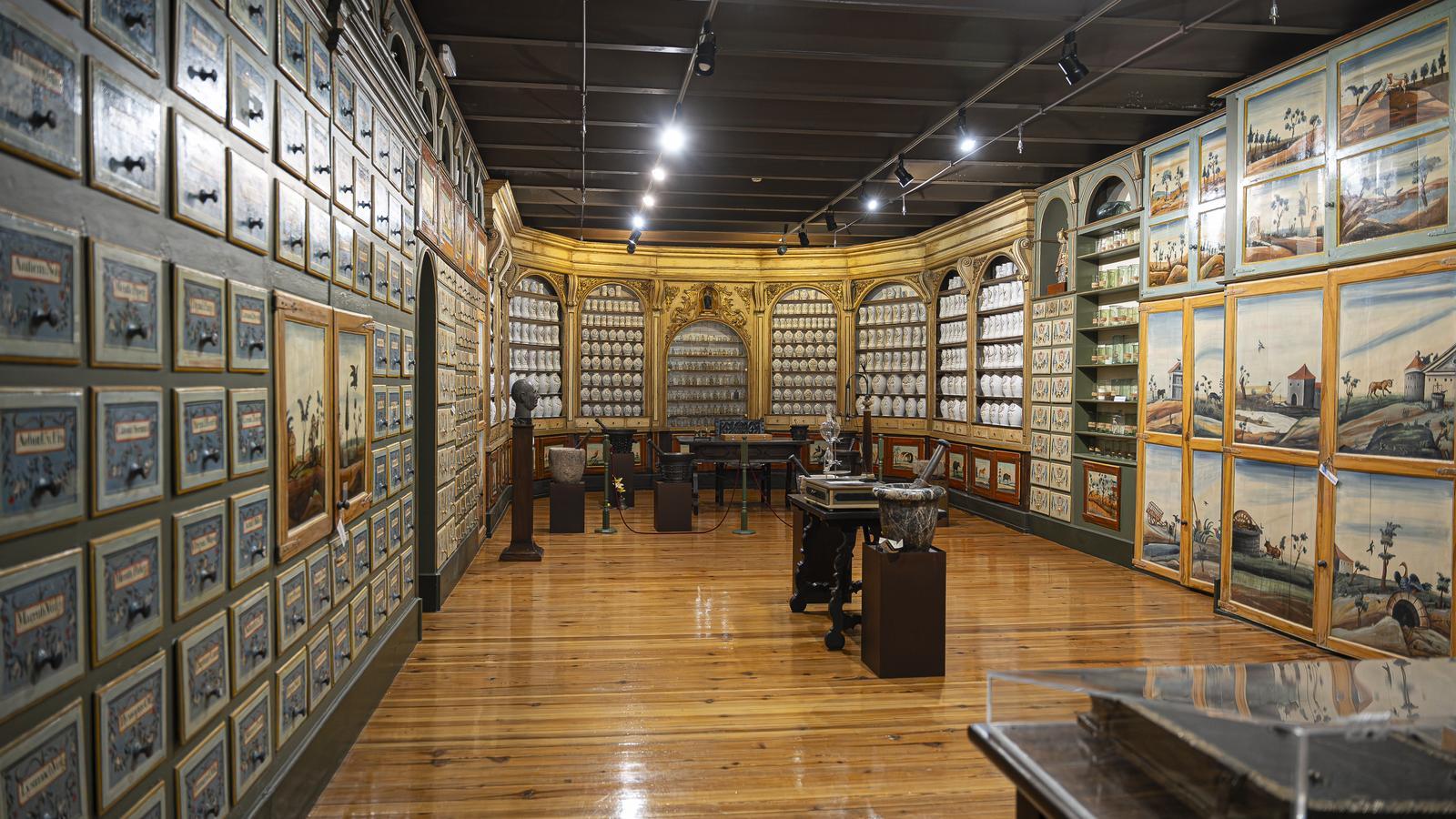
The precious pharmacy of the Benedictine abbey of Santa Maria la Real, of Nájera, had an ephemeral life but can now be seen whole at the Cusí Pharmacy Museum, in El Masnou

-
CAT -
CAST
"Coca-Cola was formulated as a medicinal syrup in 1886. Since it wasn't very successful, they decided to present it as a soft drink and it worked," Francesca Niubó, a microbiologist and head of the Cusí Pharmacy Museum, explains to me. And it certainly worked! I have a small glass bottle right in front of me, with the slanted Coca-Cola letters, the "timeless" image of this dark drink, which they say quenches thirst so well, but I'm not sure. Coca-Cola slanted, the "timeless" image of this dark drink, which they say quenches thirst so well, but I'm not sure. This is one of the many curiosities explained in the museum, a magnificent space full of objects from very diverse eras related to the world of pharmacy and medicine: ceramic pieces, glass, mortars –of bronze and iron–, ex-libris, engravings, and medical and pharmaceutical instruments. The main attraction, however, is an 18th-century Baroque pharmacy. It belonged to the Benedictine abbey of Santa Maria la Real, in Nájera. It is shown in its entirety (although, as there is no documentation, its original layout is unknown). It contains ceramic pots and jars, a cordial bottle with glass flasks, wooden drawers with the names of medicinal plants, and cabinets decorated with paintings of exotic animals, among other motifs. I am surprised to see these animals painted here, animals that were not found in La Rioja centuries ago – nor are they found currently –: a panther, a crocodile... It is likely that pilgrims or merchants who had been to other countries passed through and told them about them. And the painter, with his craft, would also have wanted to "explain" them. It is one of the many peculiarities of this beautiful pharmacy that transports us to a time when apothecaries prepared formulas by hand, mixing herbs, minerals, and other ingredients. It is said that the monks of the monastery had a garden solely for growing medicinal plants, a place to dry them, and once dried, they stored them in drawers, where they rested until they needed to be used. The pharmacy had a short life: Mendizábal's disentailment expelled the monks. But the pharmacist monk had the good idea – and the holy patience – to dismantle it, and he kept it at his brother's house. In 1920, Joaquim Cusí, with the idea of setting up a museum in the laboratories he wanted to build in Masnou, was looking for an old pharmacy. He heard about this one from Nájera, went there and acquired it. Without seeing it. It was in boxes piled up in a stable. "All the timber for the pharmacy was brought by three train wagons," Francesca explains to me, as I observe old books on general medicine, ophthalmology, anatomy, and pharmacy. We are now inside one of the museum's great treasures: the library. The oldest book is about ophthalmology – the house's specialty. It's from 1520. The history of Cusí laboratories begins at the beginning of the 20th century, when Joaquim Cusí opened a pharmacy on Carrer Ample in the capital of Alt Empordà, with the help of his brother Carles. It was much more than a pharmacy. "Quimet" Cusí – they called him that to distinguish him from his cousin Quimarro (they were the sons of two brothers married to two sisters) – was a great defender of the Catalan language. For this reason, in addition to medicines, he also had other things for "good health", such as the magazine El Patufet. In the back room, long conversations were woven, in which characters such as notary Salvador Dalí (the painter's father), the Pichot (or Pitxot) brothers, Rafael, Joaquim, and Lluís Cusí, numerous musicians, Marià Pujulà – who later became mayor of Figueres – participated. Joaquim Cusí was also mayor of El Masnou. Yes, some had political concerns and were encouraged to found a party of Catalanist and republican character, Aplec Nacionalista Republicà. They wanted Figueres to be a town that shone like those in France: "When we cross the border, we see such beautiful towns!", they said. Today, a century later, Figueres continues to be different from those in France. "Cusí was quite enterprising. He made many master formulas. He made a little formula that gave him very good results", Cesca tells me. "Why do you say it in diminutive?", I ask. "Ah!... It's because it's a very easy formula": an antiseptic ointment that cured minor eye infections. Cusí made money –and made a good name for himself– with this pre-antibiotic recipe. It began to be commercialized under the name of Cusi Ophthalmic Ointment with Yellow Oxide of Mercury. In France, a similar ointment was commercialized, but Cusí's was finer in texture and did not hurt when applied to the eyes. Its success was resounding. Cusí had "good vision": he asked the ophthalmologist Barraquer for a list of ophthalmologists from all over the world, to whom he sent samples, and he immediately received orders from everywhere. "He also excelled in dermatology," Francesca explains to me as I notice what a pharmacy jar says: Laboratorios del Norte de España. This is how these laboratories were called for years. The American group Alcon, one of Nestlé's pharmaceutical divisions, bought the Cusí laboratories, which were renamed Alcon Cusí. Subsequently, they became part of the Novartis group and are currently part of the Siegfried company. The building we are in was almost bombed during the civil war. During the conflict, Carles and Rafel Cusí remained in the country. Joaquim, on the other hand, clearly republican, went into exile in Paris. Then to Belgium, to the United States (in passing) and to Costa Rica, where he founded some laboratories, he was finally in Mexico and returned in 1945.As I said goodbye to Francesca, she gifted me one last anecdote from the war. This factory in Masnou was a target for Franco's aviation. But the commander who was supposed to order the bombing was a worker and a friend of the Cusí family, and he gave different coordinates. Otherwise, I would not have known this treasure of the world of pharmacy and medicine, nor Francesca, nor the first use that Coca-Cola had.

The laxative that inspired the name of a music group One of the numerous medications you can see at the Cusí Museum is the laxative Laxen Busto, registered in 1920. The musical group Lax’n’Busto took the name of this medication when it was no longer marketed. It is one of the many anecdotes explained by this museum in Masnou, ceded by the Cusí heirs to the Royal Academy of Pharmacy of Catalonia. The current ownership is of this Academy, but the pharmaceutical company Siegfried takes care of its maintenance. One of the requirements that the owners established when selling the company is that the museum cannot leave Masnou.

