Dansàneu claims culture as a space of creation, memory and future
The 35th edition of the Festival of Pyrenean Cultures unfolds a program that connects heritage, live arts, and landscape, with premieres, own productions, and top-level figures
4 min
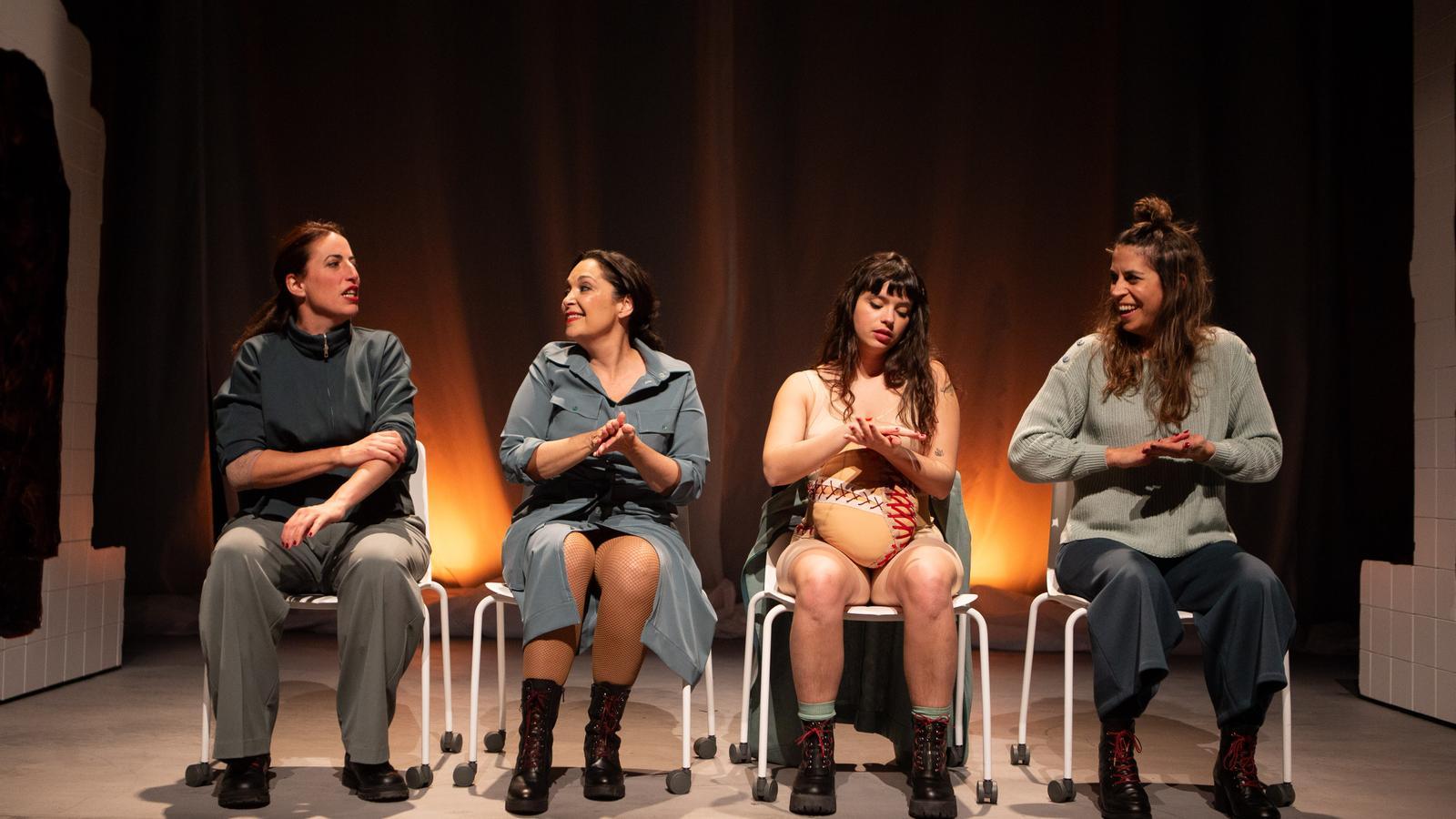
The TNC production 'Batecs' dedicated to grief.Clàudia Serrahima
The Valleys of ÀneuThe Dansàneu reaches its 35th edition, reaffirming itself as much more than a performing arts festival. From July 24 to August 2, the Valls d’Àneu will once again become a stage where music, dance, theater, literature, and thought dialogue with the monumental and natural heritage of the Pyrenees. True to over three decades of history, the festival champions a culture rooted in the territory but fully contemporary, capable of reinterpreting tradition and turning it into a driving force for creation, reflection, and cohesion.
The philosophy of Dansàneu pivots on a clear idea: heritage is not just a backdrop, but also a protagonist of the artistic experience. Romanesque churches, squares, forests, vineyards, natural spaces, and unique corners of the Valls d’Àneu host a program conceived specifically to dialogue with each location. This relationship between landscape, heritage, and creation is one of the distinctive features of a festival that also emphasizes proximity to the public and the discovery of the territory.
This year, the program is also structured around various commemorations. One of the most notable is the centenary of the death of Joaquim Morelló, a pharmacist, photographer, hiker, and patron born in Esterri d’Àneu, who contributed decisively to disseminating the country's cultural and natural heritage. The festival will inaugurate an exhibition dedicated to his figure and premiere the performative action Joaquim Morelló, pastilles i excursions, written by Xavier Albertí and performed by Laura Aubert, thus initiating the commemoration program.
Another relevant anniversary is the Year of Pau Casals. Dansàneu contributes to it with its own production Les barques volen pel cel, created by Jordi Lara and Xavier Albertí, which imagines a conversation between Pau and Enric Casals to explore the relationship between music, exile, commitment, and fraternity. The centenary of Narcisa Freixas will also be featured, with a proposal that vindicates the legacy of one of the most unique composers in the country.
Dance continues to occupy a central place within the festival. Among the most anticipated events is the return of La Veronal with Sonoma, one of Marcos Morau's most celebrated creations. The program also includes premieres and new productions by creators such as Magdalena Garzón, Lorena Nogal, Mabel Olea, or La Venidera, consolidating Dansàneu as a space for promoting new choreographic creation and dialogue between contemporary dance and popular roots.
Music will also traverse multiple languages. The lineup brings together artists such as Anna Andreu, Magalí Sare, El Petit de Cal Eril, Sandra Monfort, Obeses, and Companyia Elèctrica Dharma, alongside tributes to Jordi Fàbregas and Nova Cançó with Lídia Pujol. Oral tradition, folk, and new perspectives on root music will also have special prominence, coinciding with the twenty-fifth anniversary of the Colònies de l’Escola Folk del Pirineu.
The festival maintains the two axes that have become essential to its identity in recent years. The first is democratic memory, developed in collaboration with Memorial Democràtic, with the participation of historian François Godicheau, the show El gegant del pi, by Pau Vinyals, the conversation between Magda Oranich and Andreu Claret, the exhibition Going Extreme, or the scenic proposal Reflectir el silenci. The second is the gender perspective, present in productions such as Batecs, dedicated to perinatal grief; Descasada, by Magalí Sare; Drames rurals i altres contes, with Àngels Gonyalons, or Medea, with Sílvia Bel and Neus Borrell, which revisit female narratives from a contemporary perspective.
Audience attending one of the previous editions of Dansàneu.Provided
As is customary, Dansàneu also opts for conversation between disciplines. Literary presentations, conferences, exhibitions, mediation spaces, workshops, and the Tastàneu gastronomic activities complete a proposal that invites the public to experience the territory with all their senses, discovering both cultural heritage and local products.
A look at thirty-five years of roots and evolution in the Pyrenees
Dansàneu has evolved from a summer school dedicated to traditional dance to become one of the benchmark cultural festivals in the Pyrenees.
When Dansàneu first started in the summer of 1992, few could have imagined that a project initiated in the Valls d’Àneu would reach 35 years of uninterrupted trajectory. What began as a summer school dedicated to traditional dance has become a festival of Pyrenean cultures that has managed to grow without losing its connection to the territory. Its history is that of a way of understanding culture: from proximity, with a contemporary outlook, but rooted in the landscape, heritage, and identity of the Valls d’Àneu.The project’s origins date back to the end of 1991. After a trip to learn about European ecomuseum experiences, territorial representatives proposed to the Department of Culture the creation of a Catalan dance festival. However, the proposal seemed too ambitious for the context of the time. There was a lack of infrastructure, organizational muscle, and a sufficiently consolidated cultural fabric. The decision was to start with a summer school that would lay the groundwork for a long-term project. This patient approach, based on gradual growth, ended up defining the character of Dansàneu.The artistic and pedagogical direction of Joan Serra i Vilamitjana was decisive during this initial phase. Beyond teaching traditional dance, Dansàneu became a meeting point, a place for learning and coexistence that fostered loyalty among generations of students and teachers. That community spirit, built on participation and commitment, remains one of the festival’s main assets today.After more than twenty years of trajectory, the project faced a new turning point. Artistic languages had changed, and contemporary creation began to look at popular culture and traditions as a source of inspiration. The death of Joan Serra in 2013 accelerated the need to redefine the model. Under the direction of Rut Martínez Ribot, Dansàneu embarked on a new era without renouncing its roots, but decidedly broadening its horizons. Music, theater, literature, visual arts, thought, and interdisciplinary productions were incorporated into a project that ceased to be exclusively a dance festival to become a festival of Pyrenean cultures.At the same time, heritage ceased to be merely the backdrop for activities and became an essential element of the narrative. Romanesque churches, squares, forests, archaeological sites, and natural spaces in the Valls d’Àneu host proposals designed to dialogue with the environment, reinforcing the idea that culture and territory are inseparable. This programming approach has been accompanied by a growing commitment to original productions, premieres, the recovery of democratic memory, a gender perspective, and the vindication of intangible heritage.The festival’s scope has also expanded. What began as a training initiative is now a platform for creation, exhibition, and reflection that brings together established and emerging artists, generates alliances with other cultural institutions, and contributes to projecting Pallars Sobirà far beyond the Pyrenean region. Without losing its human scale, Dansàneu has managed to consolidate its own identity, distinct from large mass events, based on artistic quality, proximity to the audience, and commitment to the country.With the most ambitious program in its history, the 35th Dansàneu symbolizes the maturity of this journey and an opportunity to look back, celebrate the path taken, and seek the necessary alliances to ensure its future.
Rut MartínezSílvia Poch (cedida)
“The future of Dansàneu depends on the territory” ”
Rut Martínez RibotArtistic director of Dansàneu
35 years well deserve a balance... Time to look back?
— With gratitude, recognizing the work of those who have allowed us to get where we are today, but avoiding both nostalgia and epic, which I only like in novels! Anniversaries are opportunities to highlight the project's strengths and, if possible, identify and resolve its weaknesses.
And what are the strengths and weaknesses of Dansàneu?
— The best: its uniqueness and dimension, which is a festival made from and for the territory, which avoids massification, which is clearly diverse in its disciplines, which embraces all kinds of audiences, of different ages and with different interests. The greatest weakness: the lack of muscle of the non-profit cultural entity that organizes it – the Consell Cultural de les Valls d’Àneu – and which suffers more and more to move it forward.
Why does he suffer?
— Because the festival has grown, in age and artistic ambition, and this implies needs and a volume of management that a modest cultural association cannot attend to. The current Dansàneu calls for a change in its governance model which necessarily implies greater involvement of the territory's institutions, organizations and entities.
But is continuity in danger?
— I always say that Dansàneu will be what the territory (meaning the people who live there) wants it to be. If the territory considers the festival relevant, positive, necessary, it will move forward. Perhaps by modulating some issues, introducing changes, but it will have continuity as it already did in 2015 after a very important reformulation. However, for this to happen, for there to continue to be Dansàneu, the people who love the festival will probably have to make it evident: demand it, defend it.
Let's talk about programming. What shouldn't we miss?
— It's hard for me to choose because behind each proposal there is the enthusiasm, the conversation, and the shared work with many people. There are some connecting threads that help organize the programming. Dance, which is of very high quality. In the musical field, proposals of very diverse formats and styles to which we incorporate the benefits of the spaces where we program (I'm thinking of El Petit de Cal Eril at Cap del Port, in Baqueira, or Obeses at Roc Roi). And the axes of democratic memory – with two days of very powerful programming – or gender equality. I'll stick my neck out: you can't miss Magalí Sare's concert in Borén or La Venidera in Esterri (a spectacular dance proposal that has just won three Max awards) nor the concert – a tribute to the Nova Cançó by the beloved Lídia Pujol–. There are more things, but a dozen shows have already sold out their tickets!