Why Nvidia depends so much on Jensen Huang
The crisis in the company's management has shown how large AI companies finance each other

-
CAT -
CAST
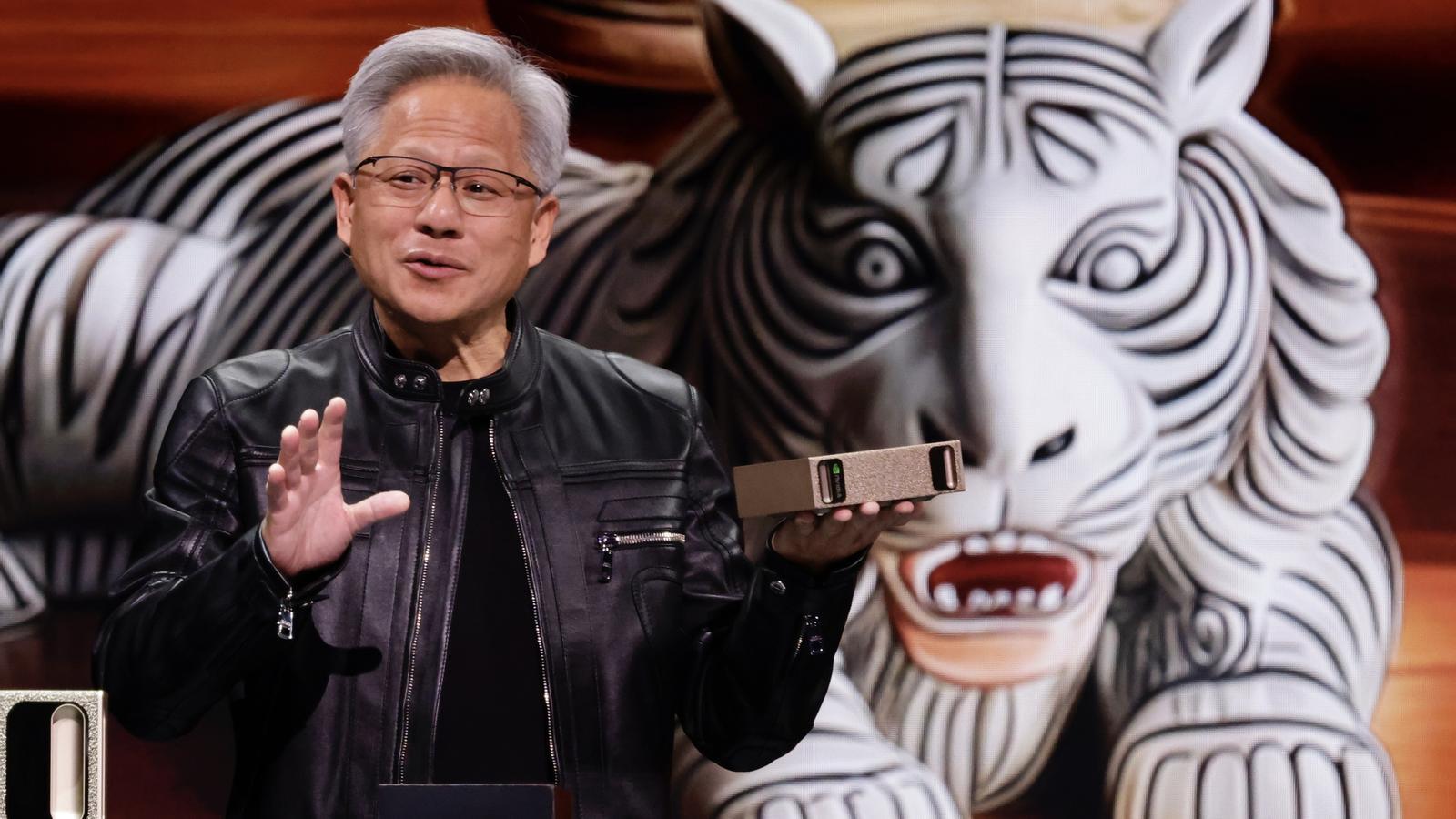
On November 12, Jensen Huang stepped down from all positions at Nvidia, the company he co-founded in 1993 with Chris Malachowsky and Curtis Priem and which designs the chips used to train and run most artificial intelligence (AI) models. Just 11 days later, the same board of directors that had ruled out reinstating him reappointed him as CEO. The process exposes little-known aspects of the turbulent AI industry.
From resignation to reinstatement
The crisis began at the end of October, when the newspaper The New York Times revealed that Huang had had an extramarital affair with Alice Huang (they are not related, despite the coincidence of the surname), who had been an executive at Megaspeed, a data center company in Singapore. US intelligence services suspect she was working for the Chinese state. Huang, however, did not resign because of the first affair, but the day after a second relationship, with a subordinate of his, became known.
Since Nvidia had no replacement prepared, the chief financial officer, Colette Kress, assumed leadership on an interim basis. One of the names that was mentioned to replace Huang, Rene Haas, a former Nvidia executive and current CEO of Arm, renewed his contract with Arm until 2033 on the same day that Huang returned.
Along the way, an open letter calling for Huang's reinstatement surpassed one hundred thousand signatures, including that of Elon Musk. However, on November 17, the Nvidia board was still ruling it out. But six days later, after receiving guarantees from the government that Huang was not under investigation, he was reinstated unanimously. Donald Trump celebrated it publicly.
Nvidia has appointed a committee of independent directors to monitor compliance with export restrictions. The internal investigation into whether Huang was targeted by a foreign intelligence service remains open. In fact, next Tuesday, Huang will be in Washington, but not to present new developments at the company's conference, but to appear behind closed doors before three Congressional committees.
A supplier that is difficult to replace
The weight of Nvidia can be seen in one figure: semiconductor companies are collectively worth more than 13.7 trillion euros, and Nvidia, with about 3.5 trillion, represents a quarter of that, more than TSMC and Broadcom combined.
In part, this is a consequence of a little-known fact: most AI engineers have learned to program with CUDA, the software that Nvidia created almost 20 years ago so that its graphics cards could perform general calculations. CUDA only works with the brand's chips, and switching suppliers would force much of the work to be redone.
It is worth mentioning that clients are looking for alternatives. Anthropic, the creator of the chatbot Claude, explains in its IPO documentation that it combines Nvidia and AMD chips with those designed by Google and Amazon. In China, where Nvidia's most advanced chips are not available, Huawei claims that it is already selling more AI chips, the Ascend range, than Nvidia, although it admits to not having enough production capacity.
It is worth mentioning that, despite the restrictions imposed by the US, Nvidia chips have continued to reach China through Southeast Asia. The aforementioned Megaspeed was one of the major buyers in the region until the manufacturer stopped selling to them in May 2025. This week, the Trump administration included it on the list of companies with trade restrictions because it accuses it of diverting chips to Chinese firms.
Huang is one of the people who has most influenced Trump regarding AI: he convinced the president to ease export restrictions, with the argument that AI is more like electricity than a weapon. It is also public knowledge that Nvidia has contributed to the president's projects such as the new White House ballroom.
The weight of the founder
Nvidia's shares fell with Huang's resignation and fell even further on November 20, when it became known that the United States Securities and Exchange Commission (SEC) is investigating the company's accounting. In contrast, on the day of Huang's reinstatement, they made their largest jump since 2003, although two days later they were already back below the price on the day of the resignation. The Department of Justice is also investigating Nvidia, and a group of shareholders has filed a class-action lawsuit against the company.
Huang has been at the helm of Nvidia for 33 years and has personally negotiated its major deals. Corporate governance experts find only one comparable precedent: the brief dismissal of Sam Altman at OpenAI, the company behind ChatGPT, in 2023.
The business, however, does not depend solely on him. Demand from large clients continues to exceed manufacturing capacity, limited above all by the shortage of memory chips, which the consultancy IDC does not expect to be resolved before 2028.
A curious “circular” economy
Nvidia has committed to investing in OpenAI and Anthropic, among other clients, and is guaranteeing loans for them to build data centers. According to Nvidia's own accounts, as of the end of October, the guarantees exceeded 90 billion euros, the bulk of which is for an OpenAI campus in Ohio. It is worth noting that the investment agreement in OpenAI, announced in 2025, is actually a letter of intent: Nvidia would contribute money as OpenAI brought new computing capacity online with its chips. With Anthropic, the agreement from the same year combines Nvidia's investment with the commitment to purchase equipment from it.
Although no relationship has been established with the Nvidia crisis, it is worth remembering that it has coincided with Anthropic's stock market debut, which began trading on the Nasdaq on November 19. It has been the largest initial public offering (IPO) in history. Nvidia invested in it again, along with other giants like Google. Shares soared on the first day, but after four sessions they were already below the initial price. The fall is mainly attributed to the sales of those who were already shareholders before the IPO and have chosen to cash out.
Be that as it may, when a supplier finances its clients so they can buy from it, it is hard to know what part of the demand would exist without that money. The precedent usually cited is that of Lucent and Nortel, telecommunications network manufacturers, which in the late nineties financed operators and lost a lot of money when a large portion of those clients went bankrupt in the early 2000s. Precisely Musk's argument to defend Huang's return was that, without him, some of these cross-financing agreements would be lost. The things of technological turbo-capitalism.
