What do Colau's short hair and Abascal's tie hide?
-
CAT -
CAST
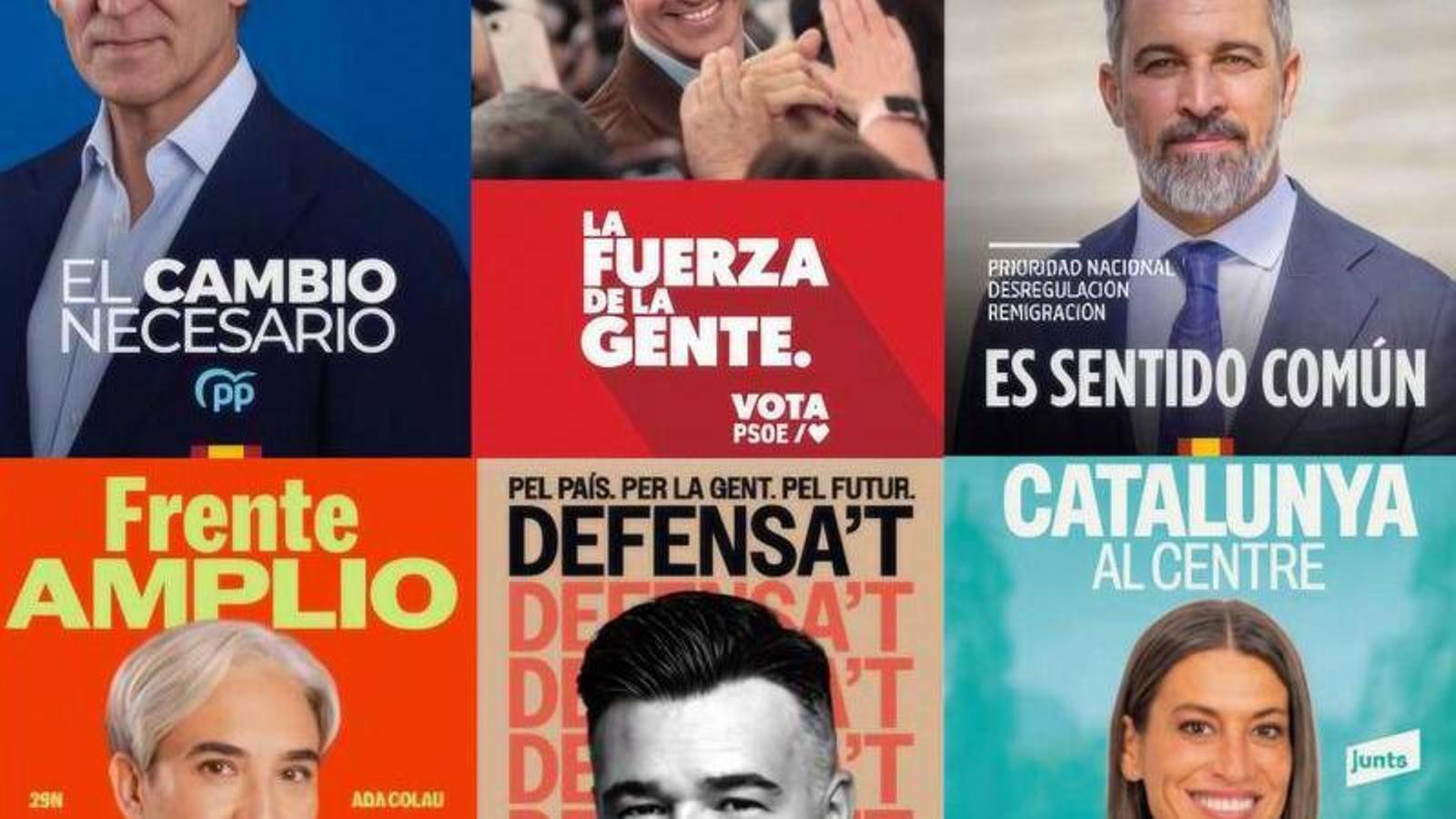
BarcelonaColau smiles at us from the banner, with her mouth closed and her name in small print, but on Thursday night, at the four-way debate, it seemed to me that her smile was widening. The candidate who writes her name in small print on the poster occupied a large space on the screen. With short, grey, undyed hair, she has cultivated in all her appearances an à la garçonne look, that of the women of the twenties who cut their hair to make it clear that they did not ask anyone for permission. Thursday it was more noticeable than ever, and she caught Feijóo by surprise, who seemed unaware of Colau's power. Hadn't anyone warned him?
Sánchez left the brown suit from the face-to-face debate in the closet and received Colau's work like holy water: a duet impossible to imagine a few days ago. He looked less tense, like on the campaign poster, where he laughs looking down amidst a crowd of people reaching out their hands to him. It is a reportage photo, with warm light and blurred hands in the foreground, and the red is relegated to the bottom half. If you look closely, he looks rounder in the face and a bit strange, as if retouched.
Feijóo and Abascal, when they are dressed for a rally, could perfectly well meet to have a vermouth at Plaça Artós: one with dark shirts to modernize his image, the other with the air of a hunter. At the debate, both dressed like a president. On the posters, however, they have not agreed on the tie. Feijóo, against a blue background, is not wearing one. Abascal is, with a white shirt, against a background where the green of Vox has disappeared. One takes off his tie to seem like one of the people; the other puts it on to seem like a president.
Nogueras, who I don't know why, when I see her, makes me think of Sant Cugat, has kept in all her appearances the white t-shirt, the blazer, and the wide jeans, in fashion. On the poster, cut out against turquoise, she shows us all her teeth: symmetrical composition and, since the slogan is “Catalonia at the center”, even the parting in the middle. In Congress, she is the deputy who seems annoyed with everyone; in Catalonia, she has decided to shake off the annoyance and distributes smiles left and right. It seems as if she is telling us: “I am not how you see me in Madrid. There I play the unpleasant one, but deep down I am a good girl. I am from here”.
And we finish with the most sought-after poster of the campaign, that of ERC, the only one that looks like graphic design and not a campaign one. High-contrast black and white, cut-out portrait, and the “Defend yourself” repeated in the background like wallpaper. Rufián looks like an album cover, with the same air as Marc Ribas onCuines: shaved hair with a quiff and a trimmed beard. He only lacks the tattoos and the biceps. It is no wonder that one has appeared on Wallapop for 100 euros. In the debates, however, Rufián gets serious and wears a tie, I suppose to compensate for the groupie effect.
One last detail: the color. Red on the left and blue on the right is the European tradition. The red comes from the workers' flag of the 19th century, and the blue was left for the conservatives. In the United States, it is the other way around: since the 2000 elections, the Republicans are red and the Democrats are blue. With the same poster, in Washington Feijóo would seem like a Democrat.
