More party than anger in Stephen Colbert's last show
CBS defends that the program was not profitable despite leading in audience, but many consider the closure to be giving in to Trump's designs

-
CAT -
CAST
Barcelona“Stand up, Jean Louise, your father is passing.” The memorable line from the film To Kill a Mockingbird, which encapsulates the dignity of the vanquished hero, could have sounded this Thursday night when the last episode of The Late Show with Stephen Colbert aired on CBS. The network insists that the decision to withdraw a format that has been rooted in the network since 1993 – when David Letterman hosted it – is purely financial due to the 40 million in losses it generated, despite being a leader in its time slot. But many see Trump's hand in it, considering that for eleven years the comedian has been one of the most critical of the American president, and that the network is making an unequivocal shift to the right.
This last episode, of an exceptionally long duration of 80 minutes, arrived with momentum. In the past few days, some of Trump's most famous enemies had been parading through the show, not afraid to tell him off. This is the case of Robert De Niro, the solidarity chef José Andrés (dressed in the Spanish national team's jersey) or Bruce Springsteen, who dedicated the song he performed to him: “You’re the first man in the United States to lose your show because we have a president who doesn’t know how to take a joke. And because Larry and David Ellison [owners of CBS] feel they have to lick his ass to get what they want. This one’s for you.”
The last day, Colbert was joined by his friends from the so-called Strike Force Five, also comedians Jimmy Kimmel, Jimmy Fallon, Seth Meyers, and John Oliver. And a few days earlier he had invited his predecessor, David Letterman, who didn't mince words in saying he was “mad” and didn't believe the official reasons given by the network executives, whom he called “lying rats”. The fact that he has achieved leadership with an audience of 2.7 million daily viewers on linear, plus millions of views of his clips on social media and platforms, but still loses money, raises doubts not only about his specific show, but about the format of late shows, which are difficult to monetize in the current landscape, where linear television is suffering an exodus of viewers. Beyond political motivations, networks don't know how to turn the notoriety they achieve with the viral moments of these programs into money.
In any case, the audience for this last episode will surely be very high. When Letterman said goodbye, he did so in front of 13 million Americans who wanted to watch his last show. Furthermore, the competition lent him a hand: both Jimmy Fallon and Jimmy Kimmel announced that they didn't want to compete with Colbert on this last day, so they decided not to air a new show and would only broadcast a rerun, with the explicit and unusual message that their recommendation was to watch this historic farewell. Despite the solemnity that could be expected from a farewell under these circumstances, Colbert tried to put on a show that was, let's say, normal, without any fuss. He didn't take the opportunity to lash out or get revenge on those who decided to cancel the show. After all, the news broke in July and, therefore, he has had a whole season to build his legacy and make his editorial line clear.
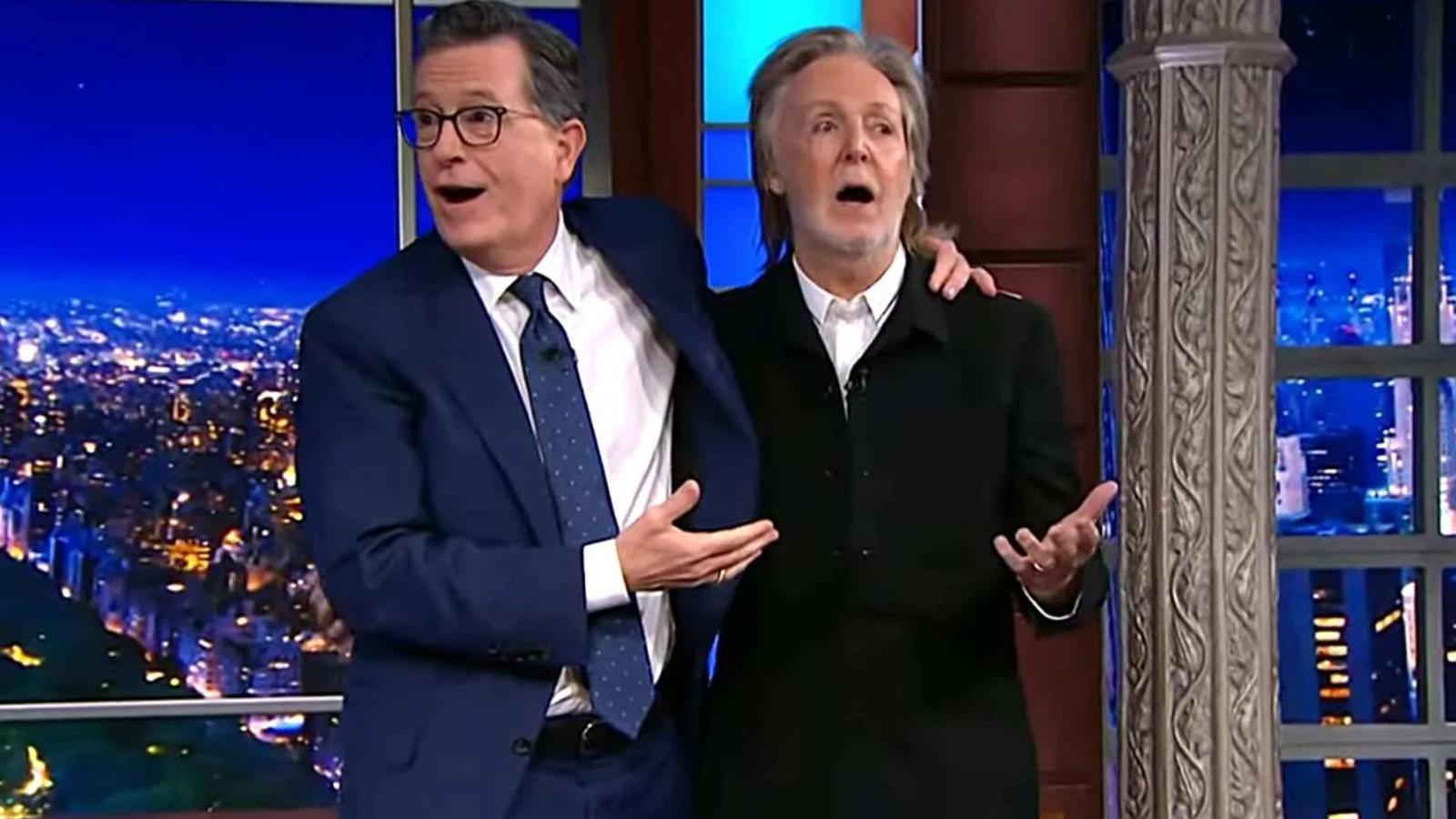
On this bittersweet night, the main guest was Paul McCartney, who was presenting an album at 83 years old, although the party ended with a performance of the song Hello goodbye by The Beatles. It was a choice that included a historic nod: one of The Beatles' most famous concerts in New York took place in this Ed Sullivan Theater where the Liverpool group performed... 62 years ago. On the other hand, the comedian had commented, when he had just started the show, that one of his life's illusions was to sing the song Jump up with Elvis Costello, and he finally made it a reality.
The tone was, therefore, more festive than vindicative. Towards the end of the episode, he did want to address the audience who had managed to get tickets to witness this historic program, and also the public at home, to launch his final message looking them in the eye and breaking the fourth wall: "The energy you have given us is what we have needed to make the best possible program for eleven years. We love making this program for you, but what we really love is making it with you," he concluded. In fact, when part of the audience booed when he said it was the last monologue, he immediately cut them off: "No, no, we have been very fortunate to be able to do it!"
Throughout the second half, a recurring gag explained that the program was about to be swallowed by the astrophysical phenomenon known as a wormhole. Time was running out, as it is inexorable in life and on television, and finally this bastion of healthy and humanistic criticism, of acid but measured humor, and of intelligent interviews that challenged the banality that is imposed in so many other areas became a memory. It is not yet known where this Atticus Finch of television will now direct his steps, fallen on the battlefield for having pointed out the emperor's nakedness.
