Barcelona prepares to experience the 'Sagrada Família effect'
The success of the blessing of the Jesus tower places the city between pride and fear of greater tourist pressure
-
CAT -
CAST
BarcelonaThe show had not yet ended and everyone already had it clear that the blessing of the Sagrada Família's Jesus tower would be one of the images of the year. This Thursday, the front pages of the world's press certified it. As in the '92 Olympic Games, Barcelona once again showed itself splendid in a global ceremony. The day after the event, it was easy to overhear conversations everywhere about the impressive effect of the drones recreating the figure of Antoni Gaudí or the beauty of the light show. Comments that, often, oscillated between pride in the image offered and reservations about whether this could lead to an increase in tourism in the Catalan capital.
The Barcelona City Council itself reproduced this dialogue in some way this Thursday. On the one hand, the second deputy mayor, Albert Batlle, congratulated himself because days like Wednesday allow us to "recover city pride and present the best image"; on the other, in an address to the media to talk about cruises and without directly referring to what had happened at the Sagrada Família, the fourth deputy mayor, Jordi Valls, defended the importance of regulating the tourist offer as is being done to "not die of success".
Within the municipal government, there is a conviction that, unlike the post-Olympic boom, this time the international projection catches the Catalan capital with a good part of its homework done. On the one hand, because the tourist accommodation offer has been limited for years and will be further restricted once the licenses for tourist apartments expire in 2028. On the other hand, because other measures have been taken, such as the increase in the tourist tax, the agreement to reduce cruise terminals, or the creation of high-traffic spaces to specifically manage more crowded areas.
The data continues to show Barcelona as one of the most profitable tourist destinations. This Wednesday, the Exceltur tourism employers' barometer on the first quarter of 2026 placed the Catalan capital as the city in the State where it is most expensive to stay –169.8 euros average price per room, 5% more expensive than in the same period a year ago– and also the one with the highest revenue per available room with 130.6 euros, 7.1% higher than in the first four months of 2025. According to data from the Barcelona Tourism Observatory, in April passenger records were also broken at the airport –5.1 million, 4.1% more than a year ago–. On the other hand, the number of cruise passengers fell by 16.4% compared to the previous April.
Beyond the impact it may have on visitors, the president of Turisme de Barcelona, Jordi Clos, maintains that with Wednesday's event, "a new universal icon has been born, full of symbolism that brings together and emits values of excellence, genius, coexistence, and entrepreneurship of civil society". "The Sagrada Família event once again highlighted this city's ability to organize historic moments that transcend time and go around the world, filling all citizens with pride," he defends, adding that "Barcelona consolidates its position as a city associated with success and progress".
Can more people fit in the Sagrada Família?
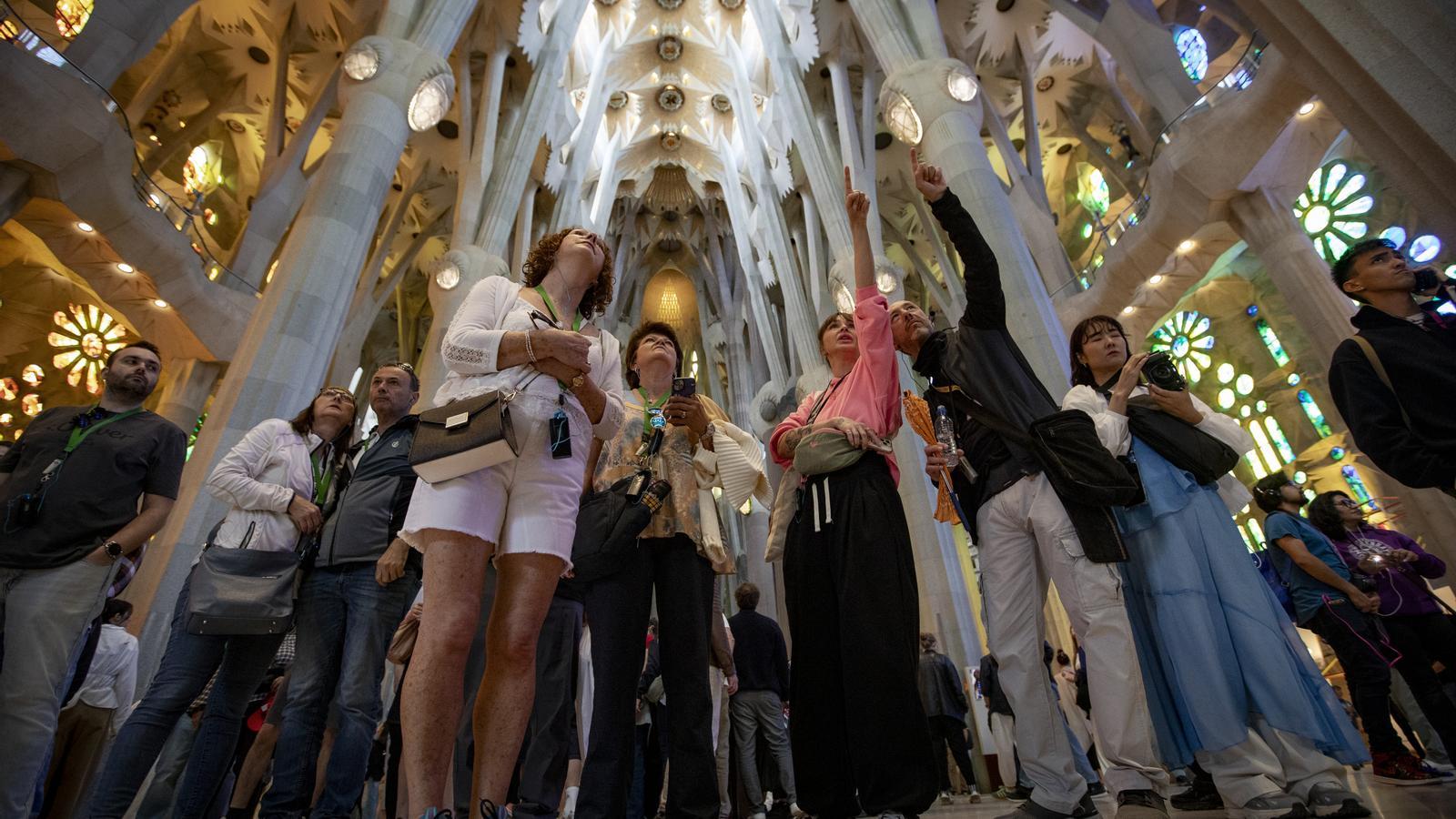
the spectacular blessing of the tallest tower of the Sagrada FamiliaRegarding the interior, the temple seems to have reached its maximum capacity for now. However, the delegate president of the Sagrada Família Construction Board, Esteve Camps, pointed out last March that in 2028 – once the tower of Jesus can be visited and there are more spaces to move within the temple – this figure will increase. Esteve also raised the possibility of extending the current visiting hours to be able to increase visitors. All of this, however, requires an agreement with the Generalitat. Outside the temple, however, residents assume that the pressure will grow soon.
From the travel agency association Acave, they admit that they are already perceiving an increase in interest in the Sagrada Família due to the completion of the tower of Jesus. However, they consider that Barcelona's international projection "has not stopped growing" since the Olympic Games and "today there is little that can be expanded."
The Barcelona brand
Beyond the trip of Leo XIV and the blessing of the Sagrada Familia, Barcelona will soon host the start of the Tour de France. Another major event with global impact that can boost interest in the Catalan capital as a tourist destination. The CEO of Summa Branding, Jordi Mateu – who founded the company, specialized in the creation, construction and management of brands shortly before the Barcelona 1992 Olympic Games – recalls the momentum the Catalan capital gained as a brand at that time. He believes that now, with the blessing of the Sagrada Familia, it has gained new momentum. "It was a great success to coincide the Pope's visit with the centenary of Gaudí's death, highlighting the relevance of the Sagrada Familia," he considers.
Repercussion in the world's press
The visit of Leo XIV to Catalonia and, especially, the spectacular blessing of the tallest tower of the Sagrada Família, have placed Barcelona at the center of many gazes around the world. The ten minutes of spectacle, with choir, lights, and drones in the sky, have attracted attention to the temple of Antoni Gaudí, an architect who is, from today and if possible, a little more global.
The front pages of the international press highlight the ceremony this Wednesday evening at the Sagrada Família, where the pontiff presided over not only a mass, but also a whole show to bless the central tower of the basilica, the tower of Jesus, all of it the culmination of a trip that has taken him over the last two days to other emblematic venues in the country, such as the Montserrat Abbey on Wednesday morning.
The New York Times recounts the celebration of the blessing by the Pope, but also focuses on the open debate surrounding the temple and its urban environment, and recounts the conflict with neighbors over possible demolitions necessary to complete the facade of Glory. CNN highlights the symbolic dimension of the Sagrada Família as a world icon of Barcelona and Gaudí's architecture. NBC News covers the event and describes it as a "ceremony of high visual and architectural impact".

In the United Kingdom, BBC and The Guardian have focused on the influx of people and the symbolism of the visit. The BBC particularly highlights the visual component of the spectacle after the mass and the international projection of images of the Sagrada Família illuminated.
The Italian newspaper La Repubblica speaks of a "majestic spectacle" in Barcelona and highlights the ceremony inside the temple and Gaudí's role. Corriere della Sera also focuses on the images with drones and the staging of the event, especially the projection of Gaudí's face in the sky. In France, media such as Le Monde, Le Figaro and Libération have noted the Pope's message against war and also the urban and tourist tensions around the Sagrada Família.
The Pope and Catalan
Regarding language, several international media outlets have highlighted that the Pope used Catalan during some moments of the trip. In fact, Reuters explicitly reports this and links it to a gesture towards local identity, noting that the pontiff once again used Catalan as a language of closeness in a territory with its own identity within Spain: "«Dear brothers and sisters, Leo opened his homily in Catalan, evoking the region's distinct cultural and political character".

