The Sagrada Família closes the debate: Barcelona imposes itself on Madrid
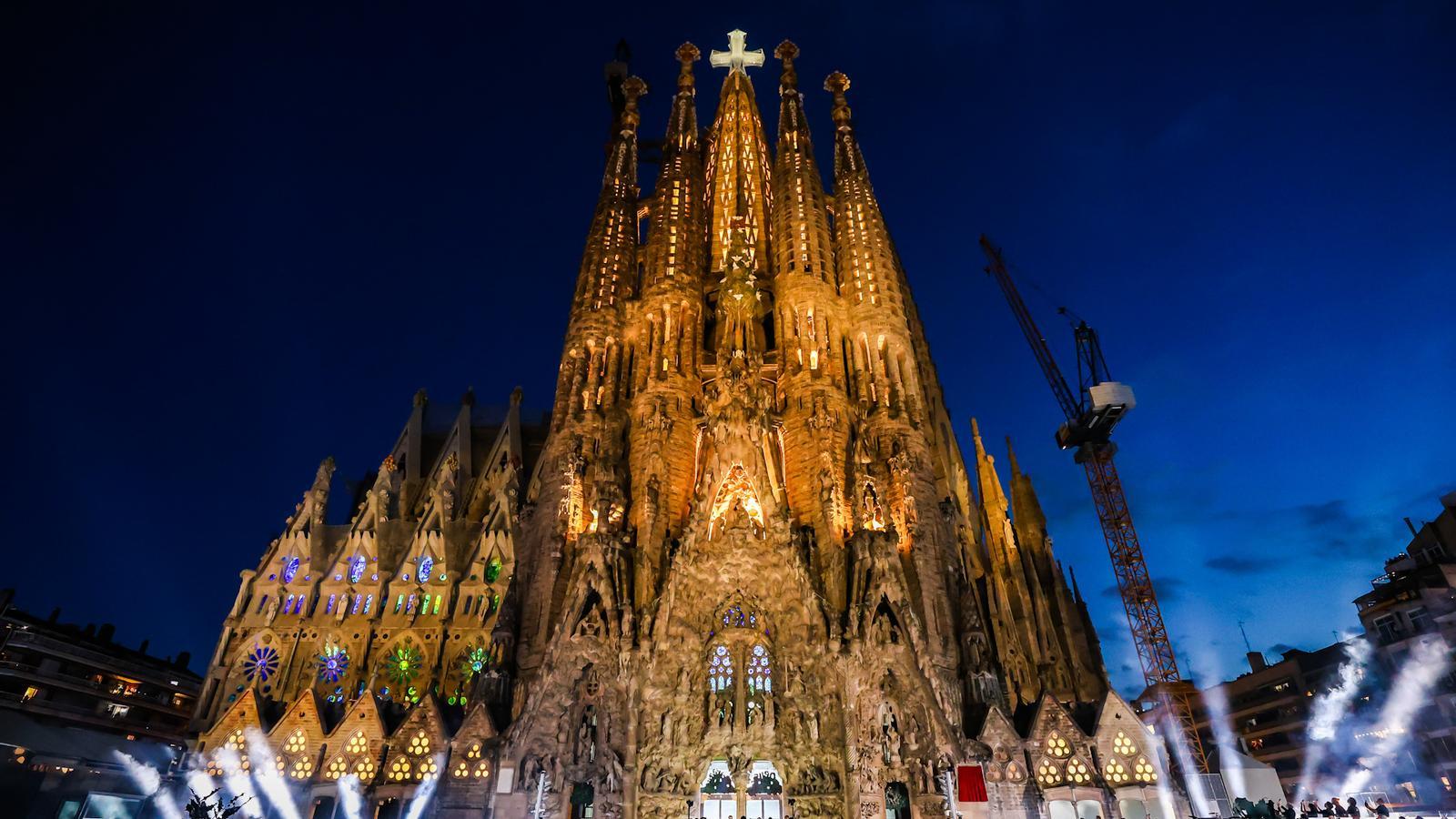
BarcelonaThirty-four years later, Barcelona is once again dazzling the world while Madrid sees that three decades of turbo-capitalism and concentration of resources and power have not served it to shorten distances with the Catalan capital when it comes to achieving a global impact like that of 1992. Thirty-four years later, Madrid has not only not had the Olympic Games, but has had to see how the blessing ceremony of the tower of Jesus of the Sagrada Família by Leo XIV has taken all the praise and headlines in the world press and left the visit of the Pope himself to the Spanish capital a few days earlier in an absolute second place. And this without going into comparing the quality of what has been seen in Catalonia in recent days (cathedral, Lluís Companys stadium, Brians, Montserrat and Sant Agustí) with the events in Madrid, particularly the performances with an evangelistic air at the Santiago Bernabéu.
Madrid has only been able to be competitive in one thing, crowds, due to the great firepower of religious education in the capital of the State. But Madrid has neither a cathedral with Romanesque roots, nor a millennial monastery, nor a modernist architectural masterpiece of the magnitude or magnetism of the Sagrada Família, which today is already a world icon. It can be thought that Madrid already had the game lost before it started. But it was not so evident that it would lose it by a landslide. And this is because, beyond the organizational capacity of one and the other or the artistic sensitivity and sense of spectacle typical of the Catalans, this visit has highlighted something more: a clash of models that is also a clash of worldviews.
The Madrid model is based on accumulation, on infinite growth, on the belief that quantity always triumphs over any quality. In this sense, few cities in the world can offer such a massive welcome to a pope as the Madrid that aspires to be a kind of European Miami. But if the great idea you can offer the world is that of two radio commentators narrating a supposed football match with the carajillero air that is its trademark, then something is wrong. What happens is that, simply, in Madrid they didn't think they would have to try harder because they believed that being... Madrid was enough.
City of wonders
On the other hand, Barcelona is a city that has always had to strive to stand out within a state that has historically been hostile to it. For this reason, unlike Madrid, its main monuments have been built with private capital and the City Council has had to invent major events to overcome old constraints: from the 1888 Exhibition to the 1929 one, passing through the Games and the Forum. Barcelona is, in effect, a city of wonders because it has had to fend for itself and has always had a clear awareness that opportunities must be seized, because no one gives anything away in this world.
It is surprising that it seems as if Madrid has now discovered the power of attraction of the Sagrada Família and, above all, that it has been aware that such a work cannot be bought. Gaudí's building seems designed for the era of TikTok and Instagram, it is unbeatable because it is unique and inimitable. That political leaders like Isabel Díaz Ayuso or anti-Catalan polemicists like Juan Soto Ivars have had to make the gesture of praising this Wednesday's staging shows how much they did not expect it. In fact, the news about the Pope disappeared from the top spots on the websites of Madrid newspapers as soon as the pontiff left his city. Just the opposite of what the international media did.
And then there is the political reading. Much has been written about how the Pope's visit has been a breath of fresh air for Pedro Sánchez at a particularly critical moment for him because he has come to legitimize both his migratory discourse and his international and defense policy. But the fact that there were 14 ministers at the Sagrada Família on Wednesday also shows that this government needs to adopt the Barcelona model to contrast it with the Madrid model. The one who saw it best was Óscar Puente, always attentive to the pulse of social media, contrasting Barcelona's "creativity" and "good taste" with the Madrid old guard.
For the Spanish government, Barcelona represents social democracy, attempts to contain market drift in the real estate sector, social and sustainable policies, but also innovation and entrepreneurial culture in contrast to the Madrid "cash-cow" mentality. What they may not know is that all this is not new, but stems from a specific national idiosyncrasy that, among other things, allowed a cultural movement like Modernism to flourish, a bourgeoisie with a national consciousness, and a genius like Antoni Gaudí.
