Enric Auquer: "Left-wing people have become very conservative because the future is very disgusting"
Actor

-
CAT -
CAST
BarcelonaGentrification, occupation and housing crisis are just some of the themes that Ravalejar touches on, a 100% Barcelona series that is now available on HBO Max after its run at the Berlin festival. The fiction, which will be shown on 3Cat later, is inspired by the family history of its creator, Pol Rodríguez, who saw his parents lose their restaurant, Can Lluís, due to an investment fund. In Ravalejar, the protagonists are the owners of Can Mosques, a centenarian restaurant in the Raval whose continuity is threatened by the appearance of a fund that wants to evict them from the building where they are located. Enric Auquer (Rupià, 1988) plays the son who is capable of crossing all limits to save his parents' business. Pol Rodríguez also directs the series alongside Isaki Lacuesta.
Ravalejar is a very Barcelona series. How would you explain what Barcelona is like nowadays to someone from outside?
— I find that I don't feel like I'm from Barcelona. I live there, but I wouldn't say I'm from Barcelona. I came here when I was 18, but I have seen it change a lot. I'd say it's a city where people still live well, but it has deteriorated and will deteriorate further. I always romanticize and imagine that I would like to live in that Barcelona that was still a Mediterranean port, which was dirtier, uglier, and more dangerous. More real. There was more neighborhood, more people in the streets, more children in the streets. The other day I was talking with a friend who is doing a doctoral thesis on the dockworkers of the port of Barcelona and he told me that one of the things he noticed is that the union struggle has changed, but because people are more individualized. That is to say, they [the dockworkers] returned from the port to Barceloneta and went to the cafés and the square, where the women were chatting, the children were playing. And they, in the café, chatted, and I don't know, that's where the political struggle took place. They worked not for the dignity of the job, but for the dignity of the neighborhood, of the families, the dignity of everything. Left-wing people have become very conservative because the future is very disgusting. I think the city lacks a sense of community.
You have rolled in El Raval.
— For three months I have been filming in the same place and you start to see the dynamic of Carretes street. You realize it's an absolutely police-controlled neighborhood. It's a ghetto where there is much more poverty than in many other places, where different races, religions, and cultures live together, but it's the neighborhood in all of Barcelona where you see the most children playing alone in the street, without parents. Children of all ages and absolutely free: Catalan children playing with Senegalese, Moroccan children, and Sikh children and children from Pakistan who speak Urdu among themselves. It feels like the healthiest neighborhood in Barcelona, deep down. It's an incredible neighborhood, but of course, there is a lot of poverty and a lot of inequality. If a tourist with a watch worth 50,000 euros comes and enters the Raval, what do you expect, dude? They will rob you. What do you want? It's like going up to a person who has never eaten and standing in front of them with a plate of spaghetti that you eat while looking them in the eye.
Your character, Àlex, is the family member who first takes action, with a bit of recklessness.
— It's what's cool about the series, that you don't really know what's going to happen and the character doesn't know what they're doing either. I would define Àlex as a very excited guy, he thinks what he's doing is what should be done. He's a noble guy, who believes he has to solve the family problem.
For him the end justifies the means?
— I think so. It fits the logic of saying: "It's an investment fund that comes to our city and for which this is a business." He thinks that if he manages to make this business unprofitable, perhaps they will want to sell the property. What happens is that he will end up justifying unjustifiable things.
Alex takes action, but, on the other hand, his mother, Elisa, initially prefers not to raise her voice.
— This series is very masculine: it shows a problem and turns into a very masculine thriller. Elisa feels ashamed of the eviction, she believes people will think they haven't known how to run the business. This shame is repeated in all victims, both when you are a victim of abuse and sexual assault or moral violence. I really like Elisa's journey, which goes from shame to seeking collective help. In the end, she is the one who ends up triumphant.
Do you think as a society we are doing enough to protest the housing crisis?
— We are doing little, very little. It seems that being militant in this is a marginal thing, it's hard to get it going. I think we should make it fashionable, because Barcelona will get worse if we do nothing. I have been to Manhattan, London, Paris, Rome, and it is much worse there than in Barcelona. Barcelona will be much worse because the expatscome to live here. The climate is good, they can work remotely, and they are people who earn 15,000 euros a month. A rent of 3,000 euros doesn't matter to them
Why do you think it's so hard for society to mobilize?
— Why do you think it is so difficult for society to mobilize?
You have participated in different demonstrations, for example to stop the eviction of Casa Orsola. When you go, do you think that the fact that you are there can influence someone?
— I don't live life with this awareness. With Casa Orsola I did realize it, but also because the Union wanted to use it. I have been to other evictions and other demonstrations and no one has come to ask me anything with a camera.
Have you ever considered not talking about political issues for fear of it harming you?
— Have you ever considered not talking about political issues for fear of repercussions?
So far, has it ever been a problem for you?
— So far, has it ever been a problem for you?
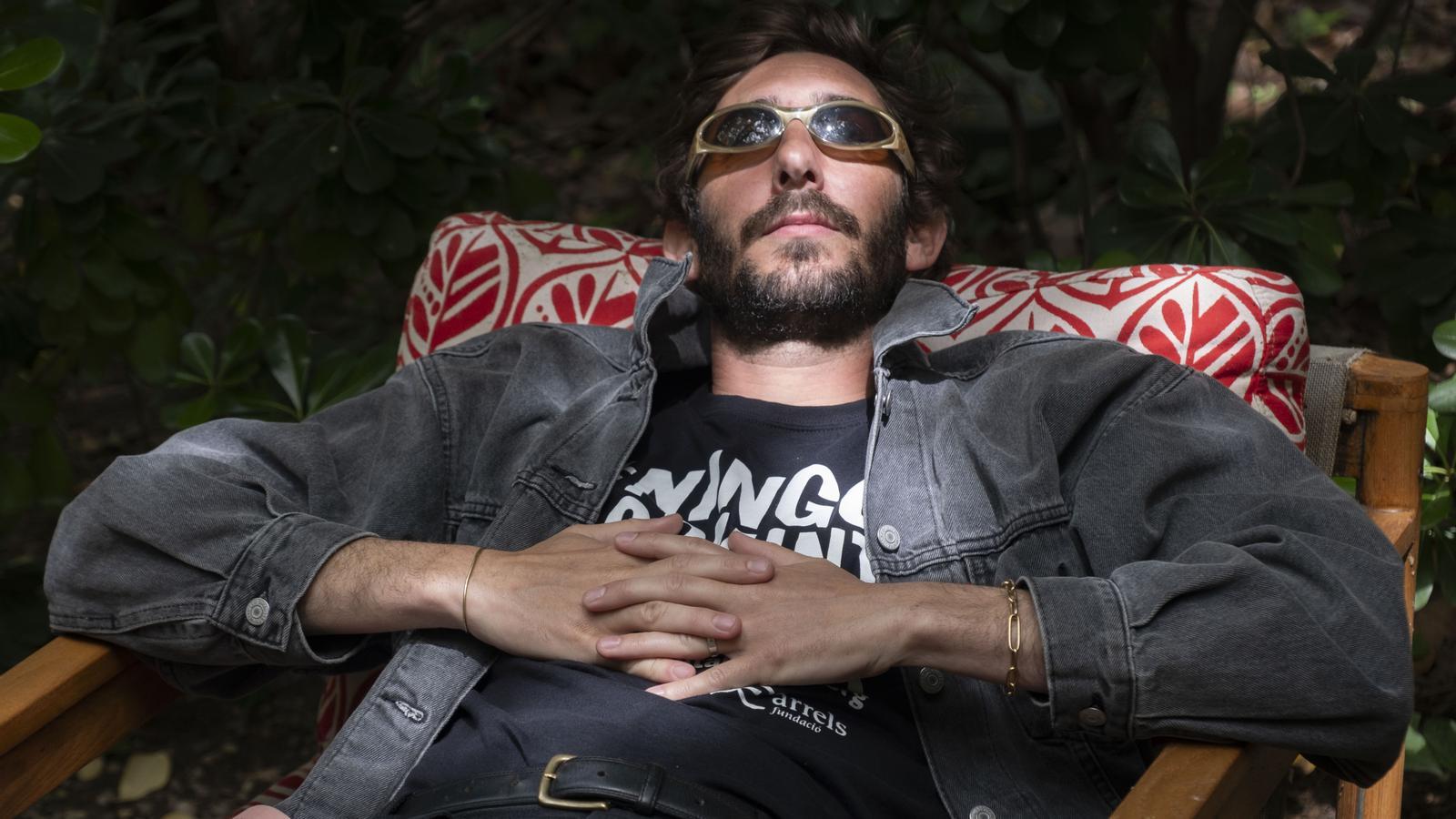
Today you are wearing a t-shirt from the Arrels Foundation. Why?
— Today you are wearing an Arrels Foundation t-shirt. Why?
You were talking about your children before. Have you considered what Barcelona will be like where they will live as adults?
— You were talking about your children earlier. Have you considered what the Barcelona they will live in as adults will be like?
