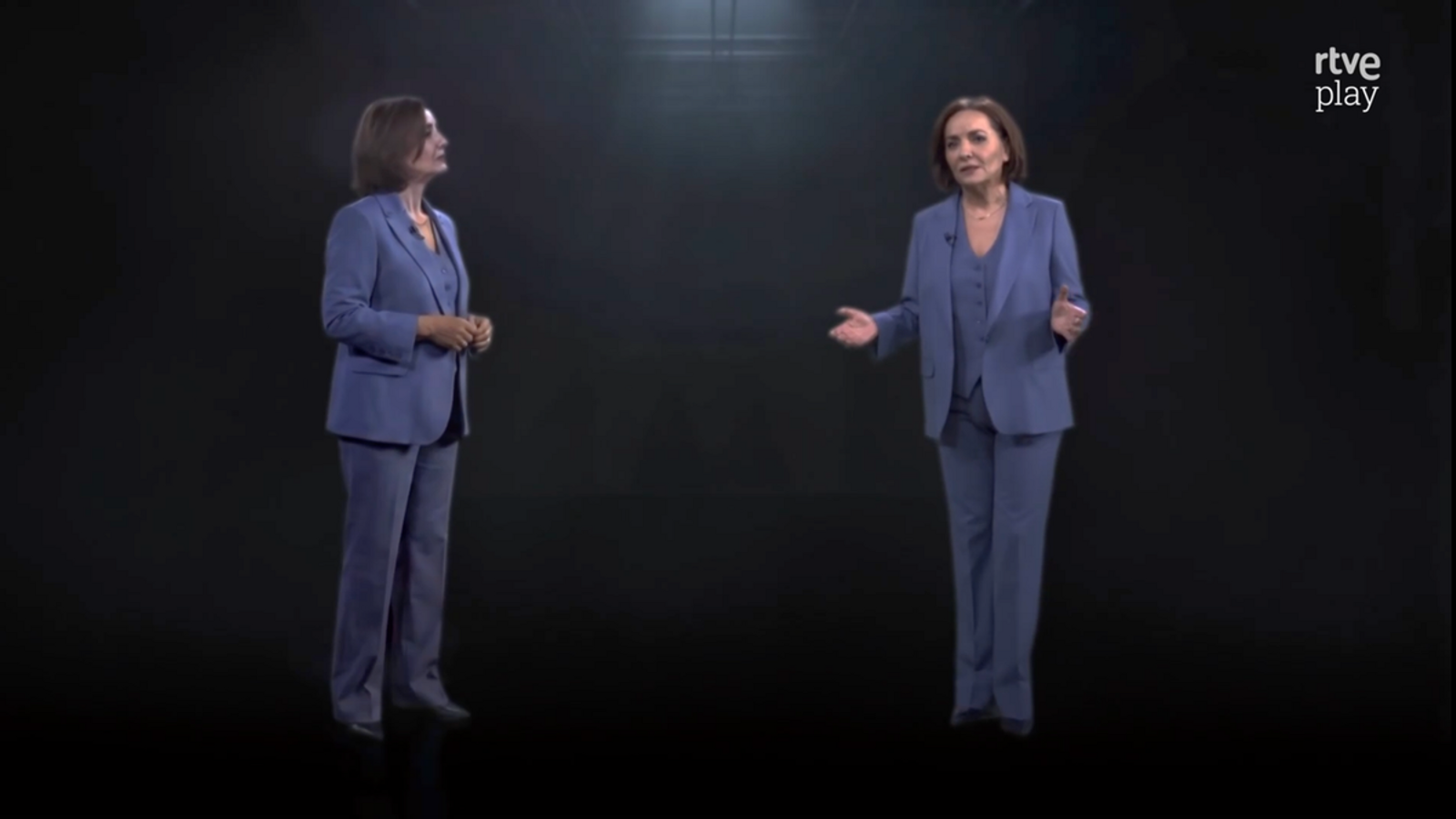

Monday evening, Pepa Bueno warned viewers that that edition of Telediario was different. She gave way to images of a fire in a residential neighborhood and hinted to the audience that perhaps they noticed something strange. She then revealed that neither that fire nor those firefighters existed but that they had fabricated the sequence with AI. The presenter had the augmented reality layer in her studio removed and the table and chair made to disappear. “And me? Am I really me? Well, I will tell you that during these seconds you have neither seen nor heard the real Pepa Bueno”. And, suddenly, a second image of her, duplicated, appeared on screen to make a great existential dilemma obvious to the viewer: the doubt between reality and fiction, or between truth and lies. “Seeing something on screen is no longer a guarantee of anything,” Bueno sentenced. The second half of Telediario was a special program to delve into the possibilities and dangers of artificial intelligence.The news report warned of the risk of manipulating collective memory by altering past images, or constructing statements that have never been made. It explained how AI is used in economic fraud, in wars, and in defense strategies, and how cyberspace control works. All this was accompanied by a reflection from an ethical perspective, perhaps a bit optimistic. The apocalyptic narrative was balanced by also exposing the benefits of AI in treating diseases, in education, or in culture. To conclude, it speculated on how AI would transform the future by delving into its consequences on our brains and on population control, and by posing in a very elementary way the difficult balance between technology and humanity.It was a different Telediario, as they had announced. Experts in the field might consider the informational journey a bit superficial or unoriginal. But it made these reflections very accessible to a very diverse audience, not necessarily accustomed to this type of debate. The dissemination is intended for the most inexperienced. The Telediario perhaps fell into some very common clichés when reporting on AI, such as resorting to iconography that attributes a symbolic female face to this technology where the brain is replaced by futuristic wiring. Or using distressing images of people obeying a screen like soldiers.But the ability to attribute a volatile format to the news, with an organic fluidity in linking topics and the skill to adjust narrative forms to the context, was original. Future news programs should no longer be conceived from the studio or cameras, but from the ways viewers look and perceive. Faced with the increasingly blurred line between truth and lies, journalism that can explain itself is more essential than sophisticated journalism.
