Keir Starmer throws in the towel, victim of his own mistakes
The Labour leader leaves less than two years after his electoral victory and leaves a clear path for Andy Burnham's arrival at Downing Street

-
CAT -
CAST
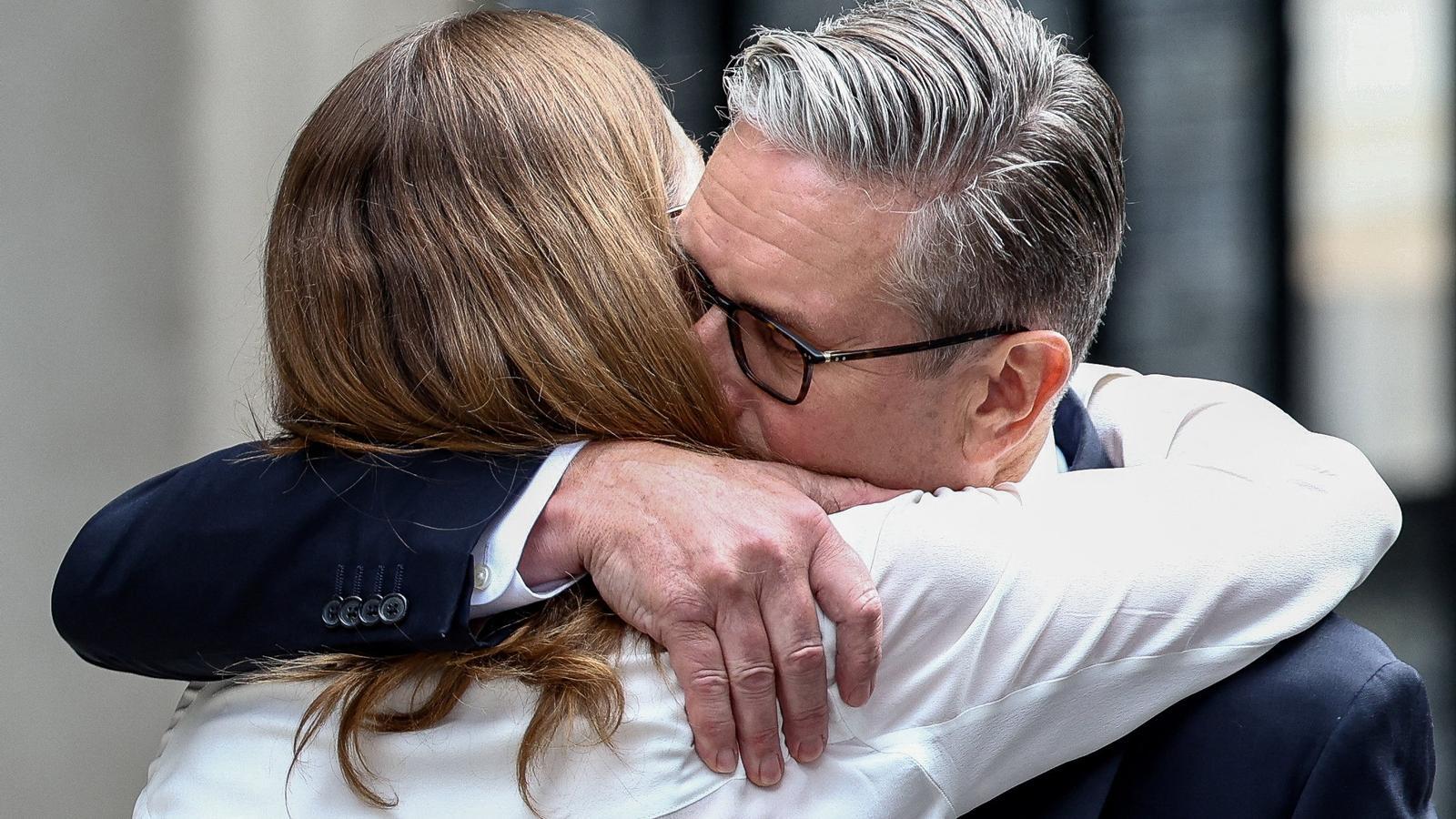
LondonA tearful and emotional Keir Starmer, Prime Minister of the United Kingdom for less than two years, announced this Monday that he is stepping down in a speech of just over six minutes. After a weekend of reflection at his country residence, and having communicated his decision to King Charles III, the premier has come to the conclusion that everyone around him had already accepted, perhaps less so himself. But the pressure has finally become unbearable given the evident lack of support within the Labour parliamentary group.
He himself acknowledged this from the lectern in front of the famous black door of number 10: "The question my party has now asked itself is whether I am the most suitable person to lead us to the next general election [initially scheduled for 2029]. I have listened to the response of my parliamentary group to this question, and I accept it with sportsmanship and elegance.
Starmer's farewell was accompanied by the Ode to Joy as a background soundtrack, an evident reference to Brexit by supporters of the European Union. All of this is a sign of the great political instability that the United Kingdom has fallen into since the referendum, which this Tuesday marks a decade since it was held. The next occupant of Downing Street – almost certainly Andy Burnham, former Mayor of Greater Manchester – will be the seventh British Prime Minister in ten years.

Starmer made the announcement of his resignation trying to defend his legacy: "Look at what we have achieved in just two years: a stronger economy, moving faster than our competitors; wages that have risen above inflation every month since we came to power. We have secured investment, infrastructure is being built, we have ended austerity; we have achieved the fastest reduction in NHS waiting lists in seventeen years…"
the scandal surrounding Peter Mandelson's appointmentAmong the most controversial episodes of the premier in office are the withdrawal of heating assistance for millions of pensioners, which he later had to reverse; cuts or reforms in certain social benefits, and a flat economy. Added to this was the scandal surrounding the appointment of Peter Mandelson as ambassador to Washington, despite his known links to the paedophile Jeffrey Epstein. Starmer appointed him and had to dismiss him nine months later (in September 2025). All of this has contributed to the image of a clumsy, cautious, technocratic, and continuity government, without ambition, project, or narrative, far from the profound change the country expected after fourteen years of Conservative executives.
He resigns, therefore, and the period to elect a new party leader and prime minister begins. Starmer has detailed that he will ask the national executive committee of the Labour party to set a timetable for candidacies to open on July 9 and close a week later.

One more than probable coronation
Although, as pointed out, he has accepted his parliamentary group's decision "with elegance", Starmer leaves convinced that the party is making a serious mistake and is imitating the chaos that the Conservative Party fell into, with Theresa May, Boris Johnson, Liz Truss and Rishi Sunak between 2016 and 2022. Despite this, the still Labour leader has assured: "I will give my successor my full and unequivocal support, knowing that he will inherit a United Kingdom much stronger and fairer than the one I inherited two years ago, better prepared to face the challenges ahead and in a better position to ensure that the Labour Party achieves a second term in government".
The first unknown of the day was resolved with the usual choreography. Silence early in the morning at Downing Street, no leaks and acceptance of the resignation, which was not made official until the prime minister's office staff began to set up the public address system and lectern outside Downing Street.
And a couple of hours later, the second was practically resolved. In all probability, Andy Burnham will be crowned. It has been practically confirmed after former Health Secretary Wes Streeting, one of the contenders to succeed Starmer, who had publicly expressed his intention to challenge him, announced in an open letter that he supports the former mayor of Manchester.
It is unlikely that any other MP will obtain the necessary support to present themselves as an alternative to the former mayor, who, on his journey from Manchester to the British capital, confirmed for the first time what was already well known, that he would aim to take the position of "premier". In a brief message on X, he assured that Starmer's decision "marks the beginning of a transition", and that "it is important that this process is carried out in an orderly and responsible manner". "I will present my candidacy within the framework of this process", he added.
The clear path to Burnham's coronation is practically open, then. Once his nomination is effective, and if he has no official rival to face, he will have to start answering some of the many questions that, de facto, he already has before him: from who his Minister of Economy will be to whether, as some of his new bench colleagues have already asked him, he will call new elections to achieve a new mandate. In the memory of Labour's history is the succession of Tony Blair by Gordon Brown, who after many doubts refused this possibility, an issue that haunted him for the three years his government lasted (2007-2010).
