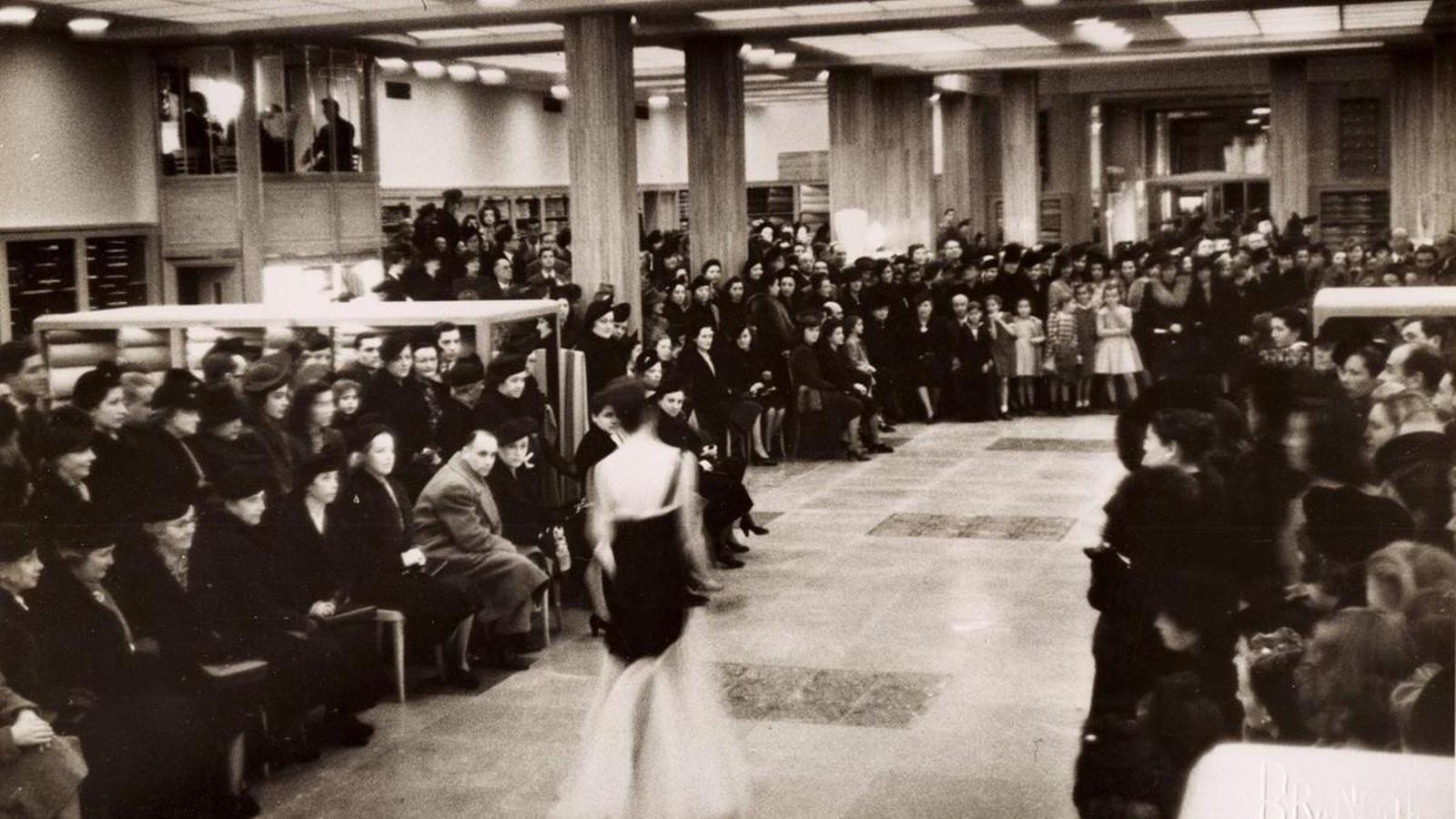
BarcelonaImagine going back a hundred years, to the Barcelona of 1926. Cinema was still silent and a fashion show could be, literally, an extraordinary spectacle. In Paris, the great houses had begun to use those presentations to showcase the new collections of the designers of the era, but in Catalonia, no one was doing it. Located at the Pla de la Boqueria, Santa Eulalia saw the opportunity and decided to import the formula. “We were pioneers thanks to the vision of my grandfather,” recalls Luis Sans, fourth generation at the helm of the house, founded in 1843. In that adventure, Pere Formosa also played a key role, having started as an apprentice and ending up becoming a master of the house and the driving force behind that event
Facade of the Santa Eulalia department store at the Pla de la Boqueria, in 1933.Santa Eulalia
The first experience spread by word of mouth among the clients, who were invited to see the season's new proposals paraded on so-called “living mannequins.” The anticipation exceeded all expectations: “It was such a huge success that in subsequent seasons it had to be by strict invitation, because everyone wanted to come,” explains Sans. Back then, seeing a collection paraded was to access a novelty arriving from Paris and to discover firsthand what it meant to dress modern.
The celebration at La Paloma of the 100 years of the first fashion show.Marc Medina
100 years later, that exclusive spectacle has turned into oversaturation: any fashion show can be followed from a mobile phone and at any time, but the capacity to attract an audience persists. This Wednesday, more than 500 guests from Catalan culture gathered at La Paloma to celebrate the anniversary. Carlos Godó, Gonzalo Rodés, Javier de las Muelas and Lázaro Rosa-Violán were some of the attendees at a night of music and audiovisual projections that also served to present Heritas, the commemorative perfume of the house, with scented scarves as a nod to its textile origins. A celebration that invites one to look back, but above all forward: what remains today of that way of understanding fashion, luxury and desire?
From the unique piece to the democratization of fashion
Behind those first fashion shows there was an entire artisanal mechanism. The garments were made in the Santa Eulalia dressmaking workshops based on drawings that an illustrator created following the designer's instructions. A single copy was made in a model's size, and during the show, the clients would note down the numbers of the dresses they liked to order them afterwards. They did not even try them on: “A salaried model would put them on again in front of them, and from there, the fittings and possible modifications would begin,” explains Luis Sans. A slightly longer sleeve, a more closed neckline, or another color of the same fabric were some of the options. “Customizations could be made, but the designer of the piece always had the final say,” he emphasizes.
Four models pose with Santa Eulalia creations next to a classic convertible car at the Palau de la Virreina in Barcelona, in 1964.Santa Eulalia
Of the entire universe, Sans also preserves a childhood memory. As a child, he loved accompanying his mother when she went to try on haute couture dresses. While the dressmakers worked, he would roam the fitting rooms with a small red horseshoe-shaped magnet, looking for the needles that had fallen to the floor. "I would pick them up one by one and keep them in a little box," he recalls. Decades later, that boy would end up running a house that would have to learn to transform as fashion did as well.
Haute couture began losing ground from the second half of the 20th century onwards in the face of mass-produced, sized fashion, which was more accessible than custom tailoring. Santa Eulalia also incorporated ready-to-wear, following the sector's evolution, and in 1968 it presented its first collection. For Sans, the fact that haute couture has been reduced to a minority does not mean it has lost its reason for being. "It continues to be a laboratory of ideas and creativity and a source of inspiration," he defends.
Santa Eulalia delivery vehicles during the 1940s.Santa Eulalia
At the same time, the house had been expanding its trades. Installed then at number 93 of Passeig de Gràcia, its current location, it promoted men's tailoring and shirt-making services. At its moment of maximum expansion, Santa Eulalia would come to have 750 employees, many of them linked to its sewing workshops.
A model wears a dress from the 1954 Santa Eulalia collection.Santa Eulalia
At the end of the century, a much more drastic decision would arrive. In September 1995, it held its last fashion show for its own collection. In the nineties, Sans had detected that new generations increasingly preferred to wear the great international designers, who were beginning to expand their stores around the world: “A local design that did not have an international dimension was increasingly less appreciated.” The house had to grow as a brand or change its model: “We could not stay in the middle,” he adds. The own collections disappeared, but not the craft. Santa Eulalia kept the tailoring and custom shirt-making, which today represent around 5% of the business, according to Sans. The current manager considers them a “spearhead and a hallmark.”
To survive means to know how to change
Always adapt. “That is why the house has survived for 183 years,” states Sans. The abandonment of its own collections gave way to a new model based on a careful selection of clothing and accessories from major international brands, combined with contemporary labels such as Jacquemus, Toteme, Khaite, and The Row. “It doesn’t all end with the big names,” he argues. Santa Eulalia thus reinforces its role as a space for curation, with unique proposals that are not found everywhere. The change was also made visible in the space. The comprehensive renovation in 2011, commissioned to the American designer William Sofield, pursued a very specific idea: to create a genuine store capable of preserving the memory of a house founded in the 19th century without turning it into a museum.
Sketch of a dress from Santa Eulalia's own collection from the early 70s, like those that served as a starting point for making the house's creations.Santa Eulalia
Santa Eulalia has also reinterpreted what it means to offer luxury. Especially considering that, on Passeig de Gràcia, the establishment competes head-to-head with the boutiques of the big brands. For Sans, it does not depend only on the product or the price, but on the quality of service and the ability to adapt to each client. “Luxury is feeling well taken care of and feeling heard,” he summarizes. Sans also observes changes in the way locals in Barcelona dress. Despite acknowledging that informality is a global trend, he believes that in the city there is a certain fear of standing out: “Let’s say we have lost our sparkle,” he summarizes. A discretion that coexists, paradoxically, with bolder young people who continue to see Santa Eulalia as a physical space of modernity in the full digital era.
The legacy continues
The future of the establishment is yet to be written. Sans has three children and none of them work at Santa Eulalia today. When he took over the family business in 1988, at just 22 years old, his grandfather gave him the choice of whether he wanted to run it. Now he wants to respect the same freedom: "I would be thrilled, but they will have to decide," he concludes. The fifth generation, therefore, is still an unknown.
Perhaps that is where the challenge of any legacy lies: to preserve enough of the past to maintain identity over time, but not so much as to get trapped in it. Currently, Santa Eulalia no longer puts on fashion shows or dictates what Barcelona will wear the following season. The celebration at La Paloma, a hundred years after the first show, spoke a different language, but it kept the perennial challenge intact: to generate expectation and desire.
Santa Eulalia store.Santa EulaliaInterior of the Santa Eulalia store.Santa EulaliaNew Santa Eulalia perfume.Santa Eulalia
A new “invisible suit”
The launch of a new perfume in a year of celebration is no coincidence. Perfumery has been gaining ground within the house and today represents approximately 7% of the business, according to Manuel Giraldo, head of the section. Santa Eulalia revived its perfume line in 2014, and 10 years later decided to give it a new boost, with Barcelona and niche perfumery as its cornerstones.
Heritas, the novelty presented on the occasion of the centenary, translates the world of fashion into olfactory language. Created by Barcelona perfumer Chris Maurice, it is structured like a fashion show in three acts: it opens with frangipani and white flowers; it evolves towards a heart of vanilla and iris, and ends with sandalwood, benzoin, and white musk. “We wanted to create a perfume that would become an invisible suit, a piece of haute couture that you could wear,” explains Giraldo. An olfactory veil, unisex and contemporary, with which the house also transfers its legacy to the skin.