"The situation of Catalan is like that of the trains, it requires shock measures"
Specialists analyze the strengths and weaknesses of the Government's language policies over the last 12 months

-
CAT -
CAST
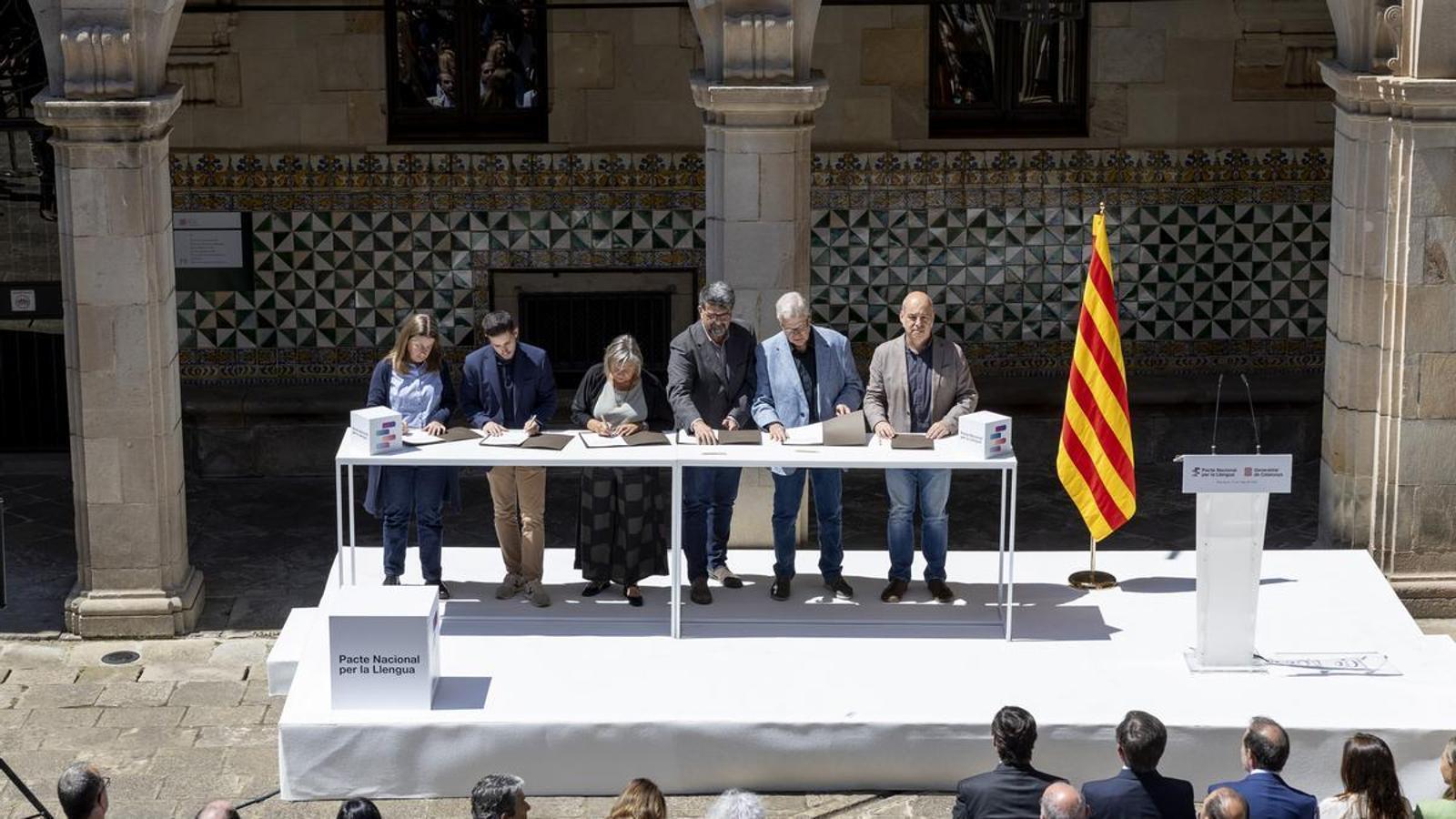
BarcelonaA year has passed since the signing of the National Pact for Language, which was meant to mark a turning point in the linguistic policies undertaken by the Generalitat of Catalonia, with the horizon of 2030. In this time, the main agents who were not present at the Institut d’Estudis Catalans meeting, such as Junts, the CUP, USTEC, or the ANC, have not joined, but municipal policy has been decisively activated, and more than 200 town councils in the country have joined, assuming their role in promoting the language. A line of aid has been created so that they can offer Catalan courses.line of aid so that they can offer Catalan courses.
The National Pact for Language represented "the political, civic, and social awareness" that Catalan is in a crisis of use that for years had been made invisible or viewed positively and was accompanied by a record budget: 255 million in the first year. The Department of Linguistic Policy also foresees, if approved, a budget of 85 million, which contrasts with the 30 million that Linguistic Policy managed ten or twenty years ago. a budget of 85 million, which contrasts with the 30 million that Linguistic Policy managed ten or twenty years ago.
The Pact marked some very specific milestones, such as the goal of achieving 600,000 new speakers in five years — when in the previous five years, half, 267,600, had been gained. For this reason, the minister announced a shock plan for adult Catalan learning with 140,000 places in 2026, and a supplementary increase of 50,000 places for basic courses for immigrants who are regularized exceptionally and for whom residence is requested. residence is requested. If the action in Catalan courses has been decisive, in other key areas such as education, university training, teacher training, justice, commerce, and the official status of the language, progress has been more scarce and sporadic.
The Government will provide a quantitative assessment of the pact next week. ARA has asked experts for a qualitative assessment of the start of the National Pact for Language in its first year of deployment.
What is the best or what has been done well? What is the worst or what has not been done?Marius Serra
Writer and member of the IEC
1.“It is good to start focusing on the true linguistic conflict, which is the marginalization and subsequent substitution of Catalan in the territories where it is the native language, after years and years of complacent depoliticization. It is good that the Catalan language is put on the political agenda and that resources are allocated to educational offerings, with the understanding that Catalan must be a factor of social progress for those who learn it”.
2.
“The vigor shown to enforce existing linguistic norms is insufficient, the imprecise response to the ruling on Spanish in classrooms, the timidity in crossing regional boundaries, and the requirement of Catalan in all administrative spheres. The sociolinguistic situation is similar to that of the railway network and, therefore, requires the same shock measures”.
Miguel Ángel Pradilla
Sociolinguist and professor at URV
1."Part of a good diagnosis that has led the institutional political world to unreservedly accept linguistic minorization. The battery of actions that has been foreseen and the, still partial, execution of the programmed interventions place us before the most intense planning action carried out to date. The actions and the budget will undoubtedly have an impact. A linguistic and, therefore, social change requires time and, above all, placing the intervention in the right direction".
2."The Pact is born crippled because political, institutional, and social agents are missing, which weakens the colossal challenge we face and keeps the language issue in a dynamic of political confrontation that does not help to reach consensus. The current situation of the Catalan language is one of extraordinary weakness; therefore, great problems require great solutions, and I fear that the Pact has fallen short. The educational, healthcare, business, and digital worlds require deep and intense interventions, and I see no signs of model changes. We must break the legal ceiling that grips us, otherwise, we will not get out. The key question is whether conflict must be accepted. I am of the opinion that it must be accepted when not accepting it leads us to the precipice".
Mireia Plana
Vicepresident of Plataforma per la Llengua
1."A good initial diagnosis has generated consensus on the fact that the situation is bad. Due to the absurd triumphalism of previous governments, the use of the language has been declining without actions taken to stop it. A decisive commitment has been made to teaching Catalan to adults, and with the creation of level A1, although insufficient. It is the most powerful commitment in favor of the language that has been presented in the last 20 years and, therefore, it must be given room to consolidate".
2."It is not a National Pact because not all political agents who support Catalan as a language of social cohesion are involved: it is an ambitious government plan, but without national scope. It has not been achieved that the other government advisors, not even the president himself, make it their own, and hence measures are not being taken in areas such as education, business, health, justice, and everything related to leisure (sports, culture, audiovisual). There has been no before and after the Pact".
Gerard Furest
Professor and union representative
1."The Pact puts linguistic rights on everyone's agenda, and has even created a certain competition to see who does more. It's interesting that the PSC is leading it because it brings in more resources from everywhere and broadens proactivity towards the language, meaning it's not an "}independentistthing. It also broadens the scope from which action can be taken. Because the future of Catalan doesn't depend on the National Pact or 200 million a year [the minimum annual investment foreseen], it depends on the Pyrenees Winter Games, Hard Rock, the airport expansion, and who buys housing in Barcelona. The pact finally addresses it in the preamble, but doesn't tackle it because neither the powers are there nor are the parties aligned. The Pact has activated municipal linguistic policy, which is key for Catalan to reach spaces like local festivals, nurseries, after-school activities, or signage. More investment for the Consortium for Linguistic Normalization for Catalan courses is also positive, although we must pay attention to usage and not just learning".
2."A problem with the Pact is that no budget has been approved, and therefore the pact is in limbo. It's very difficult to change decades-old dynamics where the language hasn't been central: the Language Policy departments are a manifestation of failure, meaning that for 27 years the linguistic policy law hasn't been enforced. The forbidden word is "taxbut for there to be more use, Catalan must be necessary, and therefore it must be compulsory: there must be pedagogy, there must be training, linguistic requirements must be set, investigations must be opened, and sanctions must be applied. It can't be that linguistic violations have grown by 650% in a decade and a citizen organization like Plataforma per la Llengua has to litigate the case. We can't pretend anymore that immersion works: the use of the language among young people is at rock bottom, and the pact ignores it. And in audiovisuals, 3Cat and ICEC cannot finance products in Spanish and not commit to creating ten international-level series in Catalan. A language is not just a feeling: it's a market".
Joan Abellà
General Director of Accent Obert
1."The most important thing is that the language returns to the center of the country's collective project and not a sectoral cultural or educational policy. The value of the Pact will depend on the ability to generate new consensuses and shared commitments. We celebrate that the decisive importance of the digital sphere is recognized. Catalan must be in the classroom, in the media, and on the street, of course, but also in search engines, platforms, devices, and artificial intelligence-based tools. Language is also a matter of infrastructure. Catalan cannot be limited to being a protected or symbolically recognized language; it must be a useful, functional, and competitive language".
2."The main risk is to remain in a merely declarative pact and not an operational program with the necessary resources. Catalan needs fewer declarations of intent and more executive governance, with priorities, periodic and verifiable public indicators, and real capacity to influence actors; among them, the large global technology platforms. The risk of linguistic disappearance or substitution is no longer so much explicit prohibition, but rather the performance differential of a language in new environments. In this battle, Catalan culture is at stake as to whether it will continue to be a culture capable of contributing to the global future or if it will be limited to preserving its own past".
