Continue intensive Catalan classes in July: "It's the first European language I speak"
The accelerated welcome classrooms are extended into the summer so that 143 students from Barcelona can do reinforcement for the next school year.

-
CAT -
CAST
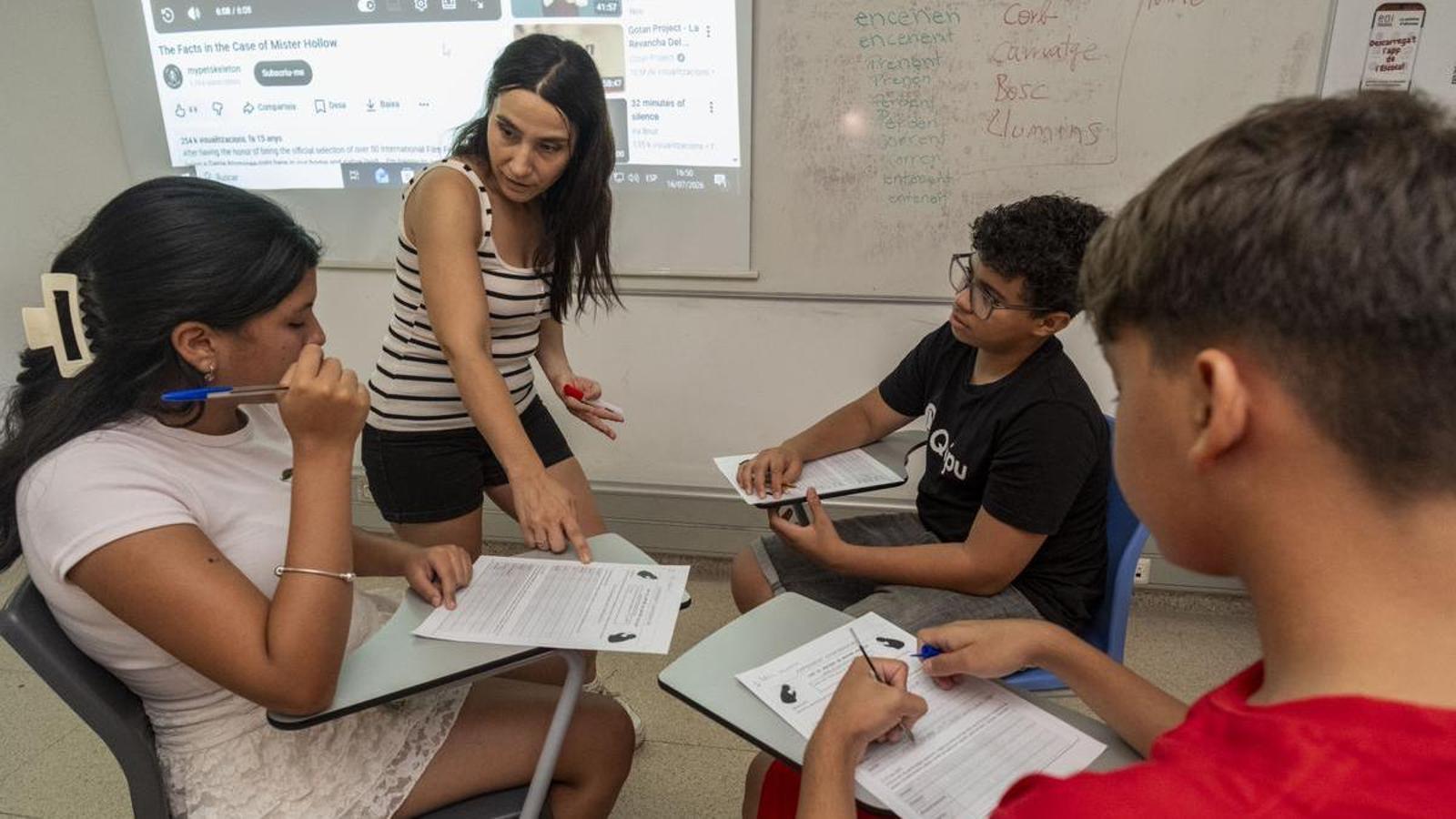
BarcelonaIt's July, but classes haven't ended for everyone. There are 143 secondary school students from Barcelona (and their teachers) who, defying the temperatures, have extended the school year for three extra weeks to do an intensive Catalan course. After last year's pilot program, this summer the Barcelona Education Consortium has expanded the initiative with seven groups of about twenty students between 12 and 16 years old, most of whom need to consolidate their B1 Catalan level. They are all young people who have arrived in the city in the last year, mostly from Latin America but also from Morocco, China, Pakistan, or Ukraine. During the school year, they have attended one of the ten accelerated welcome classrooms (AAA) in Barcelona's high schools. Unlike the 238 ordinary welcome classrooms in public and private schools, the AAAs are designed for newly arrived secondary students to have an intensive immersion in Catalan for four months before joining their assigned educational center.
Isis arrived in Barcelona seven months ago from Ecuador, at 12 years old, to reunite with her mother, with whom she had practically not lived. She spent the first five months in an accelerated welcome classroom at the Institut Barcelona-Congrés, where she began to learn the language: "On the first day, the teacher of the welcome classroom told us: "From this classroom, students leave speaking Catalan fluently», and I thought: «You are crazy!»", confesses. Isis found in the classroom a space quite mandatory to start speaking Catalan and comfortable enough not to be afraid of making mistakes. "Now I speak Catalan on the street, so I practice it, because otherwise I can only speak it in class and with my aunts and uncles. Sometimes there are people who act crazy and don't answer you in Catalan," she laments, with very good Catalan. "Honestly, I love it when they tell me I speak very well for how long I've been here. I think: 'I love you!'", says Isis. Since she will start 2nd year of ESO at the Institut Manuel Carrasco i Formiguera in September, the teacher recommended her not to lose the learning rhythm in the summer, to reach level B1.

Reduce abandonment
The accelerated welcome classrooms were born three years ago as a pilot project, when they observed that "the students who dropped out of their studies earliest were those who arrived latest," explains Eulàlia Esclapés, director of education and territory of the Consorci d’Educació de Barcelona. For some immigrants, the main school problem is the educational and cultural leap that the transfer implies, but for others, the challenge is simply that they need time to master the language. The AAA want to provide this time: they involve intense exposure to Catalan, they have specialized teachers and a systematized learning designed for adolescents who, in addition, are grouped according to whether they are Spanish speakers or have languages further from Catalan. "They gain a much more solid learning base, they gain confidence, and we see that the evolution is exponential," says professor Raquel Castells. "Furthermore, they form an emotional bond with the language and meet people from different cultures with whom Catalan is the vehicular language. They are left with a very beautiful memory of the group and of the learning, which is very empowering."
Mehedi, who arrived from Bangladesh a year ago, confirms this. He is 15 years old and will start 3rd year of ESO again. In the welcome classroom, he made friends from all over the world, many of whom did not know Catalan or Spanish: "Catalan is the first European language I speak," states this young man, who already spoke Bengali, Urdu, a little Arabic, English, and now Catalan, a subject he has passed. Adam, of Moroccan origin and 14 years old, says that it was "very easy" for him to learn Catalan in the accelerated welcome classroom. The previous year he had lived in Andalusia and it was worse: "I couldn't talk to my classmates. It's better to teach you to communicate before knowing the pluperfect," he says. Studying Catalan in the summer, at first, he felt "a bit lazy," but he admits that it has gone well for him: "To review what we have done in the welcome classroom and to have more confidence to speak Catalan with people from outside. Now I don't feel uncomfortable," he says with a magnificent accent.
The funding from the commissioner for the social use of Catalan of the Barcelona City Council has made it possible to multiply by seven the offer from last summer, which is coordinated by the Official School of Languages of Drassanes with specialist teachers from institutes and is free for young people. It has been three weeks and 45 hours of class, with weekly cultural outings, until this Friday. "The courses during the summer allow us to reduce the academic disconnection of two months without contact with the language and consolidate the learning of the course. Of the 20 students from last summer, 18 are still studying," celebrates Esclapés. The objective is for more and more students of foreign origin to reach high school and pass the PAU. For the moment, they do not plan to change the ordinary reception classroom model from top to bottom, but they do intend to improve its performance: "We want to distill what we have learned and provide training to accelerate all reception classrooms," advances Esclapés.
On the screen, Jo no sé ballar, by Naina and La Fúmiga, is playing because the teacher is teaching the fifteen-year-old students that there is also bachata in Catalan. Afterwards, they will play cards to work on the imperfect subjunctive. "It will be a different UNO," announces the teacher. And a student cracks a linguistic joke: "It will be the 'u'!", he exclaims. A good sign.
