How is "déu-n’hi-do" written? The 10 most searched doubts on Diccionari.cat
The platform of Enciclopèdia Catalana receives about seven million visits annually and allows one to take the pulse of the linguistic doubts of speakers
-
CAT -
CAST
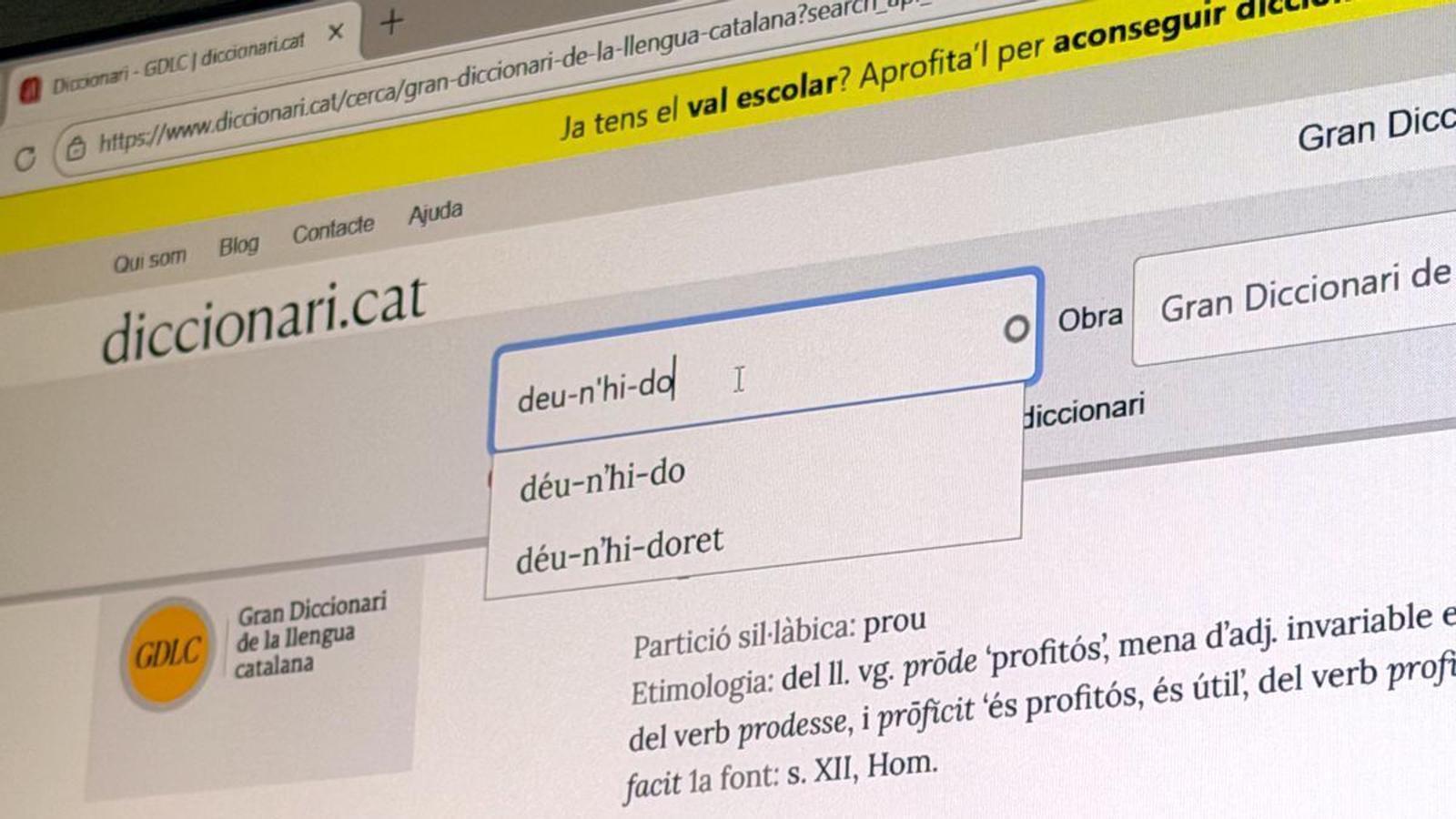
BarcelonaThere are words we use every day and yet we are not entirely sure how to spell them or what they mean. Sometimes we look them up to resolve a grammatical doubt; other times, because we have just found them in a text and they have sparked our curiosity. The searches on Diccionari.cat during 2025 leave us with a very particular photograph. "Déu-n’hi-do", "senyal", "anàlisi", and "compte" are the most consulted words, followed by "provar", "comptar", "badar", "corrent", "biaix", and "il·lusió".
The most searched words
The entire list combines words in very common use with terms that have gained presence in public debate. This is the case of "bias", which in recent years has appeared more and more in expressions such as "gender bias" or "artificial intelligence bias". There are also words like "compte", "provar" or "comptar" that can generate spelling or usage doubts. Essentially, there are four types of queries: words that have spelling difficulties ("déu-n’hi-do", an interjection that, by the way, in the ARA we write agglutinated: "deunidó"), those that present grammatical difficulties ("un anàlisi" or "una anàlisi"; "un senyal" or "una senyal"), those that have uses that for some reason have become more frequent (like "biaix", "resiliència" or "esvoranc") and, finally, those that students encounter in academic or literary texts and that are not part of their usual vocabulary (cases like "basarda", "feréstec", "badoc" or "baliga-balaga").
Artificial intelligence also leaves its mark here
Artificial intelligence has modified consultation habits, although Diccionari.cat continues to maintain a high volume of visits. According to Núria Bord, head of dictionary editing for Enciclopèdia Catalana, AI has slightly reduced queries, but the same models also turn to the platform's content to develop linguistic responses.
Diccionari.cat was born in 1998 and has established itself as one of the main digital tools for consulting the Catalan language. Alongside the dictionaries, Enciclopèdia.cat receives about 2.5 million annual queries and maintains content related to Catalan history and culture among its most frequent searches.

