Sunday midday, October 19, 2025. The Castellers de Sabadell are celebrating their own festival in Plaça Sant Roc, the city's nerve center, between the City Hall, the Banc Sabadell headquarters, and the Sant Fèlix church. For the first time since 2016, they manage to load and unload the 5 of 8. “The Saballuts shine again in Sant Roc with an imposing 5d8,” headlined the Diari de Sabadell in the chronicle of this “perfect performance.” At the top of the human tower, an enxaneta: Eloi. His father, Jordi, remembers it: “There are children who really get very nervous, but Eloi is very calm, he doesn't feel the pressure much; rather, he knows how to focus. At that moment, or even in the days before, he handled the debut of a tower very well. On the morning of the performance, we said: 'Eloi, we have to go and do the 5 of 8.' We, who were also participating, were nervous. He, on the other hand, was cold-blooded. He said: 'Yes, yes. We have to do it.' And that was it, no problem. Every child is a world of their own.”
The casteller father and the enxaneta daughter: let's make a team as a family!
Families of castellers, geganters and bastoners explain that sharing popular traditions between generations strengthens bonds
-
CAT -
CAST
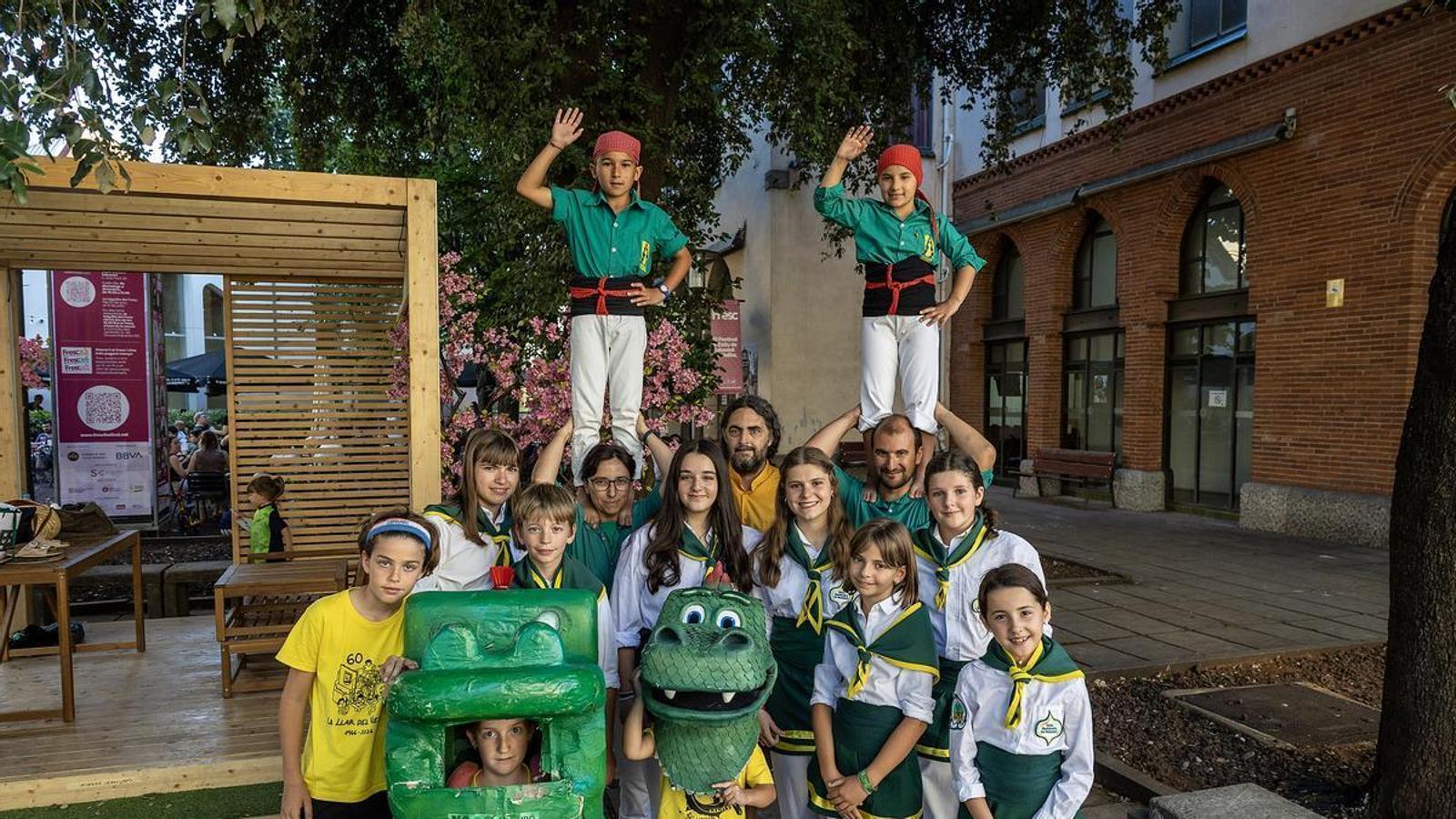
Wonderful and dazzling minority with sash and seven-ribbon espadrilles. And, very often, with a barretina and everything. In the country there are 3,000 to 4,000 groups of popular and traditional Catalan culture, which bring together more than 100,000 souls. When parents and children participate together in a group – bigger or smaller, more or less well-known – the magic happens: bonds are strengthened, the children work on values and socialize at a rapid pace, and the new generations take root in the country with much more intensity. Most of the time, the older generation drags the younger one along, which inherits, almost genetically, the passion for castells, giants or stick dances. But it must be said that, in some cases, things can go the other way: there are families whose little ones have joined the group first and, little by little, have encouraged the older ones to get involved. We approach this reality and observe it through the eyes of a child based on the testimony of three families linked to Sabadell entities coinciding with the city's main festival.
The bond of the Segura Artigas family with the Castellers de Sabadell (alias Saballuts) is total and absolute: the father was part of it since he was a child; the mother, since she was a teenager, and the couple themselves are even a result of it: Jordi and Helena met there. But with the birth of Eloi (10 years old) and Aina (7), they took off their green shirts. Jordi Segura explains: “Last year we returned to build castells because they also wanted to do them”. Like the adults: “Even if we didn't go – points out Segura – we remained linked to it in a certain way. When we had the children we knew it was very difficult to make it compatible, at least while they were very small. We have always been clear that either we all did castells or no one did”. And said and done: “The moment they said they wanted to try it, we all got hooked again”. The collateral advantages are obvious: “It gives them the opportunity to meet many people of different ages, to open up and step out of their comfort zone, which is school. It also gives them a sense of self-esteem, of confidence”.
Jordi's wife and mother of Eloi and Aina, Helena Artigas from Sabadell, admits the B-side of the quadruple bet: discipline, risk, order, strength... "There are moments in the season when you have to push yourself harder with the human towers and perhaps you get more tired, the children go to sleep later... You have to try to balance it and compensate for it with other things. It's not that we go to sleep in the early hours of the morning, but, on the other hand, if you have a performance you don't have to get up super early either, but rather you can make the most of the morning more or less and then you go to do human towers". She argues that it is not such a big deal, and that raising human towers as a family is worth it if you find moments of peace to recover: "We also look for spaces to rest and gather strength". However: in the unlikely event that any of the four lost interest in the world of human towers, all four would leave it: "In the event that they get tired of it or want to try new things, we will have to take a step back and follow the group from another perspective".
Eloi joined the group as an 'enxaneta' (the child who climbs to the very top) last year, when he crowned an emblematic 'cinc de vuit' (five-level tower with eight people per level), and this year he has started acting as a 'dos' –one of the two children who form the dome of the trunk, closed by the 'aixecador' or 'acotxador' (the person who crouches), on top of which the 'enxaneta' climbs–. These last two roles are now assumed by his sister, Aina, who usually acts as 'acotxadora' and, "very rarely", as 'enxaneta'. Having been the icing on the cake makes him proud: "I feel proud to do this tower because we have worked hard on it and it turned out well". Entering the world of human towers was a bit hard for him at first: "At first I didn't want to do human towers because there were a lot of people and it overwhelmed me, but in the end we kept going for days and I started making friends, and I learned how to climb well and I liked it, and I stayed in the group, and now I really like human towers". And they fulfill him completely: "I also like it because we do many activities all together, the children. I have many friends, too, of many ages". His classmates usually ask him: "How can you climb so high?"
The Olivé Codina stick-dancing family is what is known as the exception that proves the rule: the three children, pioneers, have dragged their parents, Marcel and Laia, into it. She recalls this in a somewhat chaotic conversation, in which Magí (10) and Vinyet (8) take turns speaking, sometimes literally in stereo: either at the same time or, even, one saying the subject and the other the predicate of the same sentence. The heir, Roc (13), already dances in the intermediate group and is the benchmark for the two younger ones in terms of technical sophistication. The happy family contagion occurred at the workshop that the Sabadell Stick-Dancing Group offered within the framework of the Aplec de la Salut (the city's small festival) in 2019. “There were already people in the group we knew and, when we saw them perform, we found it interesting. And, one year when they were little, we went, they tried it, they said they liked it, and we said: 'It already appealed to us. Let's go for it.' And we have been there ever since.” First Roc and Magí joined, and immediately after, Vinyet.
Everything is a benefit: “It brings them the cultural part; the part of sharing, of knowledge, of new friendships, of having another circle, and all these values of working as a team, of being a group, of the challenges that are posed, of new dances, dances they create themselves, dances they see the older ones doing and that later with time they also do...” And, over time, Laia and Marcel have also arrived: “There were parents who were already part of the group and who sometimes told us: 'Do you want to do a dance?' And we said: 'If the kids are rehearsing and we are watching, why don't we dance?' And we have a great time.” Even so, commitment is always difficult, as Vinyet hints when addressing her mother: “Now you are forcing us. And we say: 'No, it's just that we don't want to do it, now.' And you say: 'Well, you have to do it.' But when we were little you didn't say that.” Laia contextualizes it: “Now, sometimes, they have this moment of crisis, and we say: 'No, no... Popular culture must be done and we have committed to it, and now it continues.'”
When it comes down to it, however, the passion for the stick dance is total and absolute: “For me, being part of the group is very cool,” affirms Magí, “because I have new friends that perhaps, if I weren’t here, I wouldn’t have.” Laia reminds them: “And it is also organized so that the older ones take good care of you, the little ones, which is very neat.” Vinyet agrees: “Yes, because now the middle ones act as mentors for the little ones, sometimes.” And Magí remarks: “Sometimes, maybe, also, if we are tired, we play a game, or some days that we don’t want to go, that we feel very lazy, we play a game first and then we start the rehearsal.” And he highlights two more advantages: “Also memory, because there are dances that perhaps are easier, but it is also difficult to memorize them, and effort, because it is difficult to do them.” The healthy competitiveness between parents and children, with the triumph of the little ones, spurs them on even more, and the mother knows it: “You know more than we do. It’s you who, sometimes, teach us!” In the case of Joan del Riu, the victory is a landslide.

The Giants (and Gralles) of La Concòrdia are a sui generis, atypical giants group; in fact, just another manifestation of the leisure organization from the northwest neighborhood of Sabadell, the recreation and youth center (CAE) La Llar del Vent, the oldest in the Vallesan co-capital, which has just celebrated its 60th anniversary. Isma has spent half his life there, if not almost all of it: he went to the youth center as a child, and from the age of 14 or 15 he got involved with the giants: "Our group and the one that joined after us have never left the group: we have always stayed there." And he has been dragging his wife, Judith, along, and, immediately, the Villalón Salanguera offspring: first, Quim (10); then, Bruna (5): "We have been in the group for over 30 years. When we started having partners, we brought them there; when we had children, we brought them there. Everyone has joined naturally; that is, they come with us from the time they are babies until they begin to integrate and do things in the group." Which is, therefore, almost literally, a big yellow family.
"It gives them the opportunity to share many things, to collaborate, to organize themselves, and also responsibility," asserts Isma. The children manage to look after their own elements, such as the Bosquet dragon, and the dances it performs at every outing. "They have to work as a team, because otherwise they wouldn't go out, and we let them organize themselves quite a bit. And then, also, socializing, both with groups from other towns and villages and from the city." Quim's eyes light up, but he has a somewhat gray first memory: "It was when I was at the youth center and we were playing and it was our turn to do a parade and it was raining, and everything was a bit of a mess. But there I saw that it was very cool to be a giants group member and that the culture was very neat." All the giants are self-made, and this strengthens the sense of belonging: "I started the youth center at 5 years old and, from there, I started liking it, because we were making a giant because the other one had broken. And we spent a year doing activities about the giant and, in the end, we made it and it was very cool, and I liked how we all collaborated together."
Giants aside, Quim highlights two ingredients he has found in the organization: “A lot of sincerity and a lot of play, but not just the typical soccer, basketball games... Also the flag, things like that”. And he accepts the discipline: “It depends on the day, I like it and I don’t like it. I really like being there, but when I’ve made plans with some friends and I have to go to the youth club, I have to go, but I would rather play. Afterwards I have a good time, but it’s a bit difficult to leave it”. What is also a bit hard for him is sharing space and time there with his little sister, another situation with pros and cons: “I like it and I don’t like it. Having a sister is cool because you can talk to her, but sometimes it’s annoying because you’re having a good time and Bruna, my sister, won’t stop saying: «Quim, Quim, come here for a moment». When we are playing the flag game and she says: «I want to go somewhere», I say: «What do I do?»”. The long-suffering older brother encourages all children and young people to participate in popular and traditional culture: “It’s a very cool experience”.
Parents who drag their children along, children who drag their parents along... Communities in which one learns to live together, to collaborate and to build the country between sashes and espadrilles, and which offer everyone a celebration that is close, generous, deep-rooted and pulsing. That educate, socialize and foster cohesion. The Catalan popular and traditional culture groups welcome children with open arms and open wide the doors of a castle of light, fire and construction –and of movement, colors and smiles–, raised on a solid base: the authenticity, simplicity and honesty of the celebration of the people for the people. The Segura Artigas, the Olivé Codina and the Villalón Salanguera families have chosen, respectively, the Castellers de Sabadell, the Colla Bastonera de Sabadell and the Gegants de la Concòrdia, but they are only a small sample of the thousands of households in which the passion for making the streets and squares vibrate has captivated, at the very least, two generations. And what if you stop watching from afar and get involved?
