Start of the school year: school adaptation can also be rethought
Course after course, schools and teachers redesign strategies to successfully overcome the first days of class

-
CAT -
CAST
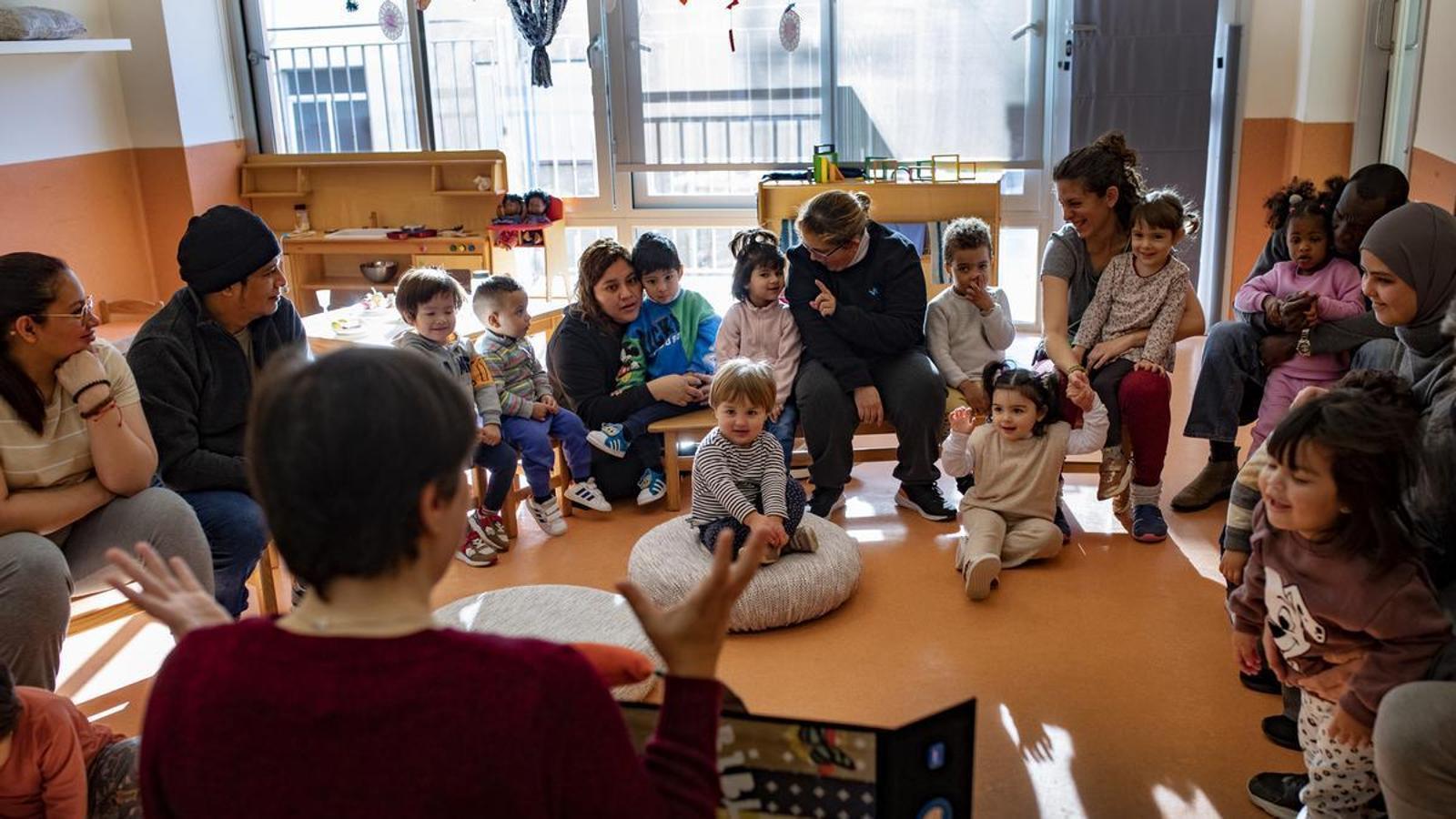
Orelletes is a rabbit who is starting preschool (I3) and experiences it with the same intensity as many children who are entering a school for the first time. He cries, he doesn't like saying goodbye to his parents, he finds it hard to share toys, and he prefers to play alone, so he hides in a corner. With a lot of tact, the teacher helps him to breathe, to be calm, and he ends up joining the circle with the rest of the group. He is the protagonist of Orelletes at school, a story that aims to help experience this process from a kinder and more conscious space. Self-published by preschool teacher Meritxell Casanova, the story empathizes with the child and gives advice to parents to make these first weeks of schooling easier.
Casanova has promoted this project after years of experiencing first-hand the first days of school for many children and verifying that they are difficult for everyone. She advises explaining well to the child what will happen these days, not prolonging the farewell, trusting the teacher, and, above all, validating all the emotions they express. "Crying, one must cry," says Casanova, who emphasizes that during these first days of school, children can be more irritable and tired.
One of the keys she practices is establishing routines because "structuring provides security" and she uses singing and expression as tools to accompany them in the classroom. School adaptation, however, is part of each school's pedagogical project. The goal is the same—that children perceive both the space and the new reference adults as safe—but the strategy changes depending on the results, the families, and the children. For this reason, centers organize interviews, family meetings, joint activities from nursery school, staggered entries…
Meetings from nursery school
The Escursell school in Ripollet is a center that has significantly changed its adaptation process in recent years. One of the initiatives that sets them apart most is that, through the municipality's 0-3 network, when children already know they will start the school year, they prepare a session with the current I3 group and the next year's group and their families. Diana Serrano, the school's secretary and I3 teacher, highlights that in this way the children see the school and the teachers get to know them better. “They are often told 'You will go to the big kids' school!', but the children don't quite understand it and if they see it, it's easier,” explains Serrano. This step complements the visit that the tutors make to the nursery schools to be able to meet the children and for them it is a first contact. But this is not the only change they have incorporated in recent times. In this school of maximum complexity in Ripollet, they have also established a shift-based entry for the first days and reduced hours, and have made family accompaniment more flexible. Some time ago, parents did not enter the classroom even on the first days, and now they have a relaxed entry throughout the entire schooling. Although, in general, the management is a bit more complicated, they are happy with it because it is more pleasant for everyone.
The energy of getting to know the families
At the Decroly School in Barcelona, they have also been changing the adaptation process and have incorporated new actions that, with practice, they see work, and this helps families during these first few days of the school year. In addition to the individualized interview with the family and the tutor, which must serve to begin building a bond with the adult reference at the school, this charter school focuses on getting to know the families. Thus, they have transformed the meeting before the start of the school year, and it is no longer merely informative regarding practical issues, but a dynamic of getting to know one another has been added between families so that they also begin to establish a bond. "Putting faces to names and sharing a few things with those you will share the school year with makes the first few days much easier," explains Berta Puente, head of studies at the Decroly School, who adds that "on the first day, all the families have already seen each other and there is a certain connection; everyone greets each other and the energy changes." As a result of this, adds Puente, the environment is more relaxed and less tense, and it helps the children feel they are in a safe space. Furthermore, they adapt the pace to each family and according to each child's needs. They do usually recommend that during the first fifteen days, the child should have been left in the classroom for at least one hour, because otherwise, the relationship with the tutor is delayed. At the start of every school year, they accompany families who, for the most part, can organize themselves to follow this gradual process, but those who cannot also know that the school is available all day. "The key is to know the child as well as possible; the adaptation is much easier," concludes Puente.
Mixed-age adaptation
The Edumar school in Castelldefels has opted for an infant stage, the little ones' community, organized into six mixed-age groups where children from I3, I4, and I5 coexist. These six groups are the reference point throughout the entire infant stage, which means that in September, in each group, only six children are new. The remaining twelve, from I4 and I5, already know the dynamics, points of reference, and spaces. The school's director, Anna Nicolás, explains that with this model, which they implemented after the pandemic, the adaptation is much easier because a calmer atmosphere is felt. “Furthermore, the older ones take on the role of companions, which greatly facilitates the process,” explains Nicolás, who sees a great difference between the previous system and the current one. “The space is not perceived as unknown or unsafe because the rest of the children from I4 and I5 are already adapted to it, and therefore, a more natural and progressive entry into the school is made,” says the director. Although only six new children enter each group, Nicolás remarks that the fact that the majority of the group already knows the school does not eliminate the need for an individualized adaptation process for the children who are joining. For this reason, they also dedicate the days marked by the Department of Education to it. The first two days they do it in shifts and only three new children attend per shift, accompanied by their families, who act as reference figures during this process. The entire functioning of the adaptation process is explained before the summer holidays, in a meeting with all the families, and before starting the school year, in September, a meeting is also organized between the new families, the new children, and the tutor.
A first week by time slots
For the team at Balandrau school, in Girona, adaptation is a very important process. Since the school was founded fifteen years ago, they have been configuring a system that wants nothing more than to accompany the family and the child. “If the family comes calm, the child notices it,” says Cristina Turbau, the director. The bond with the family begins with the initial interview, and the adaptation process is explained in a meeting with all families before the holidays. They do it in advance so that families can gain confidence. On the first day, and divided into groups of six families, the children go to the classroom for an hour and a half accompanied by their parents. They bring the requested material and a family photo album, and it is used as an opportunity to exchange feelings between fathers, mothers, and children. The rest of the week, they work in two shifts and in time slots, which avoids gathering more than ten children in a classroom, where they always have the tutor and the TEI. In addition, a specific space is reserved for them in the playground, and until the group is ready, specialists do not start entering, nor are they moved to other spaces in the school. “Everything is done very slowly,” says Turbau. What they have detected is that extending the time that parents are inside the classroom too much postpones the adaptation, and they have now set a time of between ten and fifteen minutes over a maximum of three weeks for this accompaniment. “Until the family leaves the classroom, the child does not start to create the bond with the tutor, and this bond is essential for the adaptation,” says Turbau.
And what if the adaptation were not necessary?
Although they consider that the current school context justifies the need for a gradual adaptation that allows for a calm entry into school, while taking into account the needs of every boy or girl, the Rosa Sensat Teachers' Association believes that this should be reflected upon. “Adaptation is a word that anticipates a very large break that should not exist,” they point out, and they regret that it is the child who must understand that they are in a different organization, with new schedules and new demands that they must learn. They also recommend that centers should not mirror primary school and, instead, be respectful of the pace of each boy and girl. “Currently, there is a certain tendency to believe that a quick adaptation helps to sharpen skills and, consequently, to make better use of time,” they say. From the Association, however, they do not share this view because they interpret it as “skipping” stages and important moments for the children.
-
Flexibility: There are children who are fine with just two days of adaptation and others who may need more time to feel secure in this new space and with these new reference adults, or who may even need it in I4 or I5. Hurtado recommends adapting the calendar and being flexible, taking into account the reality and life history of each family and each child: whether they have attended nursery school, whether they are a newcomer family, whether the parents have support or are free from work commitments to carry out the progressive adaptation, etc.
-
Support: To be able to attend to the needs of each family, the president of the Rosa Sensat Teachers' Association, Mar Hurtado, advocates for organizing support in the I3 classroom very well throughout the month of September. “It is a delicate moment in which many things can and do happen, and therefore, it is difficult for one person alone to sustain,” points out Hurtado.
-
Transparency: “Leaving a child crying with an adult they are seeing for the first time is the most normal thing in the world,” claims Hurtado. For this reason, she believes that the more information the school provides about what is happening in the classroom and the more it anticipates what will happen, the easier it is for parents, who may also experience these first few days with concern and a certain amount of apprehension.
-
Trust: For Hurtado, not judging families, showing understanding of the situation, and providing an exhaustive report on how the day went are tools to foster their well-being and facilitate their adaptation. This trust is transmitted to the child, who will begin to identify the school as a safe space.
