Reconcile summer in Barcelona, more expensive than in the rest of Catalonia
These territorial differences are due to the fact that there are town halls that subsidize part of the leisure center and families, therefore, pay a reduced price
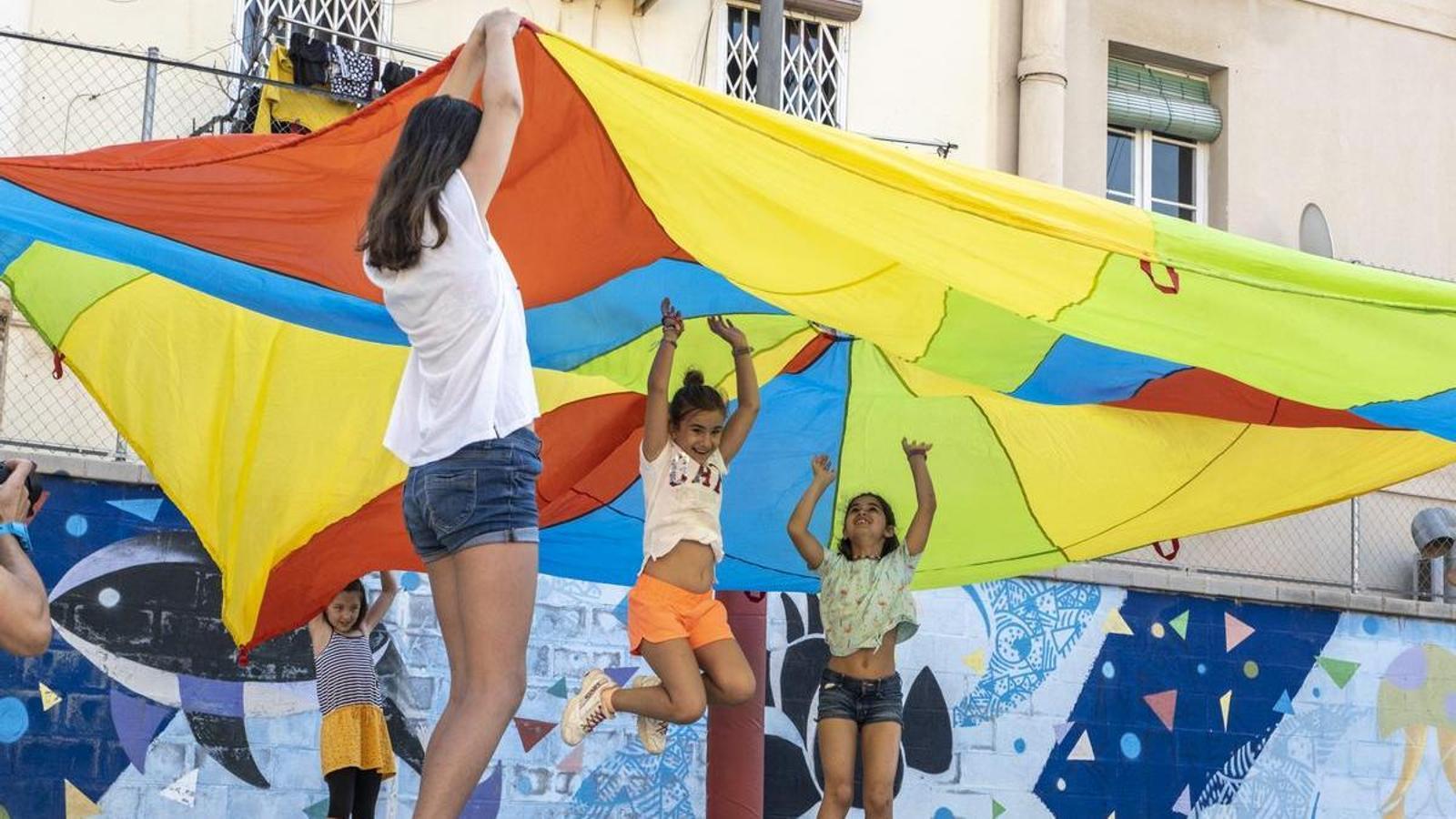
BarcelonaWeeks, if not months, have passed since families have been looking and re-looking at the calendar to try to fit the eleven weeks of summer school holidays with the month of vacation that, if lucky, working mothers and fathers have. Summer camps, camps, colonies, separate vacations in the case of couples, permits, teleworking, grandparents or babysitters are some of the possible solutions. All of this also implies planning, bureaucracy, a lot of mental load and money.

Reconciling in the summer is expensive. But in Barcelona, even more so. The average price of a summer camp in the city of Barcelona is around, without a scholarship, 150 euros per week from 9 a.m. to 4:30 p.m. with lunch included (if they do half-day or do not stay for lunch it is cheaper), that is, 600 euros per month –1,200 euros if you have two children and 1,800 if you have three, although there are camps that offer discounts of 5%, for the second child or for a large family, discounts that outside of Barcelona are, in some cases, higher.
The average price in Girona is 96 euros per week from 9 a.m. to 5 p.m. with lunch included, in Tarragona, 110 euros and in Lleida, the cheapest option, only 67 euros, but in these last two cases the camp ends at 3:30 p.m. The municipalities in the metropolitan area of Barcelona also have higher prices than in the rest of the Catalan provincial capitals. For example, in Santa Coloma de Gramenet it costs 123 euros per week (see the graph). As in Barcelona, all have bonuses based on family income.
In smaller municipalities, with less than 20,000 inhabitants, the price of summer camps can still be more economical. For example, in Roses, the summer camp costs an average of 61 euros per week, for full-day attendance and including lunch, and in Castell-Platja d'Aro, 51 euros.
These territorial differences are due to the fact that there are city councils that subsidize part of the summer camp and families, therefore, pay a lower price. "The cost ends up being the same, but families are not bearing the full cost, this is easy to do in rural areas, but in Barcelona the City Council's budgets do not support it," explains Aina Espona, head of the summer camp campaign for the Pere Tarrés Foundation. "Outside of Barcelona there are city councils that tender the municipal summer camp and have very affordable prices because they are heavily subsidized. In Barcelona everything is private, but you have the right to scholarships and support staff",adds Xavi Florido, deputy head of school programs at Fundesplai.
In the case of Girona, they can adjust the price to the maximum because the city council reaches agreements with each of the non-profit organizations rooted in the territory that organize summer camps according to their specialty: theater, sports... The clinic pays a sum per student to these organizations, an amount that is higher than what families pay. "It is difficult to say exactly how much the city council pays and how much families pay because it depends on how many families have benefits based on their income (there are six different income brackets), how many have children with special needs, or how many are single-parent or large families, who also have discounts," explains councilor Queralt Vila, councilor for Education and Participation and Citizen Care. This year, the clinic has allocated more than 625,000 euros to summer camps that will host 3,300 children, practically all of the registrations.

Jordi, 43, and Laia, 11, are a single-parent family who have been living in Girona for two years. Laia has secured a place at a summer camp in July and another in August. “I work all summer and my parents live far away, for both camps I will pay 800 euros because as a single parent I have a 5% discount,” she explains. Last year, she recalls, she paid double. “It was my first summer in the city and since I didn't know about the offers, I decided to sign her up for a camp for both months with a non-municipal organization. “I paid 1,600 euros, I almost spent a month's salary just to balance my work and family life,” she laments.
In Barcelona, there is the municipal campaign T’estiu molt to which organizations that meet certain requirements can join –among others, a price cap (the price of a full-day camp with lunch cannot exceed 153.10 euros, 175.35 for sports camps) and that it be an inclusive camp– and the City Council certifies them to participate. In this way, they can benefit from scholarships and support assistants for children with special educational needs (SEN). “Although the subsidy granted by the City Council for each child with SEN does not cover the cost of an assistant,” points out Xavi Florido, deputy head of school programs at Fundesplai.
This year, 290 entities have joined the T'estiu molt campaign, organizing more than 1,000 activities and offering more than 395,000 places for children and adolescents up to seventeen years of age. Scholarships are awarded based on income and are mainly aimed at families in vulnerable situations. However, these grants, “are supported by a budget ceiling from the City Council, they are not universal but are conditional on income and also do not cover the entire duration of the camp, the aid is only for ten days,” explains Espona, who says that, aware that they do not reach all families, the foundation also offers its own scholarships. “Scholarships reach more people, but the income brackets are increasingly precarious,” also acknowledges Florido. Income brackets range from 0 to 10,000 gross annual euros per member of the family unit. This year, 5.1 million euros are allocated to grants to be distributed among 37,797 children with approved scholarships. In 85% of cases, the assigned aid covers up to 90% of the activity cost.
2.9% more expensive
The most expensive summer camps tend to be sports or thematic ones (English, art, horse riding, sailing...) and the most economical are those held at schools, which, in Barcelona, are the most in-demand. A sailing camp can cost 250 euros, a theater camp, 240 – always with lunch included and full-day –, while a school camp can cost around 130 euros.
Until last school year, Laura and Jaume had opted for the school camp, which was more economical, for their three children, but now the two older daughters are asking to be able to go to the camp organized by the basketball club where they play. For two weeks – one of which is a sleepaway camp – they will pay 900 euros, to which must be added the camp for the youngest, this one at the school, which costs 256 euros, with the large family discount included. In total, 1,156 euros, half of her salary. With this, they cover fifteen days. To cover the rest of the school holidays weeks, they will rely on grandparents and take separate vacations, although they reserve two for all five of them to be together. "It's not ideal, but we can't afford to dedicate a whole salary to paying for camps," they admit.
In the city of Barcelona, the price of summer camps has increased by 2.9% compared to last year and has accumulated increases at least since 2023 (from 2024 to 2025 they rose by 2.4% and from 2023 to 2024, by 2.5%, according to data from the City Council). In other cities like Girona, however, they have remained the same for the last two years.
The reasons for this price increase in Barcelona are caused by several factors: the increase in the price of food, transportation, and the improvement of monitors' salaries. "Coaches are more expensive than ever, it's dramatic, and there's also difficulty finding drivers, there's less fleet," explains Espona, who says there was a 2.5% increase in the price of coaches compared to last year. Most summer camps offer at least one excursion per week. "We do what the AFA or the school asks us, and if they want two coach excursions, the price increases. Since we do it à la carte, it depends on what the client wants," admits Florido, who assures that in Barcelona there is a lot of competition and they try to adjust prices or do activities that differentiate you from the camp next door.
Part of this increase is also due to the better working conditions for monitors. "The leisure agreement has had significant increases for three years after many years of not moving, which is good news, but it entails an inevitable price increase," explains Espona. "And this impacts the price a lot because 60-70% of the camp's cost is the budget allocated to staff," explains Florido.
Another obstacle in summer camps in Barcelona is access to the municipal swimming pools of the CEM, which are managed by private companies that also organize their own summer camps. "And these companies reserve the municipal swimming pools for their summer camps before other entities, and most of the time the rest of us no longer have access. And this doesn't happen outside of Barcelona," denounces Florido.
Summer is arriving and, before thinking about holidays, rest, enjoyment, or family time, we have to reconcile schedules, budgets, and set alerts for the opening of summer camp registrations so as not to miss out on a spot. Summer is not only synonymous with holidays (for the luckiest), but also with a puzzle of schedules and money.For this reason, for this difficult-to-fit puzzle, this year I have decided to ask for four weeks of unpaid leave, taking advantage of the fact that in July I receive a double payment – I have a fourteen-payment salary not prorated – to be able to spend time with my family. The cost of summer camps is so high that mothers and fathers have to allocate a large portion of our salary to "occupy" the children with the sole objective of having time to work and generate money. It's a cycle that doesn't make much sense to me right now. While I exhaust myself at the office and count the days to go on vacation between the thermal extremes of the office air conditioning and the burning city sidewalks.Given this situation, I have decided that this year I will forgo the double payment and go to the village with my children. I will spend quality time with my family, rest physically and psychologically from the monotony of work, and yes, I will have a real vacation, taking advantage of the fact that this summer is the only summer in which Quim will be six years old and Aina will be three. With no other aspirations than to live a unique time that will not be repeated.Isabel Esparza, journalist and mother of two children
Educational and conciliation tool
Aina Espona highlights that summer camps not only help families reconcile work and family life, but are also an educational tool because they allow children to enjoy social spaces beyond school: "It is not only the school that should be responsible for learning or the introduction of language and cultural life. There are different agents, such as the camps, and this makes us a richer society," she points out.
In August, the offer decreases, also because demand falls, as it is the quintessential holiday month. However, there are organizations that offer them at reduced prices for the most vulnerable families who have no option to leave the city.
For families with children with significant disabilities, the fees for summer camps skyrocket. In Barcelona, thanks to pressure from families, this year it has been possible to equalize the prices of adapted camps (203.7 euros maximum) with ordinary ones, although children can also attend ordinary camps and have the support of an attendant subsidized by the City Council, although it does not cover the full amount, explain Fundesplai. "But in many cases the activities are not adapted," laments Maria José Tavira, mother of a 9-year-old boy with severe autism and a member of the Union of Mothers in Functional Diversity. "But the camps organized by special education schools cost more than 300 euros per week because there is no scholarship option. At the special education school my son attends, the summer camp costs 319 euros per week, only from 9 am to 3 pm." To this price, the cost of transport must be added, as there is much less offer of adapted camps and some families have to travel. "Families who have children and young people with disabilities are already bearing very large extra costs during the year, and the camp is not just leisure, it is also therapeutic. Our children must be able to develop with their peers," claims Tavira.

