Trump lands in China without resolving the crisis with Iran and accompanied by the 'tech bros'
The United States and China hope to stabilize relations on a trip from which no major agreements are expected

-
CAT -
CAST
BeijingXi Jinping rolls out the red carpet to receive Donald Trump this week on a state visit marked by the Iran crisis and overshadowed by trade tensions and rivalry between the two countries. The leaders of the world's two largest powers will hold talks in Beijing with low expectations of reaching significant agreements, but with the need to stabilize relations. In addition to the energy crisis caused by the war against Iran, the two leaders have other fronts open, such as technological competition, trade barriers, or the sale of arms to Taiwan.
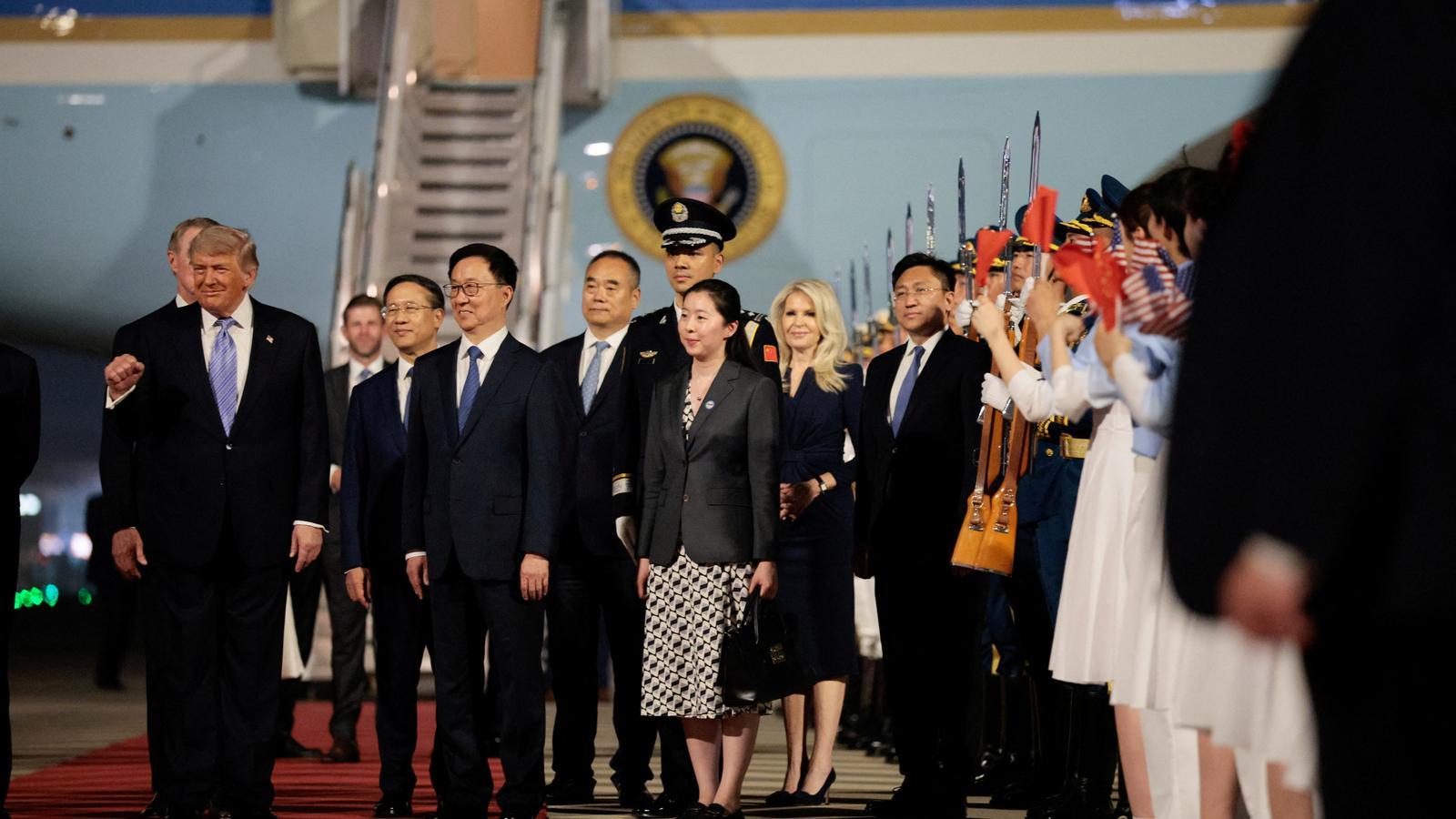
Trump landed in the Chinese capital this Wednesday for a visit that will last until Friday and in which meetings with Xi Jinping occupy practically the entire agenda. The US president arrives accompanied by a retinue of major businessmen, including Elon Musk (Tesla), Tim Cook (Apple), and Kelly Ortberg (Boeing).
As usual, the Chinese capital has been secured with extensive security measures. But despite the deployment, Trump's trip has little to do with the one he made in 2017. At that time, the US president strove to show good rapport with Xi Jinping, and the two leaders took an unusual stroll, accompanied by their wives, through the courtyards of the Forbidden City at sunset. Months later, Trump initiated the first trade war against China, which he has repeated in his second term. Today, disputes have increased, and the two powers are rivals.
The official trip initially scheduled to resolve the trade war and reach agreements on tariffs has been overwhelmed by current geopolitical events. The attack by the United States on Iran and the closure of the Strait of Hormuz have placed the crisis in the Persian Gulf at the top of the agenda. Trump is expected to ask Xi Jinping for help in resolving the conflict by pressuring Iran to sign a ceasefire and allow maritime traffic to be re-established through the strait.
Despite his usual triumphalism, Trump arrives in China weighed down by not having ended the war against Iran and the impact that the closure of this strategic maritime route has had on the world economy. Also, his tariff policy, his main negotiating weapon, has been repealed by the American Supreme Court. Xi Jinping is in a more comfortable position and presents himself as a guarantor of international order in the face of the chaos unleashed by Trump. However, his situation is also not very advantageous.
Hormuz, Taiwan, and tariffs
For the moment, China can face the energy crisis thanks to the oil reserves it had accumulated, but the reality is that 45% of the gas and oil imported by the Asian giant circulates through Hormuz. A long war will end up impacting the Chinese economy. Beijing is not interested in instability or an energy crisis that causes a global economic recession. The Asian giant continues to depend on exports, which contribute a fifth of its GDP, and therefore needs buyer countries with good economic health and secure maritime routes. It remains to be seen what kind of influence China can exert on the Iranian regime, of which it is the main trading partner, and whether it is willing to cooperate with Trump.
On the other hand, for Xi Jinping, it is a priority to address the issue of Taiwan and he would like to curb arms sales from the United States to the island. Last December, Washington announced the most important arms sale agreement to Taiwan in history, worth 11 billion dollars. It is a decision approved by the American Congress, but Xi Jinping hopes that Trump can block it or at least reduce it. For Beijing, it is important that Donald Trump reaffirms the United States' commitment to the "one China" policy and it would be a triumph to obtain a formal declaration rejecting Taiwan's independence.
The United States and China maintain a fragile trade truce negotiated last October in Busan during the APEC summit. The agreement reduced tariffs on imports of Chinese products, while allowing the United States access to rare earths controlled by the Asian giant. For Trump, it would be good to reach some kind of trade agreement that he can exhibit and that his businessmen can celebrate.
It is expected that the United States will secure China's commitment to increase the purchase of agricultural products and Boeing aircraft, as well as agreements on semiconductors. The creation of two bilateral trade and investment boards is very likely, and it is also foreseen that during the meeting the invitation for Xi Jinping to visit the United States before the end of the year will be finalized.

