How the students of a high school in Barcelona have turned a football field into a vegetable garden and a greenhouse
The co-creation project has been carried out throughout the school year within the framework of the Architecture in Schools program, which the College of Architects of Catalonia has been organizing for eight years

-
CAT -
CAST
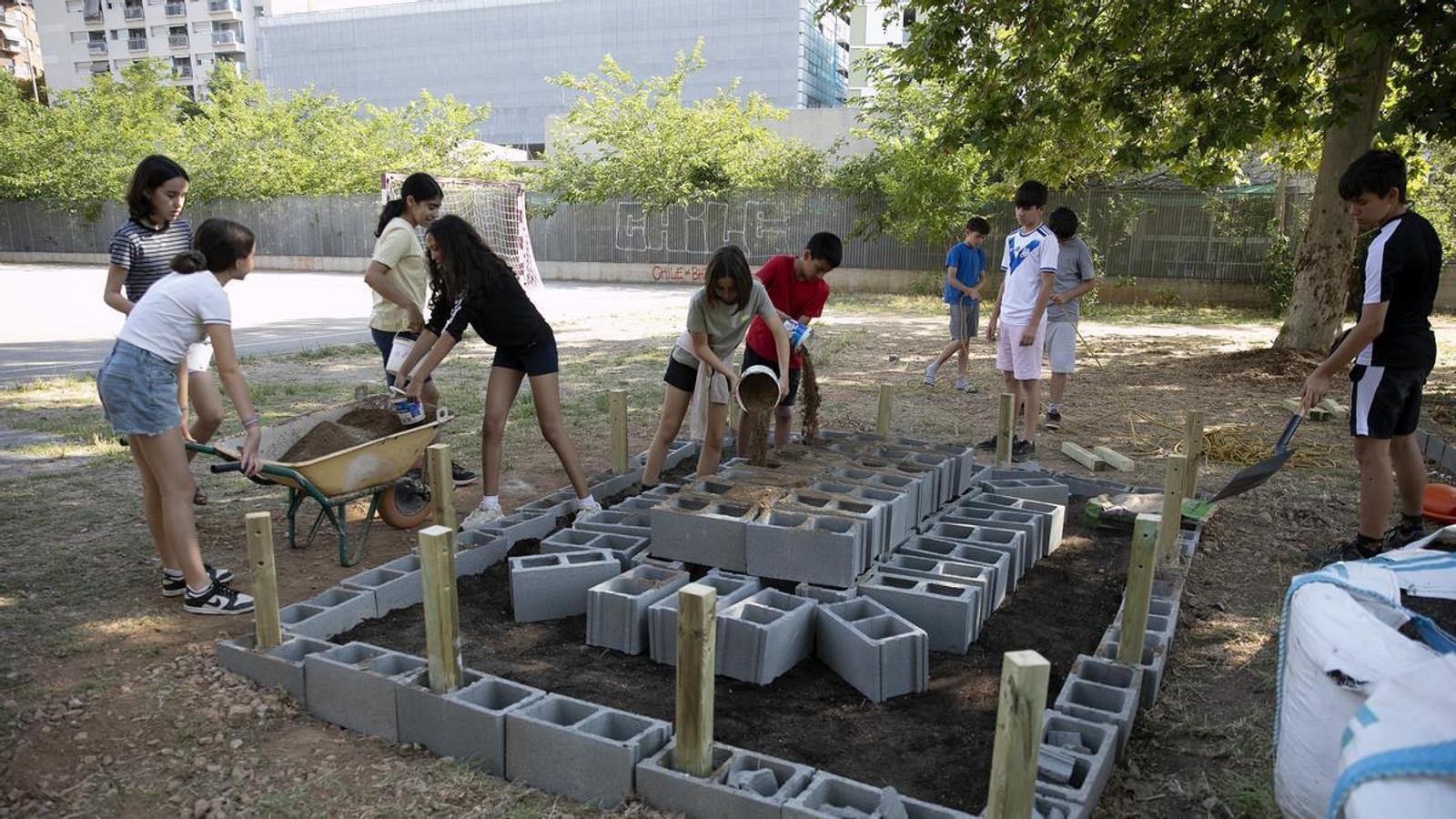
BarcelonaThe last weeks of the school year have been intense for the first-year ESO students at Institut Teresa Pàmies (Barcelona), who have managed to complete the co-creation project of a public-use plot of land on which they had been working all year. They did so within the framework of the workshop Architecture and senses, a plot for everyone, one of the 400 architecture workshops that 130 architects have taught in 25 educational centers in the province of Barcelona between May and June, coinciding with Architecture Week. Although this year the workshops are part of the program for Barcelona 2026, World Capital of Architecture, the initiative is not new, as the College of Architects of Catalonia (COAC) has been organizing it since 2019. Over these eight years, more than 55,000 primary, secondary, and high school students from more than 200 educational centers have participated.
Long-term project
It is the third year that the Institut Teresa Pàmies participates in the workshops promoted by the COAC. This time, the 120 first-year ESO students, divided into five commissions, have been in charge of redesigning the plot of land behind the center as a "plot for everyone". The objective was that they redesign the architectural space to diversify its uses, since until now it was only used as a football field. The new spaces designed and built by the students, with the collaboration of architect Elisabetta Quarta, have been a shaded area (greenhouse), relaxation areas with swings and hammocks amidst the existing trees at the back of the plot, a vegetable garden and a self-managed Mediterranean garden, and an area for an herbarium and anthotype.
The young people already started working on the project last September: they analyzed the configuration, elaborated scale plans and located the architectural elements and the plant and animal species of the plot. During the second term, the students proposed the interventions they wanted to make, which have been developed in the classroom during the last term. During the project week –the last days of the course– the different ideas worked on were executed, such as painting a mural, creating and planting native plant beds, building the shade structures, defining the play and physical activity areas, and editing the herbarium with the anthotype technique and the atlas of the plot's species with handmade illustrations. “We only have the insect hotels and the bird and reptile shelters we have built left to hang up,” explains Jordi Sabater, the center's drawing teacher.
The students as agents of change
The main objective was to get students to make a space their own by diversifying its uses in order to better accommodate their interests. “We have also been able to work on transversal and specific competencies in the subjects of biology, plastic, visual and audiovisual education, or mathematics,” states Sabater, for whom, beyond curricular learning, they have wanted to promote “values such as teamwork, active participation and student autonomy, who have acted as agents of change within their own institute”.
Sabater describes it as "fundamental" for adolescents to participate in the design of common spaces. “They are spaces where they develop their socialization and occupy them with various types of physical activities,” he points out. Therefore, he emphasizes, taking their voice into account “allows for the creation of spaces where the interests of different groups and generations are compatible, and synergies are created that can enrich everyone”.

Architecture and senses
Elisabetta Quarta's role has also been key in helping them better understand the design and transformation process of spaces. The architect has been participating in the COAC program for eight years. The last three, at the Institut Teresa Pàmies. There she wanted to recover a practice that has been lost in the post-industrial world, which is to conceive architectural spaces through the senses. “In pre-industrial times, the five senses were prioritized, but currently, sight is given much more prominence and what I wanted through these workshops was for young people to work with all their senses, to experiment with their bodies,” explains Quarta. Also to empower them, she adds, and for them to understand that architecture is not a discipline alien to them, but a tool they can use, regardless of their future profession, to feel better and to make others feel better.
After two years of previous work, first more theoretical and then with sensory workshops, this year they proposed to the students to work on the ground, on the plot near the institute, starting from a question: how do you want to make this space your own? Thinking through the senses and through commissions, some proposed creating shaded areas to feel safe and protected from the sun. “Others wanted to relax and work with the land and proposed creating a vegetable garden and a Mediterranean garden with native plants, and others wanted to personalize the space and painted a mural,” explains Quarta, who highlights that, apart from making them participants in a co-creation work like this, "the explicit objective of the initiative was to boost their self-esteem and show them that, if they are provided with the appropriate resources, adolescents are capable of creating and being active subjects of their environment, and not passive objects as often happens today, spending a large part of their time consuming videos on social networks like YouTube or TikTok".
Inar and Candela are two of the students from Institut Teresa Pàmies who have transformed the plot of land behind the center into a space for everyone. Inar participated in the Garden committee, responsible for creating a garden of native plant species with culinary or medicinal uses, which he loved because he really likes plants. The young man particularly highlights the great improvement they have made to the plot, as it was practically a desert before and now has various uses. Nevertheless, the challenge has not been without its difficulties, “like transporting the heavier things, such as sand or bricks”. For her part, Candela was part of the Wall committee, whose main task was to take measurements and find the materials they would use. “We also looked for muralists, but in the end we decided to paint it ourselves,” explains the young woman. Previously, as Candela admits, they had faced difficulties such as “finding the materials, which involved visiting many websites, comparing prices, etc., or taking the measurements of the wall, as no one was tall enough”. Difficulties that, as soon as they started painting it, quickly vanished.

