"And if someone takes a photo of them?": the fear of many families at the beach
More and more families doubt whether to leave young children naked on the beach for fear that someone will photograph or film them without permission

-
CAT -
CAST
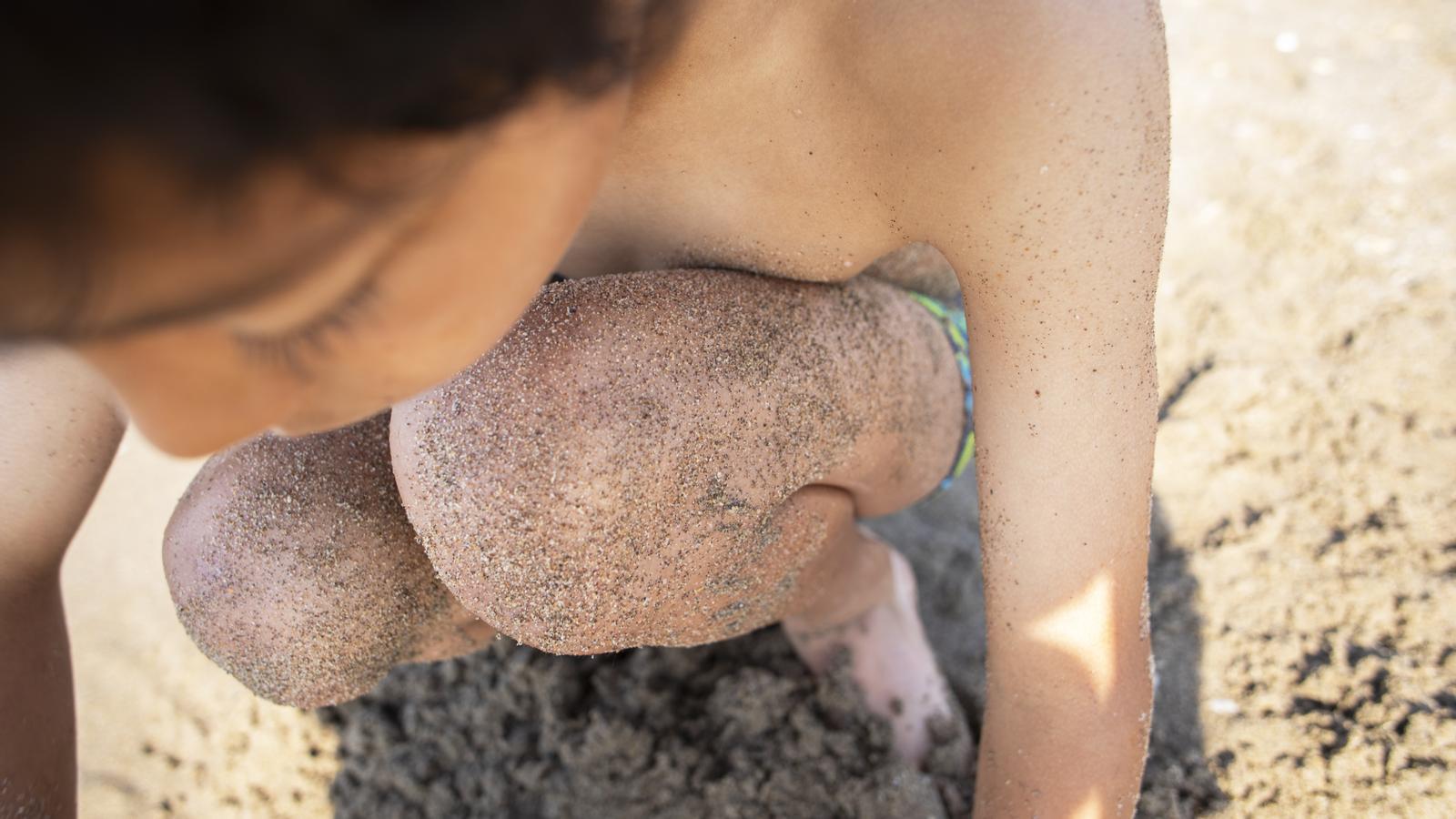
“The beaches, which should be a place of tranquility, have been transformed into a space where you have to keep an eye on mobile phones and try to guess if a person is using it to look at Instagram or if they are actually taking photos or videos of your children,” explains Laura Ferrer, a specialist in conscious and emotional sexual education for children, youth, and adults. The widespread presence of mobile phones, cameras, and social networks has changed the way many families experience children's swimming in public spaces like the beach. What a few decades ago could be experienced with more naturalness – small naked children playing in the sand or entering and leaving the water – today coexists with a new concern: what if someone photographs or records the child without permission? And where could that image end up? Ferrer's practice is increasingly receiving families who have suffered or are suffering unpleasant situations on the beach and who live in fear of the non-consensual dissemination of images of their children. “It’s not paranoia, it’s real, it’s happening and it’s very sad. We are moving to ensuring that our privacy is not stolen from the sand,” warns Ferrer. According to the therapist, these concerns have reached her from families she works with from various parts of Catalonia, Galicia, and northern Spain. Children's privacy, more exposed
Although there is no comparable data to measure the extent to which this habit has changed, many families and professionals perceive a change in the way childhood is lived in public spaces. “A daily photograph that may seem innocent at first glance – for example, at the beach, in a bikini or swimsuit – can end up being reused with artificial intelligence tools or circulating in criminal environments for the exchange of child sexual abuse images,” warns Irene Montiel, professor of Law and Political Science at the Open University of Catalonia and researcher at the VICRIM group. The current regulations on data protection do not establish specific regulations for spaces such as beaches or swimming pools, but rather apply the general framework on the right to one's own image, privacy, and data protection. There are situations in which a person may appear incidentally in a photograph taken in a public space, but the general principle is that the capture and, above all, the dissemination of identifiable images require special caution, even more so when minors are involved. “In the case of minors, it would not be permitted to photograph them, as the aim is precisely to protect their image and privacy. Since these are public spaces, we must be aware that people may appear in our photographs at any time, but the general principle is that no one should be able to take a photo of someone else without authorization,” explains Francisco Pérez Bes, deputy of the Spanish Data Protection Agency (AEPD). In the case of minors under fourteen years of age, if a photo is to be taken of them, authorization must always be given by parents or legal guardians.More eyes: when it's no longer just the mobile phone recording
But the challenge, adds Pérez Bes, is no longer just mobile phones. “There are increasingly more devices with a conventional appearance that can be used for recording. For example, smart sunglasses that incorporate photographic and video cameras. This threatens our right to privacy and makes it increasingly difficult to identify whether we are being recorded or not,” he warns. For Ferrer, the debate should not fall solely on families, but also on how we protect shared spaces. “Perhaps we will have to start implementing mobile-free beaches, as is already done in some nightclubs, to regain freedom and avoid digital exposure,” he suggests. The line between protecting and scaring
Faced with this situation, many families opt to put swimsuits or some piece of clothing on children. “Families cover them with sun protection clothing, using it as a shield so they are not so exposed to a sexualizing gaze. But, of course, the internal moral dilemma as parents is there: ‘I want my son to be able to go naked, calm and relaxed, but at the same time I am teaching him that his body is not to be shown’,” reflects Ferrer. For his part, Montiel considers that measures must be taken and the most vulnerable protected by setting limits if necessary: “Thirty years ago it was not common to see so many mobile phones or electronic devices and we did not feel so exposed. Now, anyone can take a photo or record a video without you noticing. We have to have a little more awareness and set limits, we should not fall into collective panic, but we must transmit values of care and respect for our own body”.Ferrer recommends looking for less crowded beaches and quiet spaces and, if nudism aligns with family values, opting for contexts where this practice is lived more naturally. Precisely, recent information on nudism in Catalonia suggests that the naturist collective perceives a reduction in the practice and links it, among other factors, to shame and fear of exposure on social media. "Any public space can be a risk context, considering that there are people looking for this type of images. It's not about living in fear but about being aware of it," explains Montiel, also a professor in the criminology degree at the UOC.
“It is undeniable that on the internet it is very easy for an image of any person in an uncomfortable or nude situation to flow and circulate with some freedom. There are people who dedicate themselves to commercializing these images or publishing them in certain forums. Although efforts are being made, it is undeniable that they exist and we all have to do our part,” warns Pérez Bes. According to Inhope, the international network of reporting lines against child sexual abuse material on the internet, in 2024 almost 2.5 million suspicious records containing this type of material were processed, 218% more than the previous year. For Montiel, data like this shows the extent to which the digital context has changed: “It is a terrifying reality that we must know in order to take measures and protect the right of children to their privacy and image”. It can be difficult, even when understanding the current context, to protect children without instilling fear or shame in them. “We have to explain that they are two different things. On one hand, their body is precious and they should not be ashamed. But on the other hand, their image is theirs. It's not about scaring them, but about saying that an unknown person has no right to keep a photo of their body without permission,” details Ferrer. According to the expert, children can be introduced to the concepts of privacy and image usage from the age of eight or ten, when they can better understand what the internet is and what it means for a photo to circulate. Before this age, she considers it advisable to protect them without over-worrying them.
When intervention is needed
According to Laura's experience, families have lived through this with children of all ages, from little ones of three, four, or five years old, but also in more mature stages like pre-adolescence with nine, ten, and eleven years old. “I remember the case of a mother who was with her daughter on the beach. The girl was without the top part of her swimsuit because she didn't have breasts yet, only the mammary bud, when they saw a man taking photos and videos of her,” recounts Ferrer. According to her account, it happens more with girls, because female bodies are more sexualized and they are more victimized.
But knowing how to act in these situations can be complex and experts agree that intervention is necessary. “It is very difficult to identify if we are being recorded, but if we detect it, we must call the police to verify if our rights are being infringed. Approaching the person who may be recording is complicated because they will not provide us with their device to verify it, so it is better to call the local or municipal police,” explains the deputy director of the AEPD. In the same vein, Montiel recommends: “You must ask the person to delete the image and, if we are in a place with responsible parties – like a public pool – notify them to intervene and ask them to stop recording. If the person does not do so, the police must be notified: only the authority can review or remove the mobile phone, the camera, or the images”.
For her part, Ferrer believes that families should not remain silent. “I empower them to stand up, approach the person and, assertively and politely, ask them: ‘Hey, excuse me, are you taking photos? I don't want my child to appear on any network.’ It is important to normalize setting boundaries among ourselves because it is a violation of privacy”.
However, Pérez recalls that taking a photo and saving it to your phone is not the same as forwarding it via WhatsApp or publishing it on a social network. “Saving a photo is domestic use, but the problem arises when it includes personal data (like someone's image) and is disseminated,” she comments.
Data protection regulations prohibit unauthorized dissemination. “It is one thing to have it on your device and another for the image to circulate, especially on social networks where the impact of this dissemination is greater, and we have the right to request its deletion or removal,” he adds. According to the mAnnual Report 2025 of the Spanish Data Protection Agency, that year 30,931 claims were filed with the agency, 64% more than in 2024. In the case of the AEPD's Youth Channel, one in four queries received in 2025 was related to the publication of images on social networks, especially in contexts affecting minors.
“They have stolen our peace of mind in public spaces, the innocence of summers, of children comfortable with their bodies to the gaze of adults, and for your child to end up on social media, in a WhatsApp group, or for AI to be used with your child's images,” comments Ferrer. According to data from the Internet Watch Foundation, reports with realistic images of child sexual abuse generated by AI have increased from 42 in 2023 to 491 in 2025, almost twelve times more. The entity also warns of an increase in videos: in 2025 it identified 3,443, compared to the 13 registered the previous year. For Montiel, it is not about raising the alarm, but about being aware that, “although clinical pedophilia affects 2-3% of the population, sexual interest or fantasies towards minors – especially with adolescents – can reach 25% in a hypersexualized society”. The image is also lost from home
This loss of control over children's image also has to do with apparently harmless daily practices, such as sharenting, that is, the publication of photos or information about children on social networks by families. According to the study Infancia y adolescencia en entornos digitales, by Save the Children and Fundación Orange, 54% of parents share content of their children on social networks and 39% do so despite being aware of the risks involved. “Everything has risks; in very closed and trusted groups it is logical to want to share joys, but the larger the group, the greater the risk that someone will take it, modify it, or replace it. In WhatsApp groups, we must try to reduce the components as much as possible so as not to lose control. If it is not essential to share the image, we should try not to do so; before sending it, let's ask ourselves if it is really necessary,” explains Pérez Bes.
The body is not the problem
“We must empower children so that, from a certain age, they can say ‘I don’t want photos’. It’s important to set limits among ourselves,” considers Ferrer. The report states that among adolescents, 16% believe their parents share a lot or quite a bit of information about them, and one in four feels uncomfortable or very uncomfortable with this exposure. “Any image that could be misunderstood, manipulated, or that proves humiliating for children should not be published because it influences the construction of these children’s identity,” warns Montiel, who recommends that intimate images, images of body parts, or those that could be used to mock someone should never be shared.
“Pornography has made some brains accustomed to getting aroused by minors, by infantilized bodies. If we add AI, which allows images to be modified and used perversely, and the lack of knowledge within families, everything gets worse,” comments Ferrer. “The responsibility of adults is to protect the youngest. Prevention requires providing information and clear guidelines. The problem is not the child, nor their body, but the adult gaze that sexualizes them or uses their image without permission,” summarizes Montiel. Therefore, he insists, it is not about turning the beach into a space of fear, but about reclaiming it as a safe place for children too: “We must demand that children can be children, without adult-centric gazes, but also be aware that this reality exists”.

