X-ray of Morocco: growth at two speeds and a semi-authoritarian monarchy
The development of the country leaves behind the youth, who suffer more unemployment, and there are no signs of political opening
-
CAT -
CAST
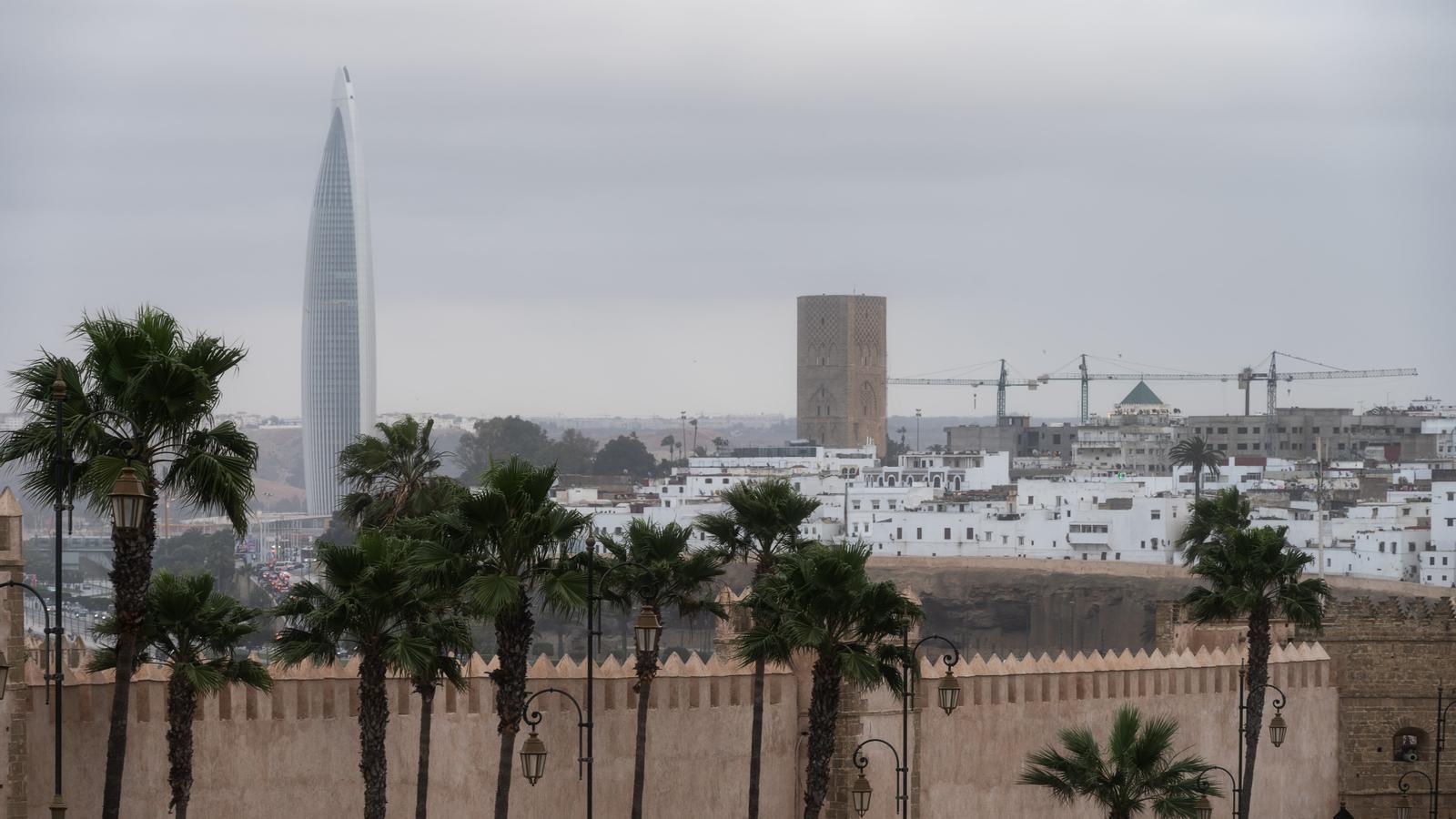
BarcelonaMorocco projects stability, modernization, new and large cutting-edge infrastructure, a stadium that rivals the Santiago Bernabéu to host the final of the next football World Cup, and regional alliances strong enough to bury the Western Sahara issue. But behind this facade, there is a society marked by youth unemployment, political disaffection, territorial inequalities, the crisis of public services, and demographic change. It is the reality from which tens of thousands of Moroccans who saw an exit in Ceuta tried to flee this summer.
Two-speed growth
In the last twenty years, Morocco has experienced accelerated economic growth: in 2018 it inaugurated Africa's first bullet train, between Tangier and Casablanca, which reaches 320 kilometers per hour; the port of Tangier has become the most important in the Mediterranean and there are plans to expand its highway network by 3,000 kilometers, in addition to having a leading position in green hydrogen investment, which exceeds 30 billion euros. It is expected that in 2028, just in time for the next FIFA World Cup, the Hassan II football stadium will be inaugurated in Casablanca, with 115,000 seats, which will be the largest in the world. Furthermore, in recent years car and aircraft factories have been built there, attracted by cheap labor, and it is one of the world's main manufacturers of fertilizers thanks to phosphates from the occupied Western Sahara. But the daily reality of millions of Moroccans is far from this image of prosperity.
The year 2025 closed with an official unemployment rate of 13%, and 37% in the case of young people. At the beginning of 2026, the High Commission for Planning, the official statistics institute, changed the calculation system and the data are no longer comparable. Be that as it may, those who have jobs in many cases can only opt for precarious work. For this reason, on July 30, many restaurants in Fnideq (Castillejos) or Martil, towns near Ceuta, ran out of waiters who literally left the trays on the counters and ran out after the crowd walking towards the Spanish enclave. The average salary of a teacher is about 600 euros and that of a doctor is around 1,200 euros.

According to a recent World Bank report, the most serious structural weakness of the Moroccan economy is "its insufficient capacity to create jobs on the scale demanded by its growing working-age population". Approximately two-thirds of total investments come from the public sector, while entrepreneurs are reluctant to make long-term investments due to the existence of oligopolies and the lack of competition.
More unemployment
The result is that despite economic growth, employment has been in free fall for a quarter of a century. When King Mohammed VI ascended the throne in 1999, it was 55% and now it is 37%. The country is developing, but its young people do not have more job opportunities, but rather fewer. According to economists' calculations, 370,000 jobs should be created each year that do not exist.
Unemployment is rampant among young people in the rural world, which also suffers directly from climate change. The Mediterranean is warming 20% faster than the global average and desertification is advancing in the south. Drought has destroyed more than a million jobs between 2015 and 2024. Women also have it more difficult: their activity rate (19% in 2024) has fallen nine points in the last quarter of a century.
And the prospects are not exactly favorable, because with a barrel of Brent crude oil above 100 dollars, an economy highly dependent on hydrocarbon imports will hardly be able to generate employment in the short term, no matter how much work the 2030 World Cup generates.
Generation Z drowned
Exactly one year ago, the Gen Z 212 movement erupted, following the death of eight women who had undergone a cesarean section at the Hassan II Hospital in Agadir. The youth revolt of the post-millennial generation (born between 1995 and 2010), which identified with Generation Z qualified by the international telephone prefix of Morocco, crystallized the anger over the degradation of public services and the lack of opportunities. Their demands were clear: more investment in education and healthcare, less sumptuous spending on World Cup stadiums, an end to corruption and nepotism, and jobs for young people. The movement, which caught the regime's repressive apparatus by surprise, organized itself through the Discord server, an online gaming platform with an encrypted messaging service, where its page exceeded 250,000 users in a single day. A week later, it brought hundreds of thousands of young people to the streets with the slogan "Fewer stadiums and more hospitals".
A month later, King Mohammed VI proclaimed in parliament that "there should be no contradiction between social programs and major national projects" and the government ordered an increase in spending on healthcare and education to 140 billion dirhams (about 13 billion euros, 16% more than the previous year). But this was only the carrot hanging from the stick: six thousand detainees, of whom more than 2,000 have been sentenced to prison terms of more than 15 years, according to the Moroccan Association for Human Rights.
As Miguel Hernando Larramendi, professor of Arab and Islamic studies at the University of Castilla-La Mancha and member of the board of the Center for Contemporary Arab Studies, points out, "the Generation Z protests are a manifestation of the young people's unrest due to the difference between their expectations and their reality, due to the lack of horizons and unemployment". He also highlights that, regardless of geopolitical issues, the fact that the day after the king's speech in which he highlighted the stability and development of the country in his 17 years on the throne, 8,000 people tried to leave the country calls into question the new development model.
Authoritarianism with elections
Most of these young people have no intention of participating in the legislative elections on September 23rd. Since 2002, electoral abstention – especially high among young people – has been a growing trend in Morocco: participation went from 58.3% to 50.2% in 2021, and furthermore, the percentage of null votes tends to be high (22% in 2011, in the midst of the wave of revolts in the Arab world). Saloua Zerhouni, a professor of political science at Mohammed V University in Rabat, attributes this to a lack of trust in the political system. "Parties are perceived as corrupt, ineffective, and disconnected from the population's concerns. And there is also a lack of interest in the elections, which are considered irrelevant or without any real impact on daily life. In fact, to understand electoral abstention, it would be useful to remember what meaning the vote has in regimes where elections are spaces of controlled competition and where voting does not offer incentives when it comes to selecting who will govern and make decisions". Low participation is disguised because it is calculated according to those registered on the electoral roll and not the entire population of voting age.
In Morocco, the government is voted for, but the monarchy has the final say. "The peculiarity of the Moroccan political system is that the monarchical pole controls all the levers of power. Who decides is the king and his entourage, and the government is an executor," explains Laura Feliu, dean of the Faculty of Political Science at the Autonomous University of Barcelona. "The monarchy also has a very important religious role, although some Islamist sectors question it, but the mosques are also under its control," she adds. The king controls the police, the intelligence services, and also the army (there is not even a Ministry of Defense) and also public policies in the final instance. That is why he can emerge from crises by combining repression with social measures. "The independent press has been disappearing in recent years and critical voices have been silenced or have to work from abroad through the networks," she adds.
Furthermore, in the case of Morocco, the Alaouite dynasty also holds the highest religious authority, which makes him a sacred figure who cannot be criticized. "You can criticize the government, but not the figure of the king, and it is very difficult to know the perception of the monarch among the population because everyone knows that there are informants around him," he adds. Mohammed VI is not very active in public life, has health problems, and in recent years has been involved in some scandals, such as when in August 2022 a video went viral in which he was seen apparently drunk on the streets of Paris alongside the Azaitar brothers, the martial arts fighters who have become inseparable figures. There has been speculation for some time about the succession to the throne of Prince Moulay Hassan, born in 2003, but it has not yet materialized.
To the polls on September 23rd
A study by the association The Citizens in June reveals that, although 66.6% of Moroccans consider it important to vote, only 13.6% believe in the result. A survey by Sunergia points out that 38.7% of those consulted are not even registered in the electoral census. Participation, and not so much the result, is the most interesting aspect of the legislative elections that will be held in less than two weeks.
The crisis of legitimacy of the outgoing government crystallizes in the figure of Aziz Akhannouch, prime minister since 2021 and the second largest fortune in the kingdom due to his empire of gas stations and the agribusiness Akwa Group. In January, Akhannouch announced that he would not run for a third term, a decision that, according to some observers, may have come by decision of the Palace. Many Moroccans will remember again on the 23rd the joke by the popular comedian Bziz, who said of the first elections with Mohamed VI: "the fraud, this time, will be clean and transparent".
The Sahara and international alliances
In the diplomatic sphere, Morocco has managed, through its alliance with the United States and Israel, to secure key support in its main dispute: Western Sahara, the Spanish colony it occupied at the end of the Franco regime. Donald Trump recognized—in a tweet—Moroccan sovereignty over this territory, contravening international law, a step that has since been followed by several European governments, including Pedro Sánchez's. It has also shown its alliance with Israel, which is historic, more unashamedly, despite popular support for Palestine, which has grown with the genocide in Gaza. "Mohammed V was the architect of the construction of the modern Moroccan nation-state, Hassan II deepened Morocco's alliances with the West, and the main achievement of Mohammed VI is the recognition of Moroccan sovereignty over Western Sahara by the USA and European capitals," explains Moussa Bourekba, a researcher at Cidob.
Rabat's collaboration with Israel has always been close, and it was uncovered by investigations such as that of Forbidden Stories that implicated Morocco in the use of the Pegasus spyware from the Israeli group NSO, which infiltrated the mobile phones of thousands of journalists and activists.
"The country is consolidating itself as a geopolitical power and the gateway for investments in Africa, but with the persistence of inequalities between the countryside and the city, youth unemployment, and half of young people considering emigration, the way it is establishing itself as a regional power is questionable," adds Bourebkba.
Demographic change: a society in transition
Beyond the shielding of the political system and the economic dynamics, there is a society that is advancing much faster than the institutions. This is expressed in the demographic change and the traditional family model. Moroccans are marrying later, having fewer children, living longer, and shifting from the extended family to the nuclear one. The average age of marriage has risen to 26 years for women (now massively schooled) and 33 for men, and half of the singles say they do not want to marry. Families have gone from an average of 4.6 members in 2014 to 3.9 in 2026, which is explained by the fall in fertility (1.98 children per woman, fewer than would be needed to maintain the population). Morocco is leaving behind the model of a very young society, with large families and rapid demographic growth.
